


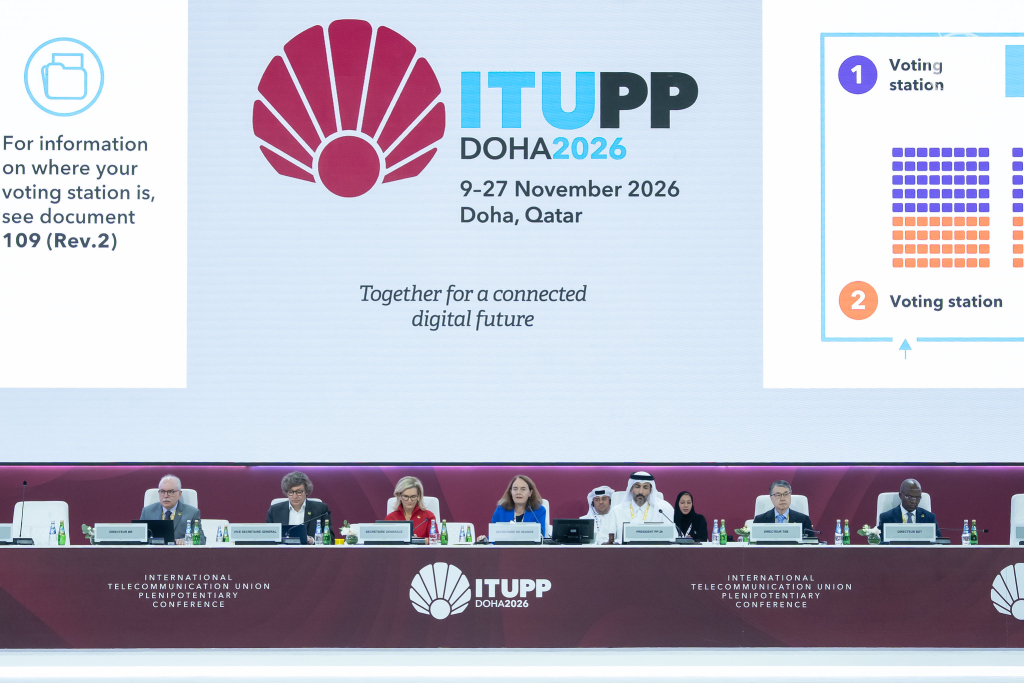
At the Plenipotentiary Conference (PP-26), currently taking place in Doha, attended by the Delegation of Vatican City State, led by the President of the Governorate, Sr. Raffaella Petrini, the re-election of the Secretary-General of the International Telecommunication Union (ITU) for the 2027–2030 term was formally confirmed on Thursday, November 12.
Doreen Bogdan-Martin, the incumbent Secretary-General, was confirmed in office and will thus lead the organization for a second consecutive term. Her re-election reflects the determination of the ITU's voting Member States to continue pursuing the strategic direction established over the previous four years. Before assuming leadership of the Union, Bogdan-Martin had acquired extensive experience in telecommunications and digital policy, distinguishing herself through her commitment to promoting inclusive and sustainable technological innovation.
Her new mandate will focus on three key priorities: bridging the digital divide, artificial intelligence governance, and infrastructure resilience. The Conference will continue with the election of the Deputy Secretary-General and the finalization of strategic resolutions for the next four years.
The previous day, the Plenipotentiary Conference of the International Telecommunication Union (PP-26), which sets the organization's strategic priorities every four years, continued its proceedings. During committee and working group sessions, the Vatican City State Delegation followed discussions among Member States, paying particular attention to issues at the intersection of technological innovation, infrastructure security, and international cooperation.
Of particular interest were the programs presented by candidates for the organization's senior leadership positions for the 2027–2030 term. Their proposals outlined the major challenges of the coming years: bridging the digital divide, the responsible development of artificial intelligence, infrastructure security and resilience, and the management of radio spectrum and orbital resources. Despite differences in approach, a common understanding emerged of the need to accompany innovation with appropriate governance mechanisms to ensure equitable access to the opportunities offered by digital transformation.
Artificial intelligence was a recurring theme throughout the sessions attended by the Delegation, particularly in relation to standardization, conformity testing, combating counterfeit devices, and network protection. An ad hoc group is envisaged for Resolution 214 on artificial intelligence, while consideration is also being given to establishing an additional working group tasked with developing an overarching strategy to be presented to the Conference Plenary at the conclusion of its proceedings.