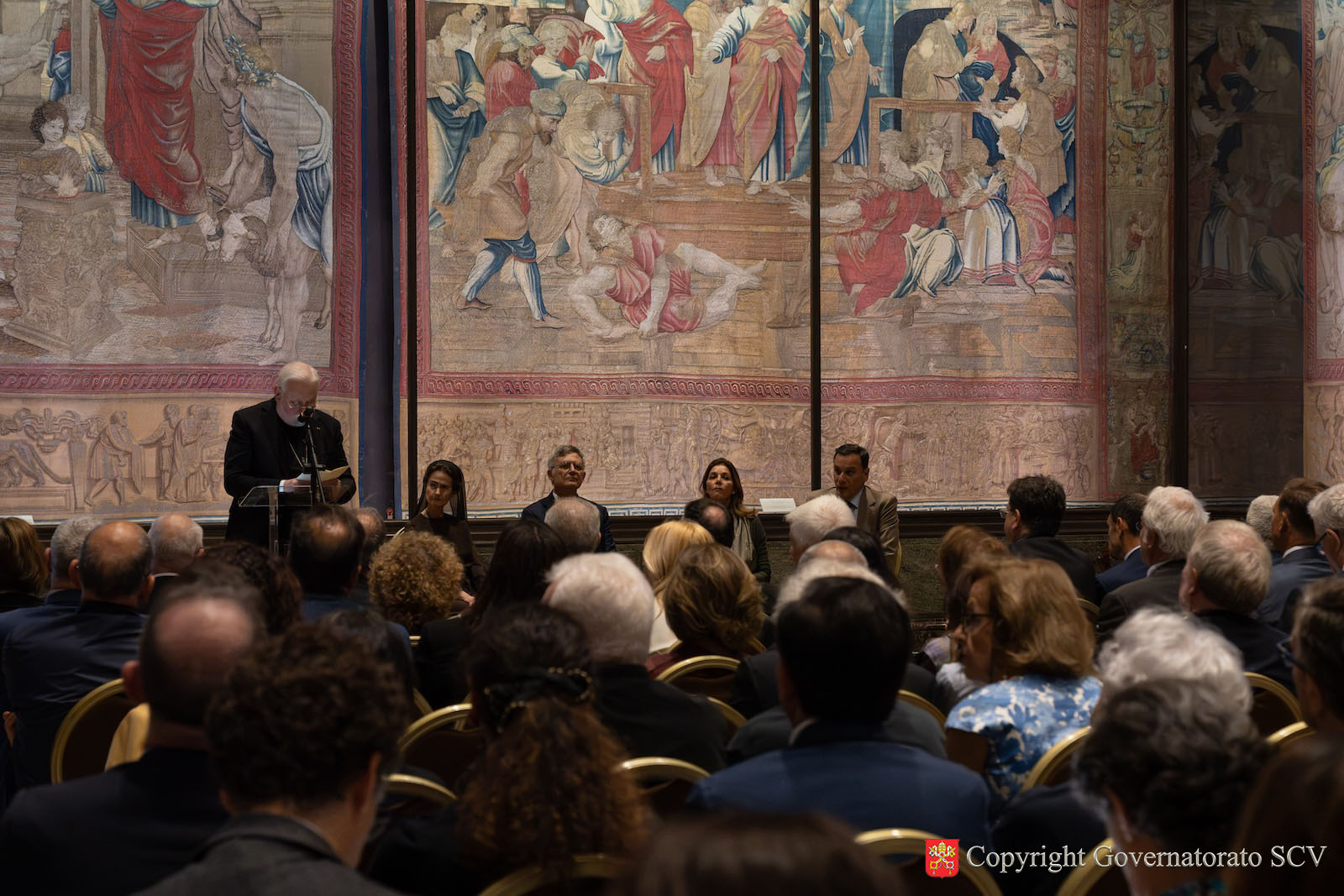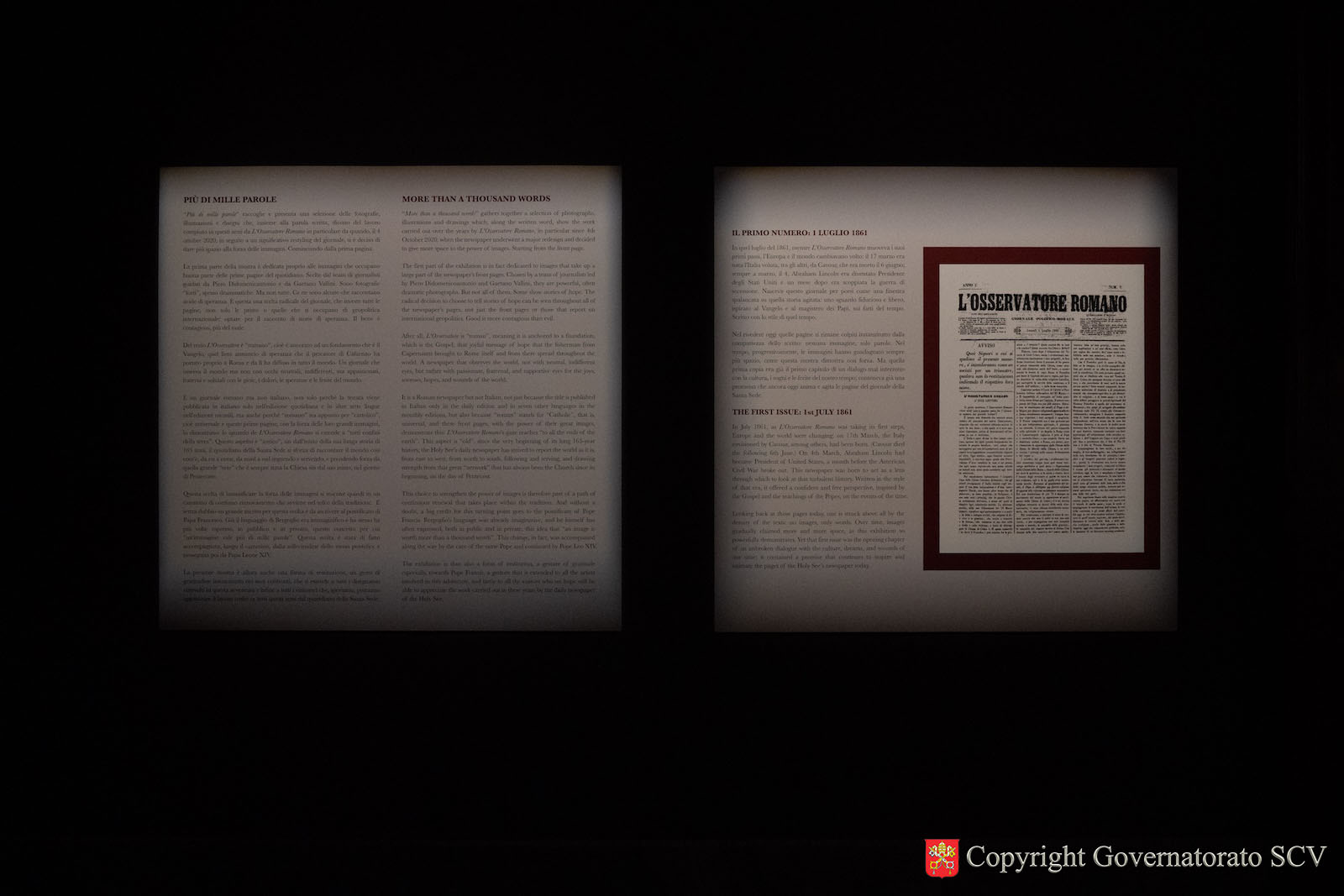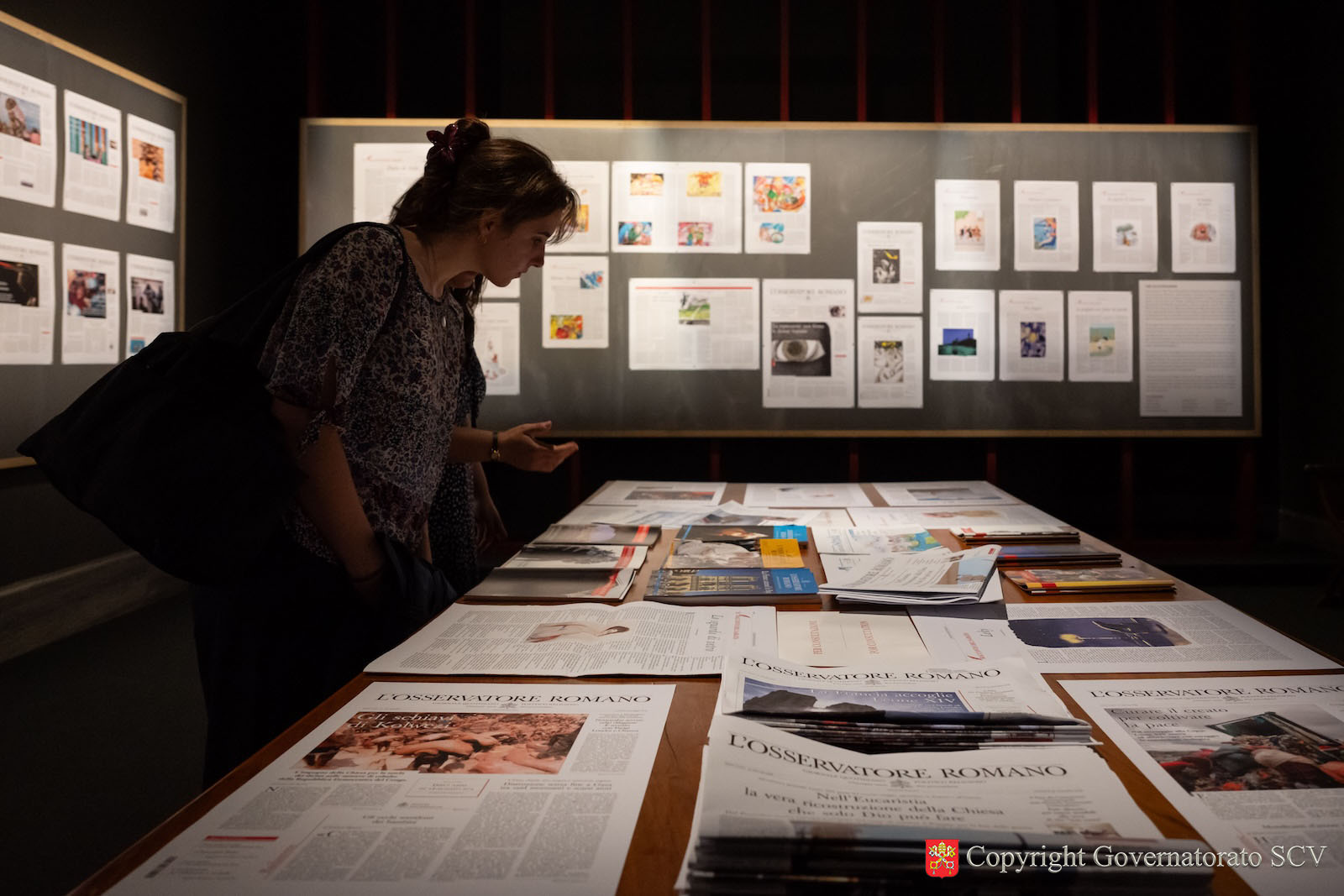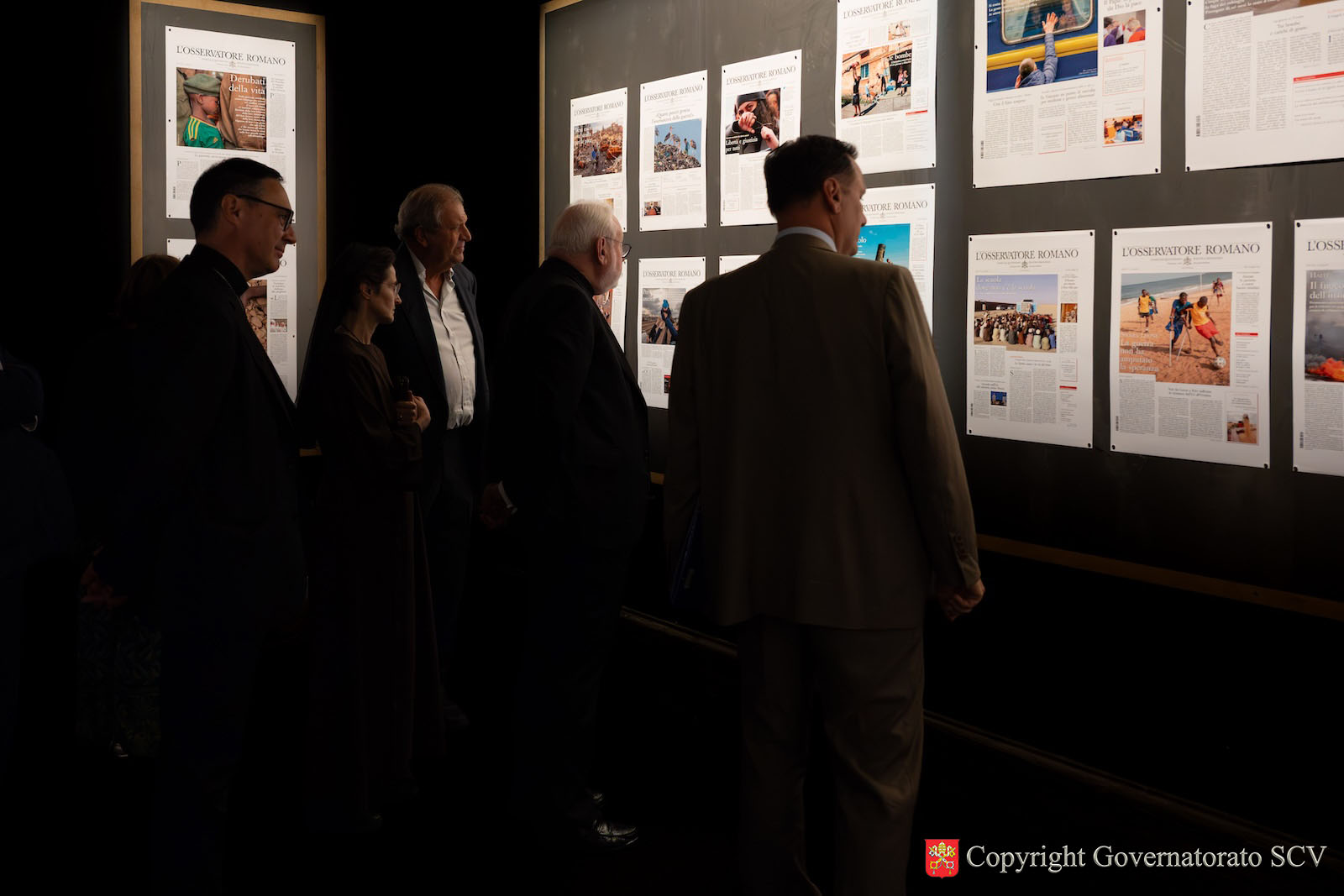


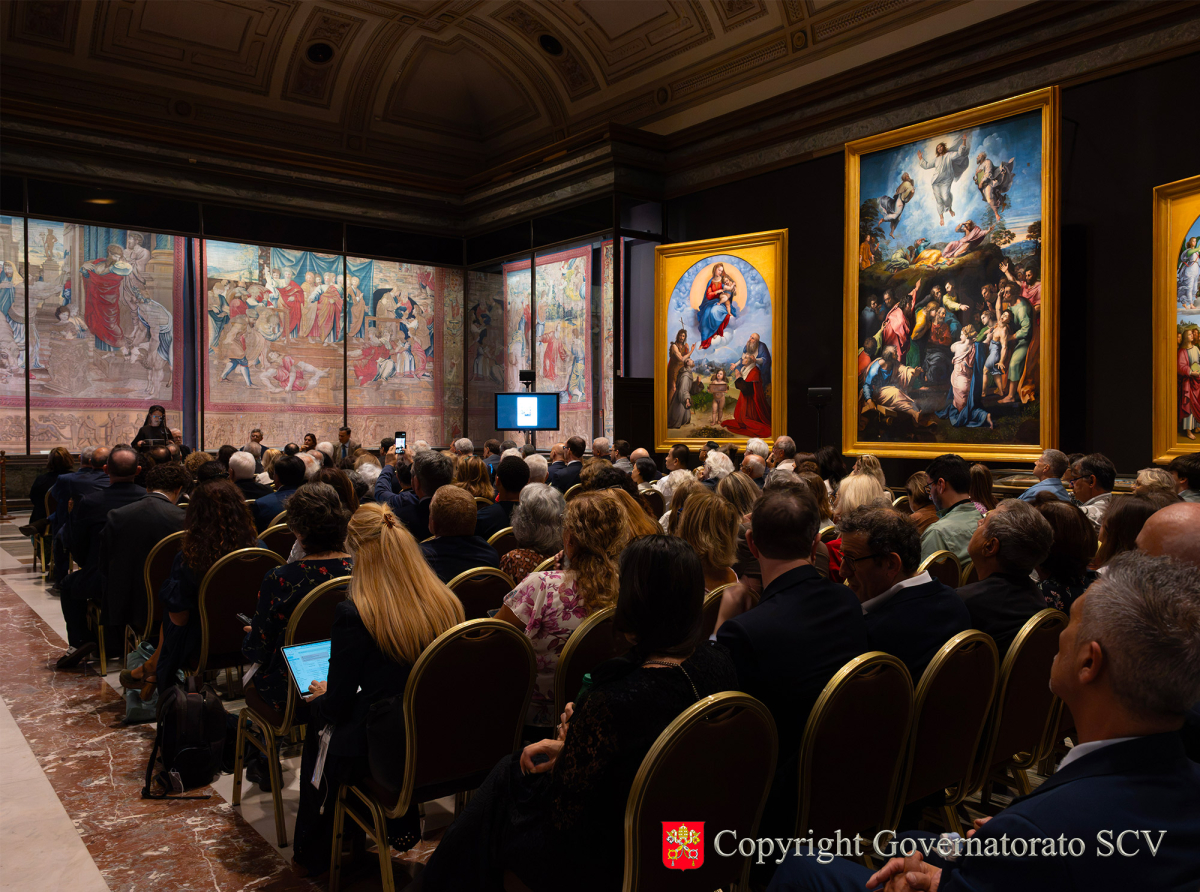
The exhibition “Più di mille parole. Immagini da L’Osservatore Romano” [More than a Thousand Words. Images from L’Osservatore Romano] was inaugurated on Wednesday, 30 September, in the Raphael Hall of the Vatican Museums. The exhibition is on display in Rooms XVII and XVIII of the Pinacoteca.
Dedicated to the 165th anniversary of the historic newspaper’s founding, the exhibition presents a selection of photographs, illustrations and drawings offering a portrayal of the world as seen from the Vatican.
The first part of the exhibition features images that have appeared on the front pages of the newspaper, while the second is devoted to works by artists and illustrators created for its various news columns and editorial features.
Among those taking part in the inauguration were Archbishop Paul Richard Gallagher, Secretary for Relations with States and International Organizations, Archbishop Emilio Nappa, Secretary General of the Governorate, Sr. Raffaella Petrini, President of the Governorate of Vatican City State, Paolo Ruffini, Prefect of the Dicastery for Communication, Andrea Monda, Editor-in-Chief of L’Osservatore Romano, and Barbara Jatta, Director of Vatican Museums and Cultural Heritage.
Below is the address delivered by the President of the Governorate:
I greet Archbishop Paul Richard Gallagher, Secretary for Relations with States and International Organizations;
Archbishop Emilio Nappa, Secretary General of the Governorate;
Dr Paolo Ruffini, Prefect of the Dicastery for Communication;
Dr Andrea Monda, Editor-in-Chief of L’Osservatore Romano;
Dr Barbara Jatta, Director of Vatican Museums and Cultural Heritage;
Authorities and all those present.
“A most singular newspaper”: this is how Giovanni Battista Montini, the future Pope Paul VI, described L’Osservatore Romano in 1961, in an article dedicated to the Holy See’s newspaper on the centenary of its founding.
Its use of images alongside its articles is equally distinctive. The same Pope emphasized that L’Osservatore Romano is not simply a newspaper that provides information, but also one that offers formation.
Today, as a tribute to the Pope’s newspaper, we inaugurate the exhibition “More Than a Thousand Words. Images from L’Osservatore Romano”, hosted in the galleries of the Vatican Museums’ Pinacoteca.
The selection of photographs, illustrations and drawings brought together for this exhibition offers a glimpse into the life of the Church and society, as well as the events that have unfolded over the years, as seen and interpreted by the newspaper’s editors and contributors and presented to its readers.
News reports and features tell us what is happening daily. Images, however, often continue to speak long after the pages have been filed away and the news itself is no longer new — something that today happens with extraordinary speed.
Through this exhibition at the Vatican Museums, we can therefore read the passage of time through the photographers’ lenses, editorial choices, and the people and places that have taken center stage in the newspaper.
Powerful images also challenge us to confront difficult realities, to reflect, and to look beyond what we immediately see, so as to discern the message they seek to convey — a message that extends beyond the boundaries of the frame. This is perhaps the most important aspect: transforming the pages of past editions into a living space where the past and the present can meet.
Moreover, the combination of text and image makes the Pope’s newspaper truly unique, precisely because of its vocation to recount the life of the Church and the Vatican. From its very beginnings, L’Osservatore Romano has served as an echo of the Petrine Magisterium, enabling Catholics throughout the world to follow the Pope’s activities closely and to read his messages, thereby recognizing themselves as members of the one Church.
We should also remember the role the newspaper has played over the decades, not only by providing a forum for cultural and social debate, but also by lending support to the many missionaries engaged in the apostolate who often encountered obstacles and suffered persecution. For many people, particularly in local Churches geographically distant from Rome, the voice of the Pope conveyed through L’Osservatore Romano has been a source of encouragement, strengthening their sense of closeness and belonging within the ecclesial community.
I would like to conclude by thanking everyone who contributed to making this exhibition possible: the photographers, journalists, archivists, curators, and all those involved in selecting and displaying the images.
Thank you.