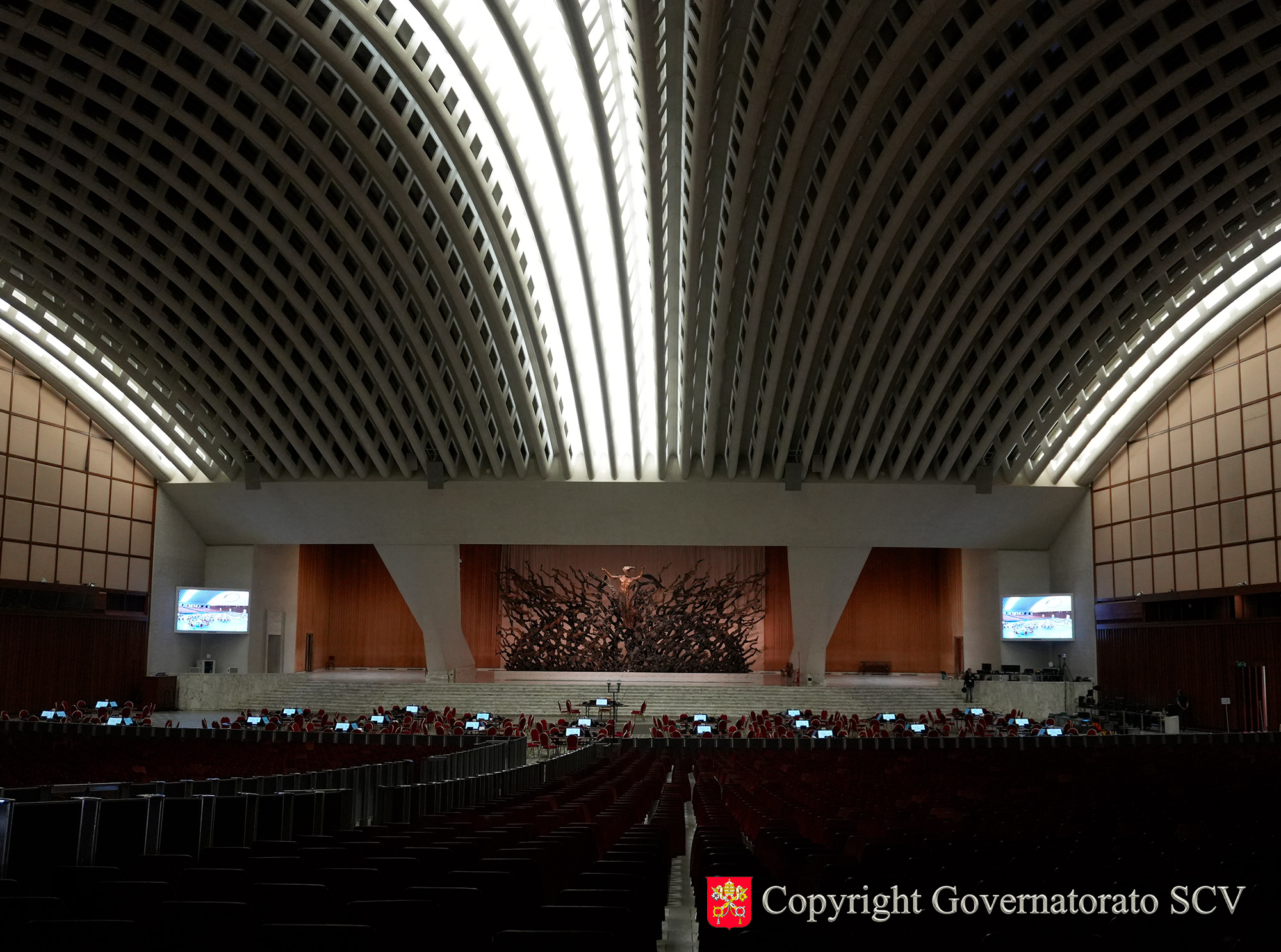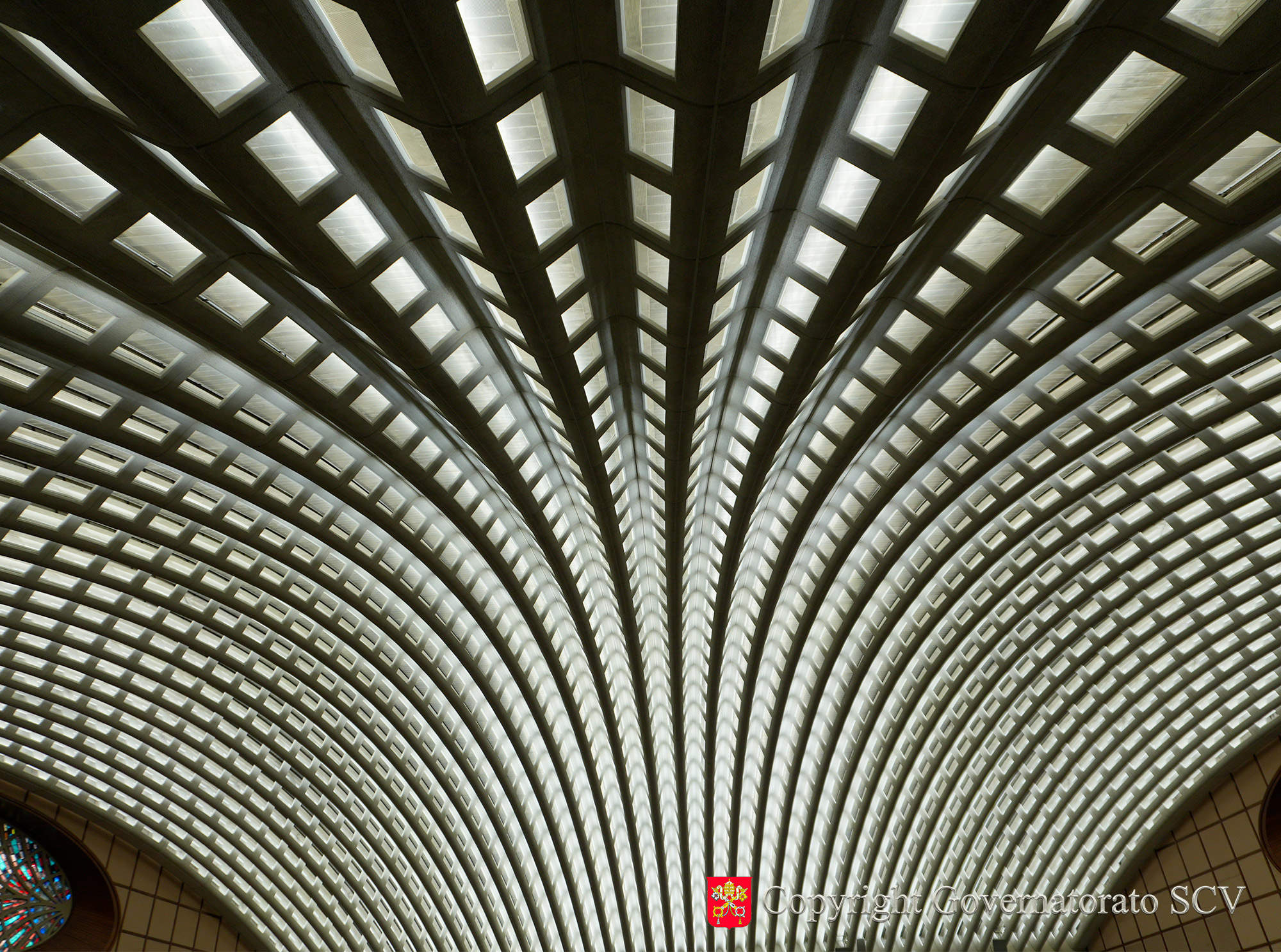


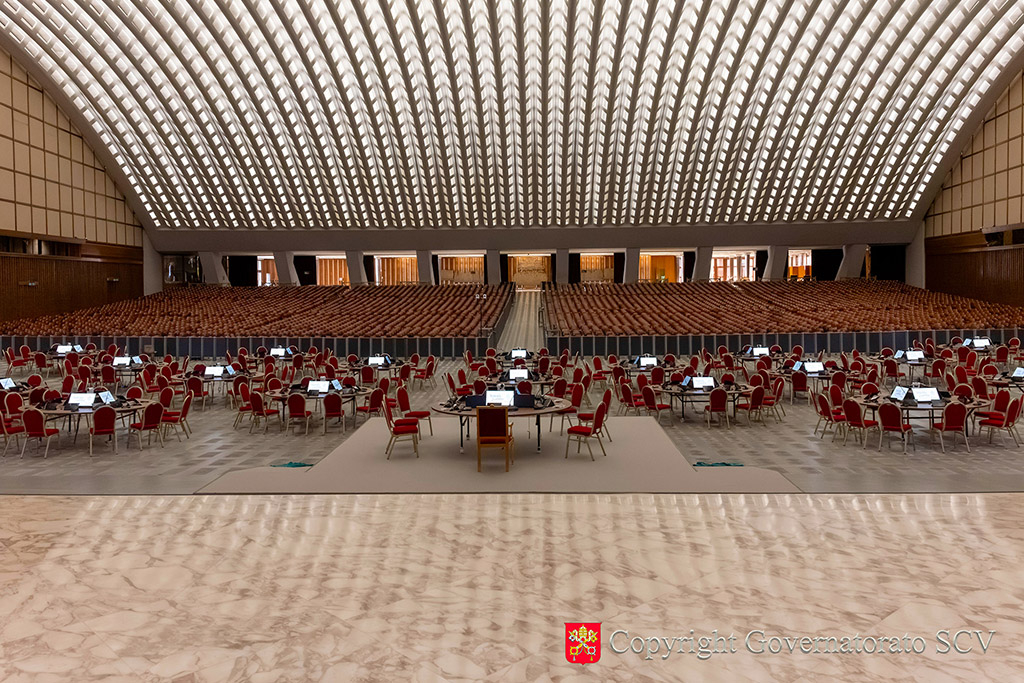
The lighting upgrade of the Paul VI Audience Hall, also known as the “Sala Nervi,” was completed on August 27, one day ahead of the contractual deadline. Over the course of 34 days of work during the summer, the 2,214 fluorescent light fixtures installed in the in the 1970s were replaced with new LED technology developed specifically for this unique setting.
The project, designed and carried out by the Directorate of Infrastructure and Services of the Governorate of Vatican City State in collaboration with Zumtobel-Osram, also involved the four electrical switchboards and their associated circuits, as well as the installation of a new digital lighting control system. The aim was to upgrade the technology without altering the original lighting concept of the vault: preserving the backlighting effect of the double-ribbed ceiling while at the same time increasing efficiency and flexibility and, importantly, reducing energy consumption.
Lighting Designed to Welcome
Inaugurated on June 30, 1971, the Audience Hall was created at the initiative of Pope Paul VI, who wanted a space for audiences and gatherings with the faithful that could better accommodate growing attendance. In his address at the inauguration, the Pope himself recalled that he had encouraged the architect Pier Luigi Nervi to a “dare” in designing the building.
Indeed, the architecture of the monumental hall is based on a carefully conceived relationship between structure, visibility and acoustics. The great parabolic vault draws the eye toward the stage, where Pericle Fazzini’s scupture Resurrection, created between 1970 and 1975, is located. Two large oval polychrome stained-glass windows by Hungarian artist János Hajnal complete the Hall’s natural lighting scheme.
The new lighting has been integrated into this architecture without altering its identity. The design has preserved the philosophy of the existing system: the technology has changed, but the lighting effect originally conceived for the Hall’s vault remains unchanged.
From Fluorescent Lighting to LED
The vault is divided into four quadrants. Each quadrant consists of 20 or 21 ribs, each fitted with 27 light fixtures, for a total of 2,214 units.
The fixtures were replaced one by one, retaining the same length as the existing units and therefore leaving the geometry of the vault unchanged. The new fixtures use two LED modules and balanced asymmetric linear optics, configured according to a Master-Slave system.
The increase in efficiency is significant: from approximately 75 lumens per watt with the previous lighting system to 154 lumens per watt. Under equivalent operating conditions, power consumption has been reduced from approximately 266 kW to 150 kW, with a projected maximum load of 206 kW.
“The innovative LED lighting has significantly reduced glare while enhancing the architectural lines of the Hall. The efficiency of the fixtures, combined with the digital control system, has made it possible to achieve a substantial reduction in energy consumption, in keeping with the Holy Father’s call to care for creation,” said engineer Salvatore Farina, Director of Infrastructure and Services.
Digital Control for Every Occasion
The new lighting is managed through a DALI (Digital Addressable Lighting Interface) system, an open international standard for digital lighting control that makes it possible to manage the four quadrants of the vault independently and to program different lighting scenarios.
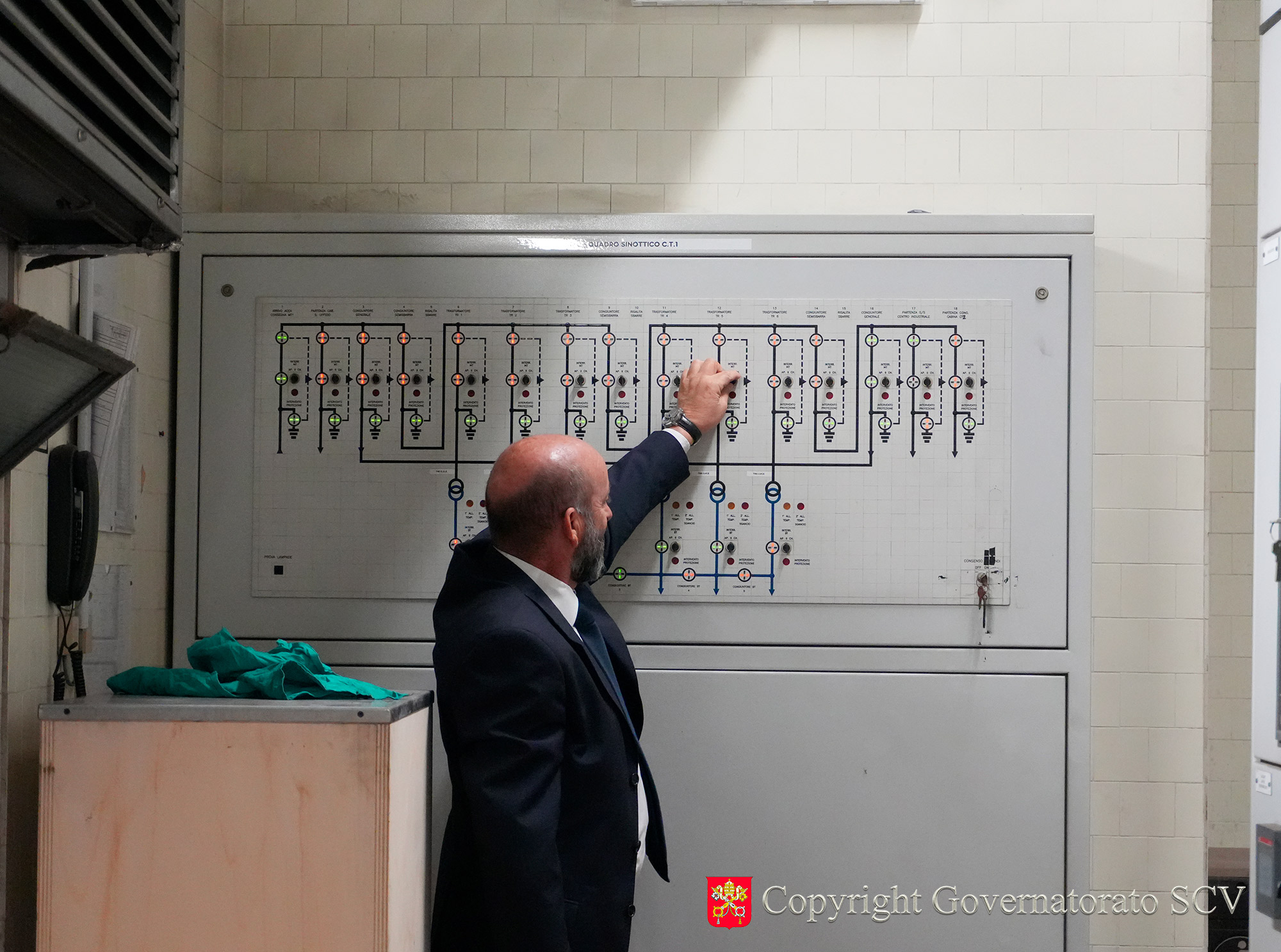
Two Litecom devices respectively control the Q1-Q3 and Q2-Q4 pairs of quadrants, while two additional units are configured as backups. The system is operated from a control panel located in the control room and allows the lighting to be adapted to the Hall’s various uses, from General Audiences and concerts to Synods, events for young people and institutional gatherings. When necessary, technicians can also use a computer to manage and further develop the lighting scenarios currently envisaged.
The electrical system was upgraded as well. The four switchboards, each serving one quadrant of the vault, include sections for the normal power supply and an uninterruptible section for emergency lighting, powered by a UPS (Uninterruptible Power Supply). A UPS is an electronic device installed between the electrical grid and the equipment it supplies, protecting it against power outages and voltage fluctuations.
Thirty-Four Days at a Height of 18 Meters
The complexity of the project was not merely technological. The replacement of the 2,214 fixtures was carried out during the summer at a height of approximately 18 meters [59 feet], using aerial work platforms and adopting specific measures to mitigate the effects of the heat, which proved particularly challenging on working days. The work was organized by quadrant, with multiple teams and lifting equipment operating simultaneously.
Particular attention was dedicated to working conditions, safety and the handling of the materials removed. The old fluorescent tubes, which contained mercury, were classified as WEEE R5 waste and sent for separate treatment and disposal.
The Directorate’s Work
The Directorate of Infrastructure and Services was responsible for the design, works supervision and management of the various technical aspects of the project.
Engineer Domenico Sandulli served as the project manager, while engineer Luca Di Maggio was responsible for supervising the works.
The new LED solution was custom-designed in collaboration with Zumtobel-Osram, with the primary objective of combining new technical and environmental requirements with the preservation of the vault’s original lighting effect.
More Efficient Lighting for a Unique Architectural Space
The project forms part of the Governorate’s broader energy-efficiency program. Since 2008, the Paul VI Audience Hall has been equipped with a large photovoltaic system comprising 2,400 modules installed on its roof, helping to meet the energy needs of the “Sala Nervi” and the surrounding buildings.
Today, the new lighting marks another step forward along this path: greener, more modern and more flexible technology, more precise control, and a lighting system capable of adapting to the many different functions of one of the Vatican’s most distinctive historic buildings.