


Safeguarding Our Humanity: Challenges and Responsibilities of the University in the Age of Magnifica Humanitas
“Today, the ultimate task of the educational mission is to integrate the opportunities offered by technology into a journey of wisdom that embraces the three dimensions of existence, forming young people capable of living humanely in the digital age, inspired by a freedom that can truly express itself in all its magnificent beauty: guided by the search for God, responsibility toward others, and respect for the surrounding environment.”
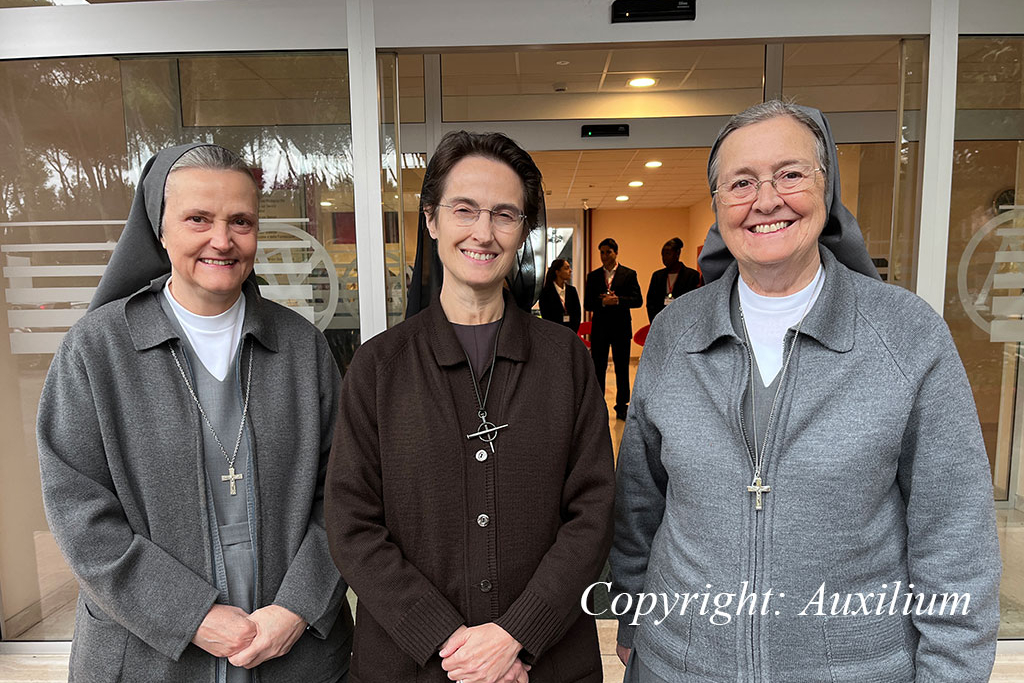
These were the words of Sr. Raffaella Petrini, President of the Governorate of Vatican City State, in her keynote address entitled “Caring for Our Humanity: Challenges and Responsibilities of the University in the Age of Magnifica Humanitas,” delivered on the occasion of the inauguration of the 57th Academic Year of the Pontifical Faculty of Educational Sciences “Auxilium.”
The event took place on Wednesday morning, November 5, at the Faculty’s campus in Rome, which welcomes male and female students, religious and laypeople from 67 countries.
In her address, Sr. Petrini observed that “in the age of digital transition, the practice of care within the university’s educational mission is one that is attentive, first and foremost, to respect for the dignity of the human person in both the bodily and spiritual dimensions, open to the person’s transcendent origin.” She further emphasized that, in the age of digital transition, “within the university’s educational mission, the practice of care is one that is attentive, first and foremost, to respect for the dignity of the human person in both the bodily and spiritual dimensions, open to the person’s transcendent origin.”
Continuing to invest in education in a digital world, which, according to Pope Leo XIV, should be regarded as “a new continent to be evangelized,” requires adopting the attitude of “artisans of education, daily willing to undertake patient work, sustained by broad and shared educational alliances.”
This was the message conveyed by Sr. Piera Ruffinatto, Dean of the Faculty, in her address, as she identified the first of four challenges. The second challenge concerns a commitment to “study and research, where the challenge of integrating different fields of knowledge calls us to train ourselves—and our students—both in the ability to connect and synthesize knowledge in order to understand complexity, and in fact-checking techniques.”
The third challenge is the need to come together and coordinate efforts toward rebuilding, so that “the city may be reborn not through the initiative of a single individual, but through the responsibility of the entire people.”
Finally, “the fourth challenge is a journey that will reach a significant milestone in 2027: the 150th anniversary of Saint John Bosco’s written work on the Preventive System” [in the Education of the Young].
At the conclusion of the ceremony, Sr. Chiara Cazzuola, Grand Chancellor of the Faculty and Superior General of the Daughters of Mary Help of Christians, officially declared the 2026–2027 Academic Year open.
She encouraged faculty members and students to “make their own contribution by reaffirming their commitment to ‘being present’ amid the challenges and demands of our time, in order to form competent professionals in education, today and tomorrow,” while rediscovering how “to safeguard our humanity and reaffirm the responsibility and value of education, knowledge, and the common good.”