


An Extraordinary Lesson in Humanity
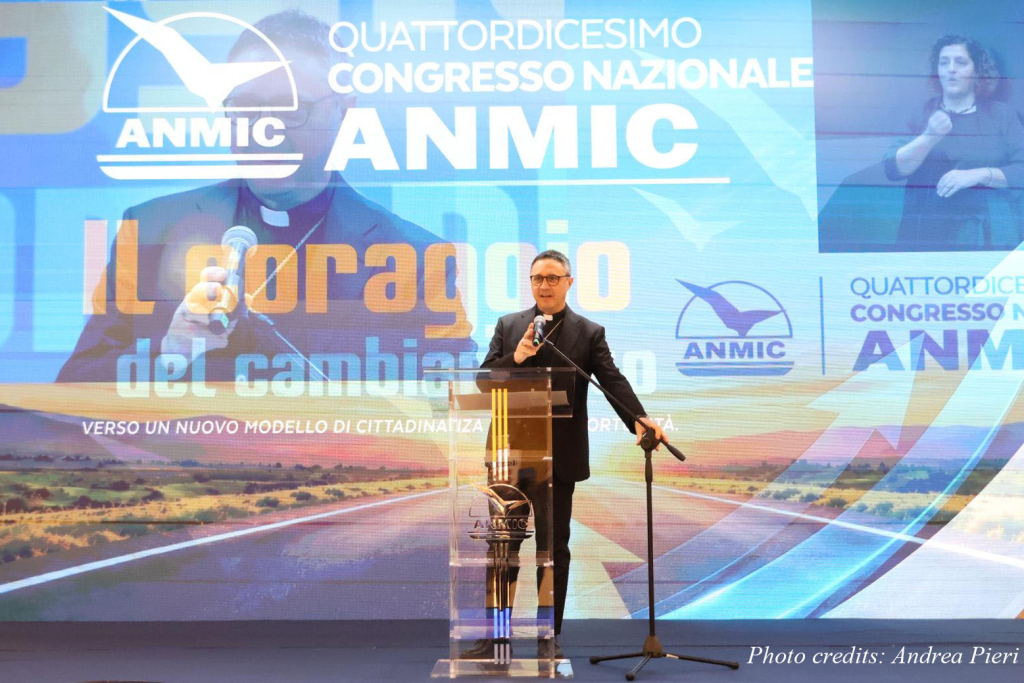
“Towards a New Model of Citizenship and Equal Opportunities” is the theme of the 14th Congress of the ANMIC-Associazione Nazionale Mutilati e Invalidi Civili [national association of persons with civil disabilities and injuries], being held in Rome from November 11 to 14, marking the 70th anniversary of the Association’s founding.
Archbishop Emilio Nappa, Secretary General of the Governorate of Vatican City State, attended the Congress and delivered an address in which he emphasized that “When people with disabilities and their families are left alone, we become impoverished within, losing our sense of the value of life and human relationships, and ultimately surrendering to a hopeless view of reality.”
The Congress provides an opportunity for discussion and dialogue on the need to move beyond outdated social and economic models and build a more inclusive and compassionate society in which every person can fully realize his or her potential.
This requires investment in three fundamental areas: overcoming structural inequalities, promoting active citizenship, and fostering social cohesion and inclusion.
The gathering also offers an opportunity for reflection and renewal, featuring the photographic exhibition Scatti di Storia [Snapshots of History], the presentation of a book dedicated to the Association’s leadership and history, and the ANMIC National Award, “Ali di Gabbiano” [Seagull Wings].
The full text of the Secretary General’s address follows:
I extend my cordial greetings to:
The Honorable Alessandra Locatelli, Minister for Disabilities;
The distinguished Nazaro Pagano, President of the National Association of Persons with Civil Disabilities;
The distinguished authorities, esteemed speakers, officials, and delegates;
Ladies and gentlemen present here today.
Allow me to address you with words that come from the heart: dear families, dear brothers and sisters.
As I entered this hall today and looked at your faces and your hands, a thought came back to me, one that often accompanies my prayer and study: All too often, at conferences and institutional gatherings, we risk speaking about disability as a ‘category,’ a ‘social issue,’ or a ‘matter of budgets or welfare.’
But disability is not an issue. Disability is flesh. It is life. It is a story. It is the face of a mother who awakens at dawn with a heavy heart and weary arms. It is the look in a father’s eyes as he asks, with a lump in his throat: “What will become of my child when I am no longer here?” It is the proud dignity of so many young people and adults who must struggle every day, not only against physical limitations, but against the cruelest barrier of all: indifference and loneliness.
Before conveying the official greetings of the Governorate of Vatican City State, I feel compelled to say a few simple words, arising from the depths of my conscience: thank you. And forgive us.
Thank you for the extraordinary lesson in humanity that you offer us every day. And forgive the institutions, forgive society, forgive us men of the Church as well—for all the times we have been deaf to your needs, bureaucratic, inattentive, and for all the times we have left you alone to bear a burden that should have rested on the shoulders of the entire community.
We live in strange and, at times, merciless times. Ours is a society afflicted by the illusion of technological prowess and performance, one that idolizes the myth of the “superhuman”: we must always be perfect, fast, independent, high-performing, at the top of our game! Those who cannot keep up are silently cast aside, pushed to the margins.
But this is a fundamental falsehood.
The human person is never defined by what he or she “can do” or by how much he or she “produces”. The human person possesses infinite worth simply because he or she EXISTS! And it is only in this Magnifica Humanitas, so profoundly reaffirmed by the Magisterium of Pope Leo XIV, that the sacredness of life shines forth: a sacredness that resides not in the efficiency of the body, but in the beauty of a soul that loves, suffers, and hopes. The algorithm discards fragility, while the human person learns to recognize its sacred value, discovering that disability is not a limitation to be corrected, but a mystery of dignity to be safeguarded with respect and infinite love.
My faith and my studies tell me that the human person is not an accident of nature or a mistake of fate. Every human life bears within it the sacred imprint of the Imago Dei—the image of God. And that image is not chipped, broken, or diminished in value when a body cannot walk, when a mind struggles to communicate, or when illness leaves its mark upon the flesh. As a theologian, I could offer you many abstract concepts, but theology, if it does not touch the wounds of humanity, is nothing more than sterile theory.
Our faith teaches us that God did not choose to reveal Himself through strength or perfection, but through limitation, weakness, and wounds.
The Risen Lord did not erase His wounds to show that He had conquered. He appeared to the Apostles showing them His pierced hands and His wounded side. Why? Because in God's language, wounds are not a source of shame: they are the openings through which the light of authentic love shines.
When a mother holds her disabled child close to her, when a caregiver spends sleepless nights caring for a loved one, what takes place there is not merely “assistance.” It is a sacred liturgy. It is an act of spiritual and cultural resistance against the barbarism of utilitarianism.
When people with disabilities and their families are left alone, we become impoverished within, losing our sense of the value of life and human relationships, and ultimately surrendering to a hopeless view of reality. The protection of rights, full inclusion, the removal of physical and cultural barriers, and access to healthcare and employment are not “concessions.” They are a debt of honor. They are a duty of justice. There can be no true democracy where vulnerable people are forced to beg for what is rightfully theirs by virtue of their dignity as citizens and children of God.
I would therefore like to leave you with an image: I imagine a hand. A weary hand. Perhaps the hand of a mother. Perhaps that of a father. Perhaps that of a caregiver. Perhaps the hand of a person with a disability, searching for another hand to hold on to.
One hand alone can close into a fist. Two hands can support one another. And many hands can build a community. Civilization, after all, always begins in this way: when a hand is not left reaching out into emptiness. When someone sees it. When someone reaches for it. When someone says, “I am here.” This is the highest expression of politics in the service of human dignity. This is the responsibility of institutions. And for us Christians, this is a concrete expression of the Gospel.
For at the end of our lives, we will not be asked how many times we appeared invulnerable. We will be asked what we did in the face of the vulnerability of others. Whether we ignored it. Whether we feared it. Whether we regarded it as something scandalous. Or whether we stopped. Whether we looked upon that face. Whether we recognized, in that fragile body, an infinite dignity and the presence of Jesus.
Let us therefore defend this dignity, especially when the world struggles to recognize it. Let us defend it in the child, in the adult, in the elderly person. In the able body and in the wounded body. In clear speech and in silence. In independence and in dependence. Because no life is a leftover of history. No human being is disposable. No form of fragility can revoke one's membership in the human family. And no wound can erase the image of God that every person bears within.
Perhaps the greatness of a civilization is not measured by how much stronger it can make those who are already strong. It is measured by its ability not to leave those who are vulnerable alone.
Dear friends of ANMIC, dear Mr. President, your daily work is not merely the activity of an association: it is a labor of hope.
To those among you who experience the challenges of disability firsthand, or the demands of providing daily care, I want to say with all my heart: you are not alone. The Church regards you with profound respect, loves you, and bows before your dignity.
Continue to fight, to demand justice. But above all, continue to teach our distracted and, at times, despairing world what it truly means to love, what it means to persevere, and what it means to live.
May each of you and your families be assured of my prayers and my deepest solidarity.
I wish you a fruitful Congress, and I thank you from the bottom of my heart for your invitation and for your witness!