


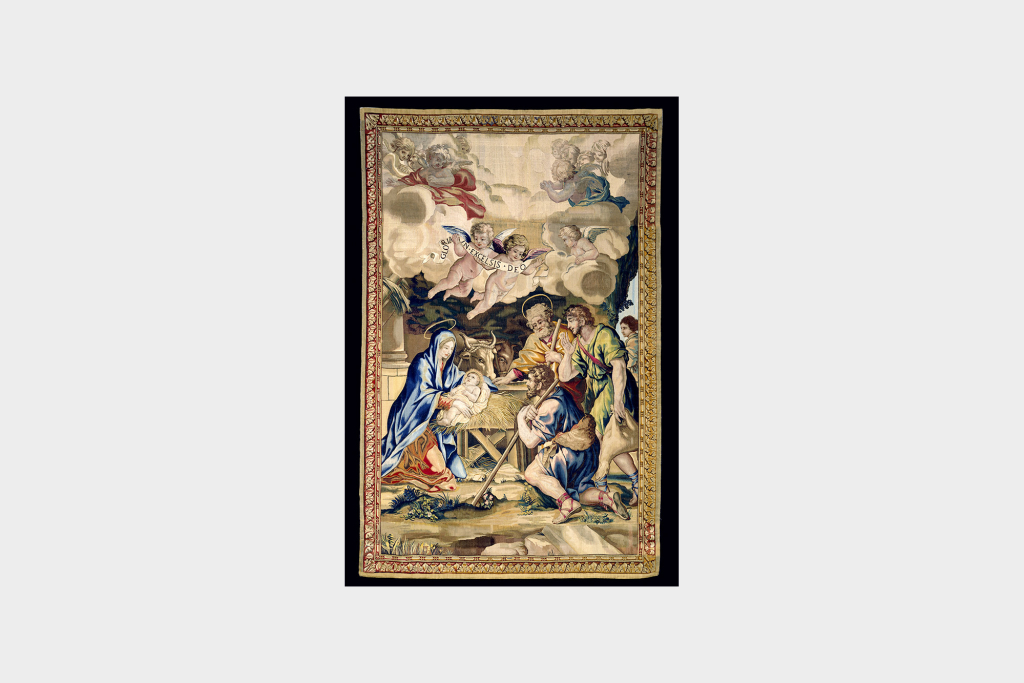
This year, at the Apostolic Palace in Castel Gandolfo, the announcement of Christ’s birth is entrusted to a magnificent seventeenth-century tapestry. The work was selected by the Directorate of Museums and Cultural Heritage and the Directorate of the Pontifical Villas for the upcoming Christmas season.
The tapestry depicts the Nativity, based on a design by Pietro da Cortona (1596–1669). It portrays the Adoration of the Shepherds, with the Virgin Mary presenting the Christ Child lying in the manger, while Saint Joseph and the shepherds gather around Him. Above the Holy Family are several angels, two of whom hold a scroll bearing the words recorded by Luke in his Gospel: Gloria in excelsis Deo.
The tapestry was commissioned in 1635 from the Barberini tapestry workshop by Pope Urban VIII, the first Pontiff to choose Castel Gandolfo as his summer residence, in 1626. It was intended for the papal chapel, presumably the Sistine Chapel, where it was placed behind the altar as a backdrop to the papal baldachin.
The weaving of the Nativity tapestry began in September 1635 and was completed in February 1636 under the direction of Giacomo della Riviera, with the work carried out by the Flemish weaver Michele and the French weaver Antonio. Papal inventories describe the tapestry as being made “with gold, silk, and wool,” confirming the use of metallic threads, silk, and wool, and attribute its design to “Il Cortonese,” namely Pietro da Cortona.