


The Lord’s supper (Maundy Thursday)
 "Pin It")
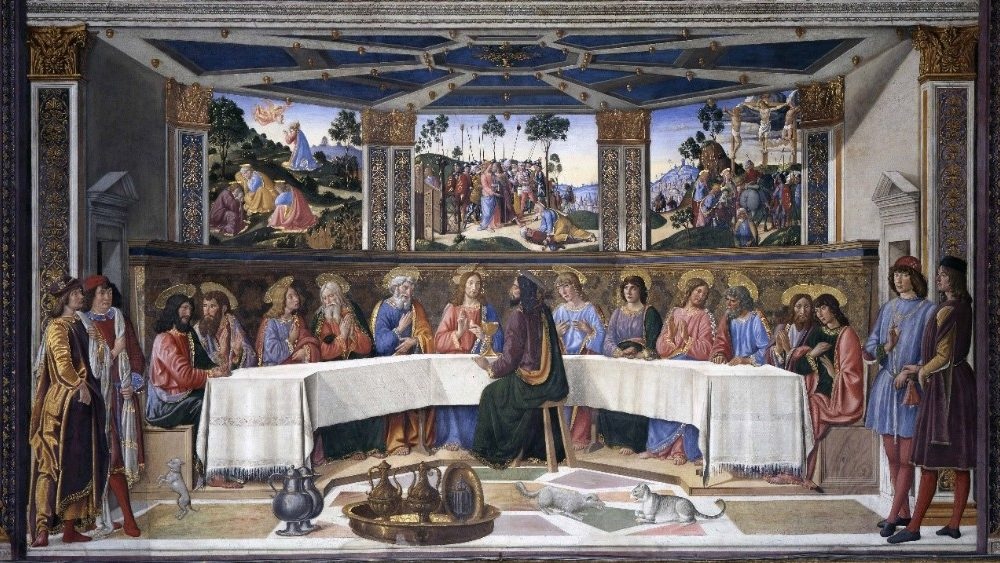
1. “Jesus… rose from supper and took off his outer garments. He took a towel and tied it around his waist. Then he poured water into a basin and began to wash the disciples’ feet and dry them with the towel around his waist. (Jn 13:4–5).
Introduction
The Lord’s Supper compared to Abraham’s meal
2. We read of a similar event in Genesis: “Let some water be brought, that you may bathe your feet, and then rest under the tree. Now that you have come to your servant, let me bring you a little food, that you may refresh yourselves; and afterward you may go on your way.” (Gen 18:4–5).
>What Abraham did for the three messengers, Christ did for the holy apostles, messengers of the truth, who would preach faith in the Trinity throughout the whole world; he bowed at their feet like a servant and, thus bent down, washed their feet. O inconceivable humility! O unspeakable condescension! He who is adored by angels in heaven bends down at the feet of fishermen; that head which makes angels tremble bows beneath the feet of the poor.
For this reason Peter was afraid and said: “You will never wash my feet!” (Jn 13:8), that is, never. Overcome with fear, he could not bear that a God should humble himself at his feet. But the Lord replied: “Unless I wash you,” that is, if you refuse to be washed by me, “you will have no inheritance with me” (Jn 13:8), that is, you have no part in me. Comment: whoever is not washed through baptism and through confession and penance has no share with Jesus.
After he had washed their feet (cf. Jn 13:12), he made them rest under the tree, which was himself. “I sat down under his shadow with great delight, and his fruit”—that is, his body and his blood—“was sweet to my taste” (Song 2:3). This is the morsel of bread that he set before them, by which he refreshed their hearts to endure hardships. “While they were eating, Jesus took bread, blessed it, and broke it” (Mt 26:26). He broke it to show that the “breaking” of his body would not happen without his will. First he blessed it, because together with the Father and the Holy Spirit he filled with the grace of divine power the nature he had assumed. “Take and eat; this is my body” (Mt 26:26). Understand it thus: “He blessed it,” that is, saying, “This is my body.” Then he broke it, gave it to them, and said: “Eat!” and repeated: “This is my body.”
I. Allegorical Sermon
3. Let us see the allegorical meaning of the supper, the garments, and the towel; as well as of the water, the basin, and the disciples’ feet.
The supper is the glory of the Father; the laying aside of the garments represents the annihilation of majesty; the towel signifies the innocent flesh; the water represents the outpouring of blood or the infusion of grace; the basin the hearts of the disciples, and the feet their affections.
He rose from the table at which he was with God the Father: “A man gave a great dinner to which he invited many” (Lk 14:16). A great supper, because it is splendid and overflowing with the glory of divine majesty, the riches of angelic blessedness, and the delights of double glorification. Many are called to this supper, but few go, because “What is crooked cannot be made straight, and you cannot count what is not there” (Eccl 1:15), the number of fools is infinite who despise “the supper of life” for the dung of earthly things. The pig prefers to sleep in the mud rather than in a fine bed. Christ rises from the happiness of his supper in order to raise these people from the misery of their filth.
“He took off his outer garments.” Note that Christ laid aside his garments four times. At the supper he laid them aside and then took them up again; at the pillar he was stripped and then clothed; during the mockery of the soldiers he was also stripped and clothed; but it is not read that he was stripped by Herod; on the cross he was stripped and not clothed again.
The first laying aside refers to the apostles, whom he left but soon called back to himself. The second refers to those who were received into the Church on the day of Pentecost and those who are received little by little. The third refers to those who will be received at the end of time. The fourth refers to the perverse mediocrity of our time, which will never be received. The second and fourth strippings are commemorated today in some churches, when the altars are stripped, then sprinkled with water and wine and struck with branches like scourges. To lay aside garments means to annihilate oneself; after the washing, Jesus took them up again because, having fulfilled obedience, he returned to the Father from whom he had come.
In the Passion of the blessed Sebastian it is read that a king had a gold ring adorned with a precious gem. The ring, very dear to him, slipped from his finger and fell into a sewer, causing him great sorrow. Finding no one able to retrieve it, he laid aside the garments of his royal dignity, clothed himself in sackcloth, descended into the sewer, searched long for the ring, and finally found it; having found it, full of joy he brought it back to his palace.
That king is a figure of the Son of God; the ring represents the human race; the precious gem set in the ring is the human soul. This slipped, as it were, from God’s finger from the joy of earthly paradise and fell into the sewer of hell; the Son of God was deeply grieved by this loss. He sought among angels and men someone who could recover the ring, but found no one, because no one was capable of doing so. Then he laid aside his garments, emptied himself, put on the sackcloth of our misery, searched for the ring for thirty-three years, and finally descended into hell, where he found Adam with all his descendants: full of joy he took them all with him and brought them back to eternal happiness.
4. “And having taken a towel, he girded himself.” From the most pure flesh of the Virgin Mary he took the towel of our humanity. This corresponds to what is said in Ezekiel: “The Lord said to the man clothed in linen: Go within the wheelwork beneath the cherubim” (Ez 10:2). The wheel, which returns to the point from which it started, is human nature, to which it was said: “For you are dust, and to dust you shall return” (Gen 3:19). It is said “in the midst” with respect to the two extremes: the beginning and the end.<
Note that human nature is marked by three things: the impurity of conception, the misery of pilgrimage, and the destruction of death. The man clothed in linen is Jesus Christ, who received a linen garment from the Blessed Virgin: he did not enter the world through an impure conception, because he was conceived by the most pure Virgin through the Holy Spirit; he did not end in human corruption, because “you will not let your Holy One see corruption” (Ps 15:10); but he came “in the midst” of our pilgrimage, poor, exiled, and a wanderer, and in the whole world he scarcely had a dwelling.
Nehemiah says in 2:14: “Since there was no room here for my mount to pass with me astride”. Nehemiah, whose name means “consolation of the Lord,” is a figure of Christ, our consolation in time of desolation. Isaiah says: “For you have been a refuge to the poor, a refuge for the needy in their distress, a shelter from the storm, a shade from the heat” (Is 25:4). Amid the thorns of human adversity, the storm of diabolical temptation, the heat of lust and vainglory, he is our consolation; his beast is humanity, upon which divinity sat. This beast, on which he placed the wounded man—that is, the human race—had no dwelling in the whole world, because “he had nowhere to lay his head” (Mt 8:20; Lk 9:58); he had only the cross, on which, “bowing his head, he gave up his spirit” (Jn 19:30).
He therefore entered among the wheels beneath the cherubim, because he was made a little lower than the angels (cf. Heb 2:7), when he took the towel with which he girded himself. In that flesh he girded himself with humility, because it was necessary that humility be as great in the Redeemer as pride had been in the betrayer.
5. “Then he poured water into the basin.” Comment: He poured out his blood upon the earth to cleanse the footprints of believers, soiled by earthly sins.
Note that the basin is a concave vessel, resonant, and with an open rim. Such was the heart of the apostles—and would that our hearts were the same: concave through humility, resonant with devotion, with an open rim to accuse oneself. The basin is called in Latin pelvis, because feet (pedes) are washed in it. On the day of Pentecost the Lord sent the water of grace into the hearts of the apostles; and he sends it every day into the hearts of the faithful, so that their feet—that is, their affections—may be cleansed from every impurity. This is what Job says: “I washed my feet in milk” (Job 29:6): in the richness of milk is signified the devotion of the soul, by which Job—that is, “the one who grieves” over his sins—purifies the affections and thoughts of his mind.
And he wiped them with the towel with which he was girded, because all the suffering and passion of the Lord’s body is our purification. With this towel we must wipe away the sweat of our labor and the blood of our suffering, taking in every tribulation the example of his patience, so that we may rejoice with him in his glory. May he grant this, he who is blessed forever. Amen.
(From the Sunday Sermon “The Lord’s Supper” by Saint Anthony of Padua, Doctor of the Church)