


Exhibition of Historic Armor of the 16th and 17th Centuries at the Apostolic Palace of Castel Gandolfo

Military history in defense of the Papacy
For the Jubilee Year 2025, the Directorate of Museums and Cultural Heritage, in collaboration with the Directorate of the Pontifical Villas, is presenting an extraordinary exhibition entitled “In Difesa del Papa.” [In Defense of the Pope]
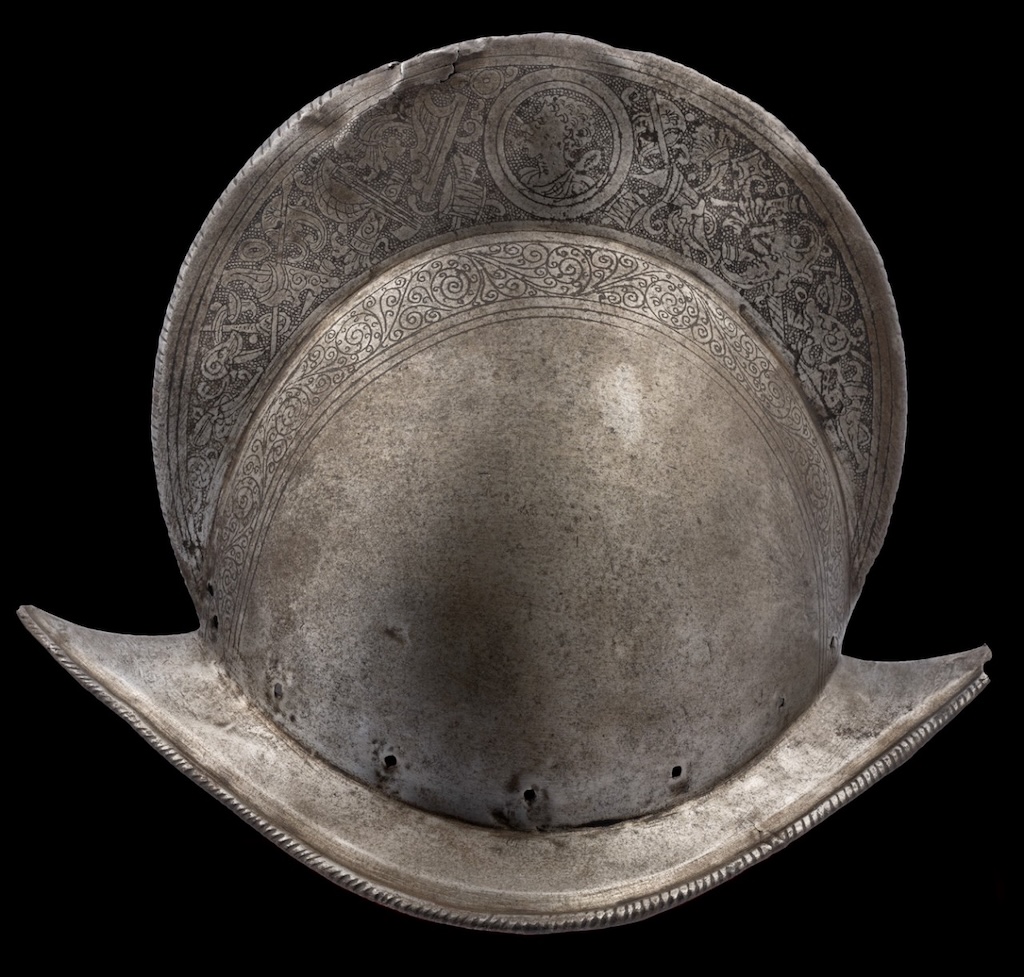
Set up in the halls of the Apostolic Palace of Castel Gandolfo, the exhibition offers visitors a rare opportunity to closely admire a unique and exceptional collection: original helmets from the 16th and 17th centuries drawn from the Historical Collections department of the Vatican Museums.
Curated by Sandro Barbagallo with the collaboration of Marco Iuffrida, the exhibition brings together artifacts never before displayed, including morions, zuccotti, cavalry helmets, burgonets, and tasquettes. Each piece bears witness to the evolution of military defense at the service of the Pontiff.
The helmets—the true protagonists of the exhibition—are presented not merely as instruments of protection in battle, but as symbols of a spiritual power intertwined with strategic necessity. In Renaissance and Baroque Italy, the defense of the Pope took the form of a complex defensive apparatus reflecting the rise of the Papal States as a modern power.
Among the most significant objects are the morion helmets with its distinctive pointed crest—emblematic of the Papal Guard—the zuccotto caps used by arquebusiers and musketeers, the pikeman’s headpiece of the Swiss Guard (still in use today), and a cavalry helmet adorned with noble coats of arms, such as that of the Barberini family. The display also includes ceremonial burgonets combat helmets and the exceptionally rare tasquette with “lobster-tail” design, once belonging to a 17th-century papal cuirassier.
The exhibition guides visitors on a journey through time, where the art of warfare merges with symbolic language - engravings, mythological motifs and naturalistic details reveal the values, identities and ideologies of the age. The helmet thus becomes not only a piece of armor but also a visual manifesto of faith, authority and community.
The exhibition is set within a particularly significant historical context, spanning from the traumatic Sack of Rome in 1527 to the War of Castro in the 17th century. During this period, the Papal States developed new defensive structures and elite armed corps, where loyalty to the Pope became both a code of honor and a distinct military consciousness.
A further marvel awaits visitors in the Hall of the Popes at the Apostolic Palace: one of the tapestries designed by Raphael for the Sistine Chapel, depicting The Conversion of Saul. This masterpiece, part of the celebrated Acts of the Apostles series, was commissioned by Pope Leo X, who entrusted the project to Raphael and the workshop of Pieter Van Aelst, one of the most renowned Flemish weavers. The preparatory cartoons, created by Raphael and his pupils, were later transformed into magnificent tapestries that still adorn the walls of the Sistine Chapel. This particular tapestry belongs to the Tapestries and Textiles department of the Vatican Museums, curated by Alessandra Rodolfo.
The exhibition was inaugurated at the Apostolic Palace of Castel Gandolfo on Saturday, October 18, at 11:30 a.m. Speakers included Barbara Jatta, Director of the Vatican’s Museums and Cultural Heritage, Andrea Tamburelli, Director of the Pontifical Villas, Sandro Barbagallo, Curator of the Historical Collections department of the Vatican Museums and Marco Iuffrida, also of the same department of the Vatican Museums.