

Interview with Paolo Violini, Chief Restorer of the Paintings and Wooden Materials Restoration Laboratory of the Vatican Museums

Splendor conserved for centuries to come
Rediscovering Michelangelo’s fresco in all its expressive power is an extraordinary experience—one that stays with you for a lifetime. Paolo Violini, the Vatican’s Chief Restorer of the Paintings and Wooden Materials Restoration Laboratory, recounts his work in the Sistine Chapel on the occasion of the extraordinary maintenance of Michelangelo Buonarroti’s monumental fresco the “Last Judgment”.
The project involves professionals and technicians from various departments of the Vatican Museums, including twenty restorers from the Paintings Restoration Laboratory, organized into four teams rotating on site. They are joined by staff from the Department 15th and 16th Century Art, specialized technicians from the Scientific Research Cabinet, and personnel from the Office of the Conservator and the Photographic Laboratory. An important contribution also comes from the Directorate of Infrastructure and Services of the Governorate, responsible for installing the scaffolding and monitoring the air-conditioning system, as well as from the generous financial support of the Florida Chapter of the Patrons of the Arts in the Vatican Museums.
What were the main reasons that made this intervention necessary?
The primary reason was the evident formation of a widespread whitish veil deposited on the painted surface, caused by the settling of microparticles of foreign substances circulating in the air. Over time, this veil has muted the chiaroscuro contrasts and dulled the original colors of the fresco.
Was this a planned intervention or an urgent action prompted by specific issues?
The intervention had been planned and forms part of the general preventive maintenance program for the entire decorative complex of the Sistine Chapel. The aim is to safeguard the frescoed surfaces through the systematic removal of deposits that gradually accumulate over time. Operations began about twenty years ago and have so far been conducted exclusively at night using mobile platforms. They have progressively addressed the walls with Michelangelo’s lunettes, the series of Pontiffs, and the large fifteenth-century scenes with their draperies below, excluding until now the wall of the Last Judgment, which required the installation of fixed scaffolding.
Which environmental factors (humidity, dust, tourist flows) most affect the conservation of the work?
A certain amount of dust naturally settling on wall surfaces over the years can be considered normal. In addition, particularly on the Last Judgment wall, a whitish deposit has formed as the result of a combination of factors. Humidity, air circulation, temperature, and anthropic factors—when combined in specific proportions—together contribute to the formation of such surface sediments.
What were the main issues found on the fresco before the intervention?
Thanks to its extraordinary execution technique, the Last Judgment remains in excellent condition, a result of the major restoration carried out between 1990 and 1994 by Gianluigi Colalucci’s team from the Vatican Museums’ Paintings Restoration Laboratory, under the direction of Carlo Pietrangeli and Fabrizio Mancinelli. This was confirmed during preliminary tests conducted about a year ago in selected areas of the painted wall: removing the whitish patina revealed the fresco intact in its original chromatic brilliance. Michelangelo’s particular precaution—having an inclined wall constructed for the Last Judgment, projecting outward at the top by about 40 centimeters—also contributed to its preservation, limiting dust accumulation typically found on vertical walls.
What materials and techniques are used for cleaning?
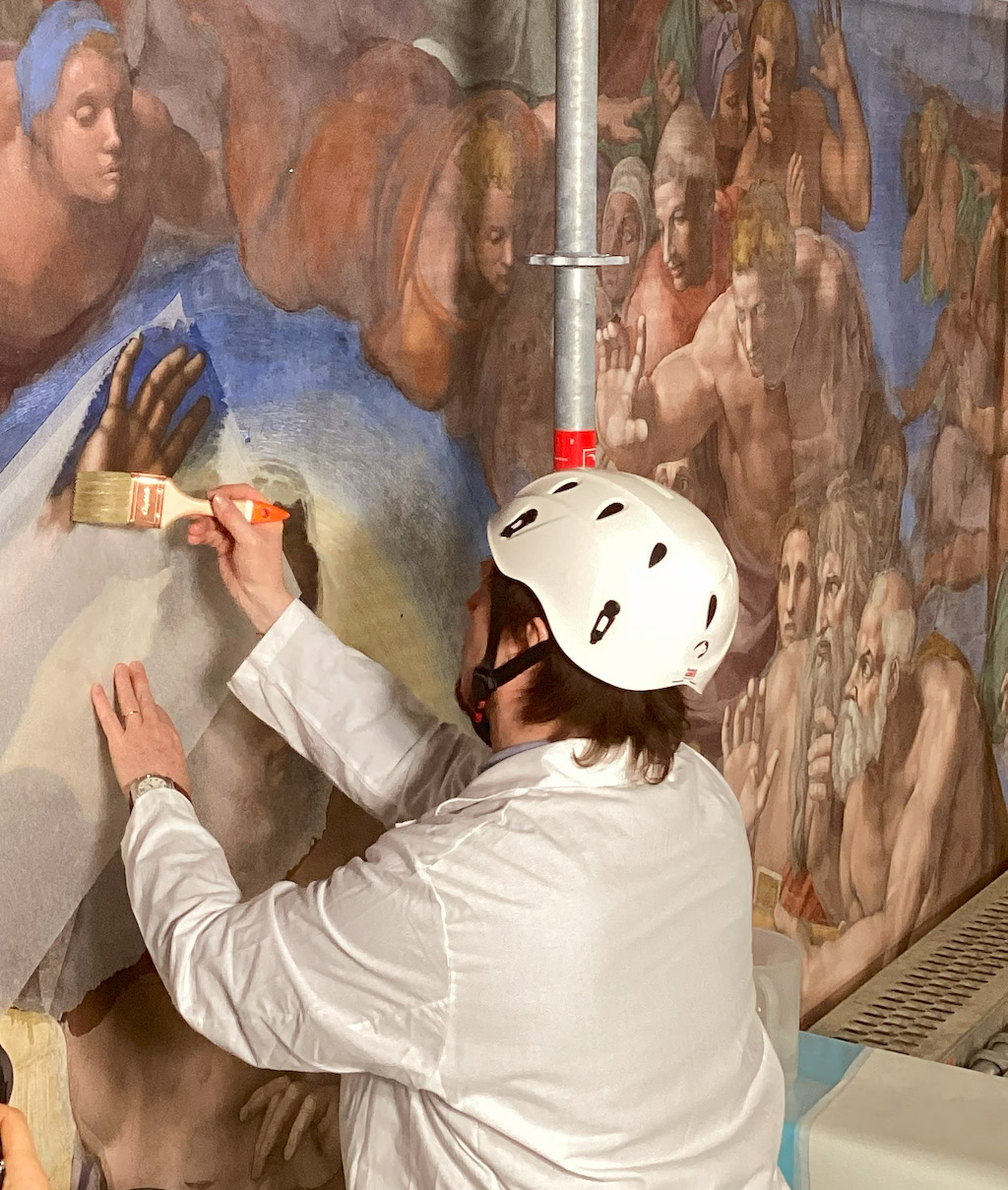
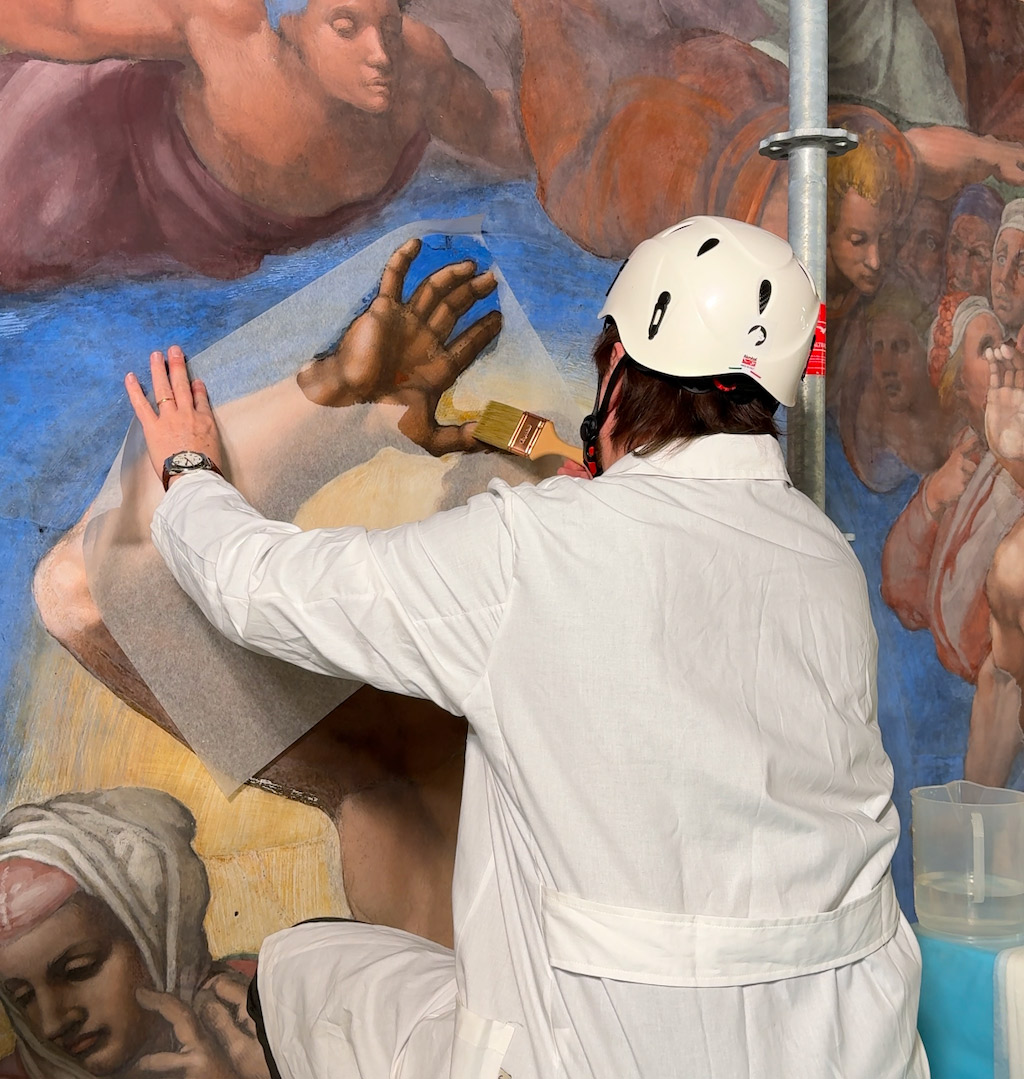
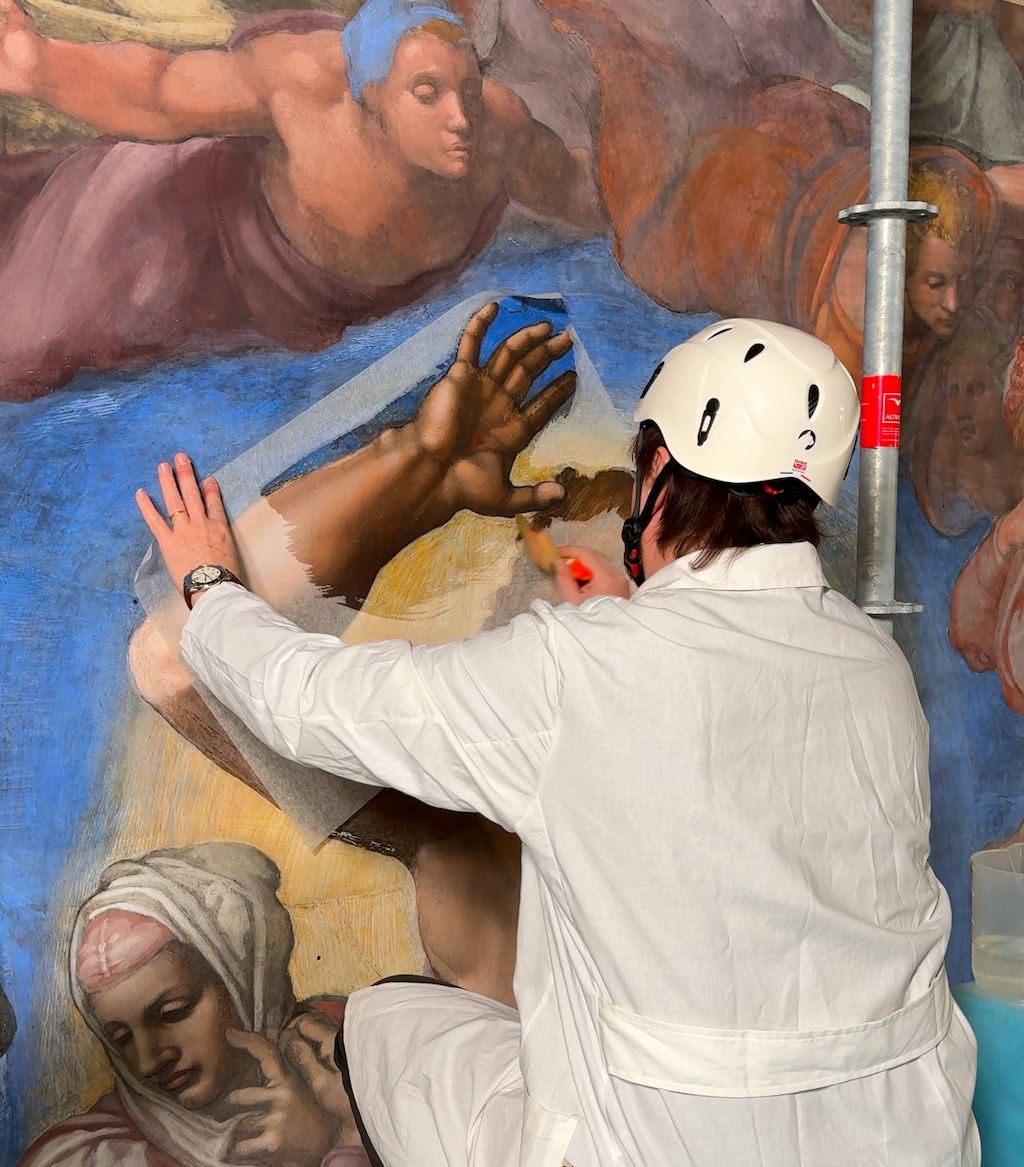
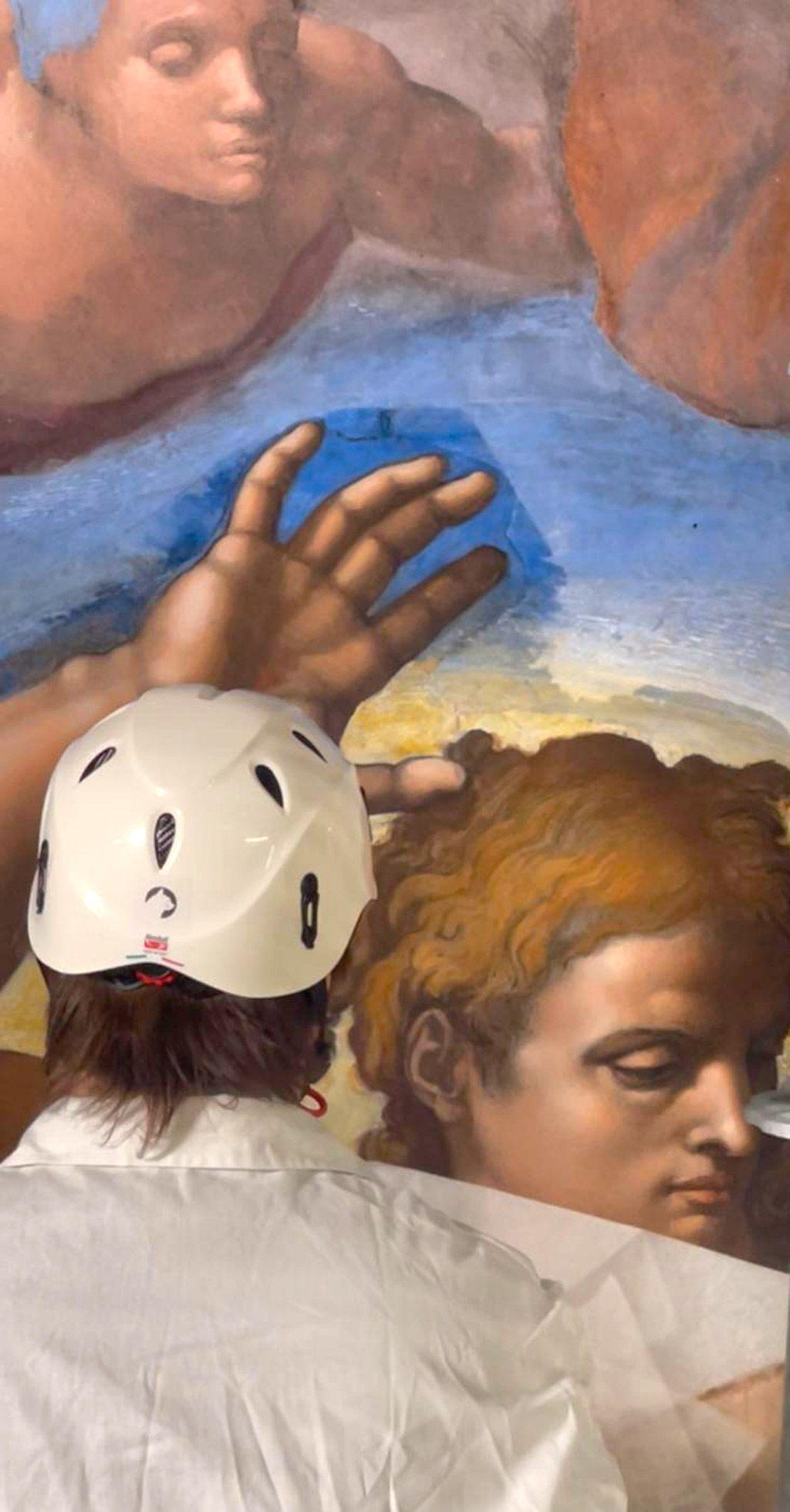
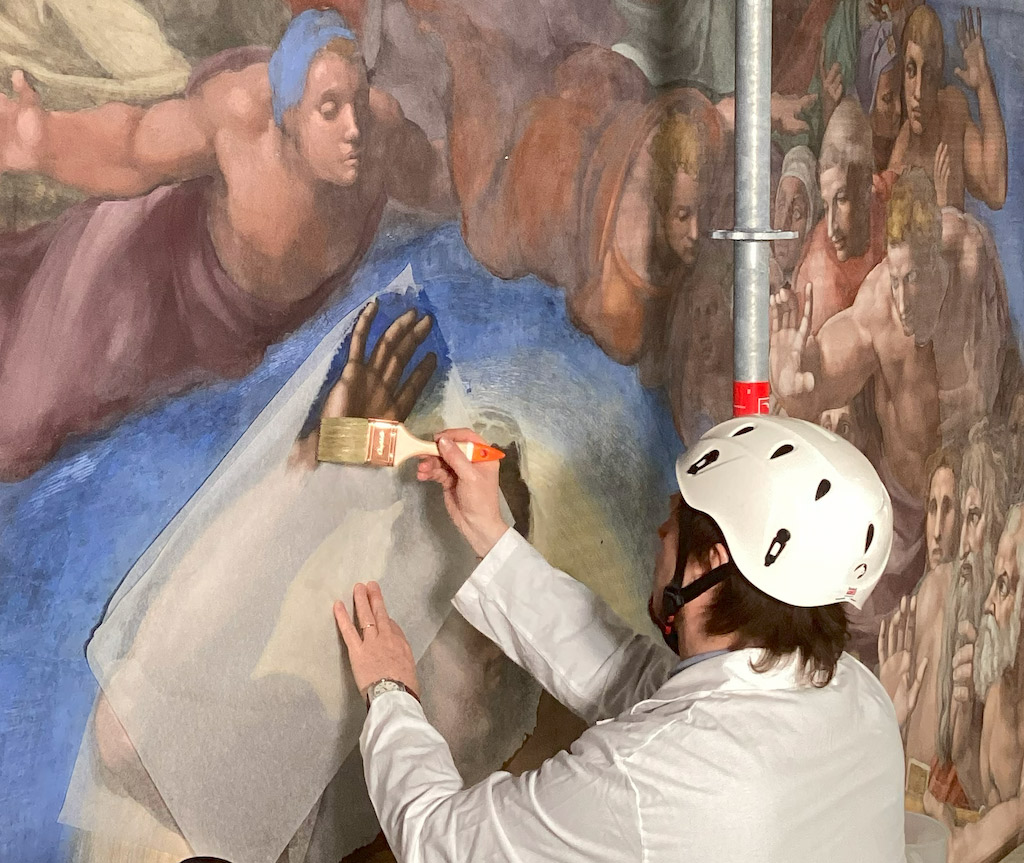
Fortunately, the white veil proved to be completely soluble and removable with the simple application of deionized water applied by brush over a double layer of Japanese paper used as support.
Did the intervention involve innovative technologies (laser, multispectral imaging, etc.)?
The current intervention is relatively straightforward and does not require particularly innovative technologies. However, the restorers’ work is preceded by thorough preliminary scientific investigations, detailed photographic documentation, and precise condition mapping of the artwork. These steps are aimed at data acquisition and verifying the compatibility of the chosen procedures. Advanced technologies are used for these assessments, including high-resolution infrared imaging analysis, colorimetric measurements before and after extraction, portable FT-IR and Raman surface analyses, and ion chromatography of extraction waters. Micro-samples were also taken for SEM (scanning electron microscopy) analysis of the painted surfaces.
What guiding principle underlies the maintenance of a work of such historical and spiritual value?
The guiding principle in art restoration is the constant search for the best possible balance between the historical integrity of the work and its aesthetic value. This is a broad concept, open to various interpretations, which must always be properly justified in light of the perspectives of the different professionals involved—art historians, restorers, and experts in applied diagnostics for cultural heritage. It is a complex field where technical aspects intersect with theoretical reflection, art history, and art criticism.
In the Vatican context, special importance is also given to recovering the intrinsic meaning of the work—its transcendent value, embodied in the message the artist or patron intended to convey within a specific historical framework. Restoration choices, including aesthetic decisions, must therefore aim to safeguard and restore these values, which have often served as a fundamental vehicle of doctrine and teaching for the faithful.
Finally, implementing a preventive maintenance program is essential, particularly for large mural cycles such as the Sistine Chapel or the Raphael Rooms. Such programs are indispensable to ensuring the proper conservation of restored works, mainly through indirect protection measures such as environmental monitoring and the prevention of potentially harmful conditions.
Is a future periodic maintenance plan foreseen?
Certainly. We will continue monitoring the microclimate in the Sistine Chapel and systematically carry out annual dust removal on all painted surfaces.
How many professionals were involved?
Within the Paintings Restoration Laboratory, twenty restorers are at work, divided into four teams rotating daily, so that each may have the extraordinary opportunity to stand face to face with Michelangelo’s fresco—an occasion that does not occur often. I had the privilege of being present during the restoration thirty years ago, and I can assure you that the emotion of rediscovering Michelangelo’s fresco in its expressive power is something that remains in the soul forever.
In addition to the restorers and the Department of 15th and 16th Century Art, specialized professionals from the Scientific Research Cabinet, the Office of the Conservator, and the Photographic Laboratory are involved. The Directorate of Infrastructure and Services oversees the air-conditioning system.
How was visitor presence managed during the work?
The scaffolding occupies only the Last Judgment wall and thanks to a passageway running through it, still allows visitors access to the Chapel. The public can view a faithful reproduction of the frescoed wall printed on a large canvas covering the scaffolding. All scaffolding installation operations were carried out during closing hours, and the Sistine Chapel has remained open to visitors throughout.
How might climate change affect the conservation of the fresco?
By their nature and physical structure, frescoes—especially those located indoors—would not be particularly affected by climate change. However, we have observed that the general rise in temperatures, combined with increased humidity levels during large gatherings of people, can lead to the formation of compounds responsible for the whitish patinas we must remove from the frescoes. Constant regulation of air-conditioning and ventilation systems is therefore essential, in response to environmental thermo-hygrometric parameters that vary more rapidly and significantly. Indirectly, increasingly frequent violent storms linked to climate change may damage roofs and window frames, causing water infiltration and potentially irreversible damage to interior decorated surfaces.