

Extraordinary maintenance of the Last Judgment in the Sistine Chapel

The contribution of the Patrons of the Arts in the Vatican Musems
With great expectation and excitement, and following the installation of scaffolding in the Sistine Chapel, the extraordinary maintenance of Michelangelo’s The Last Judgment was begun during the final weeks of February 2026.
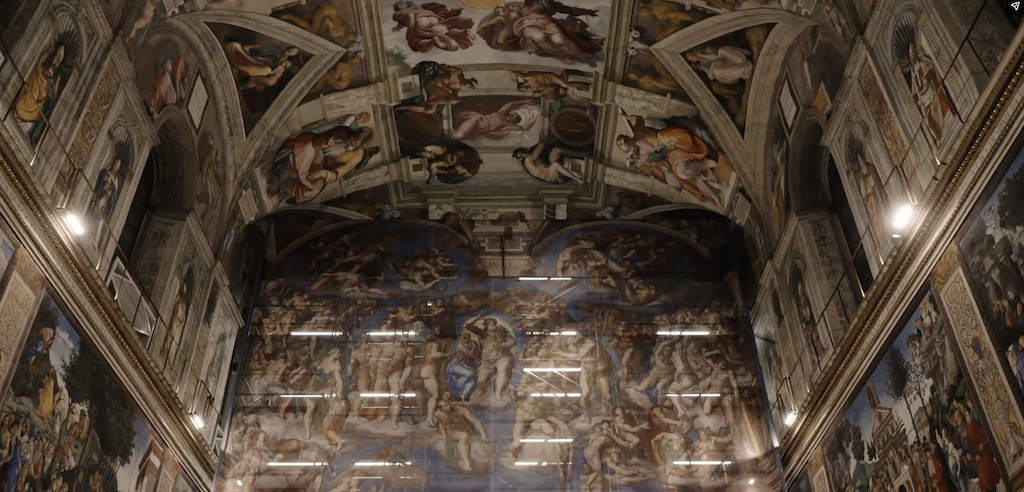
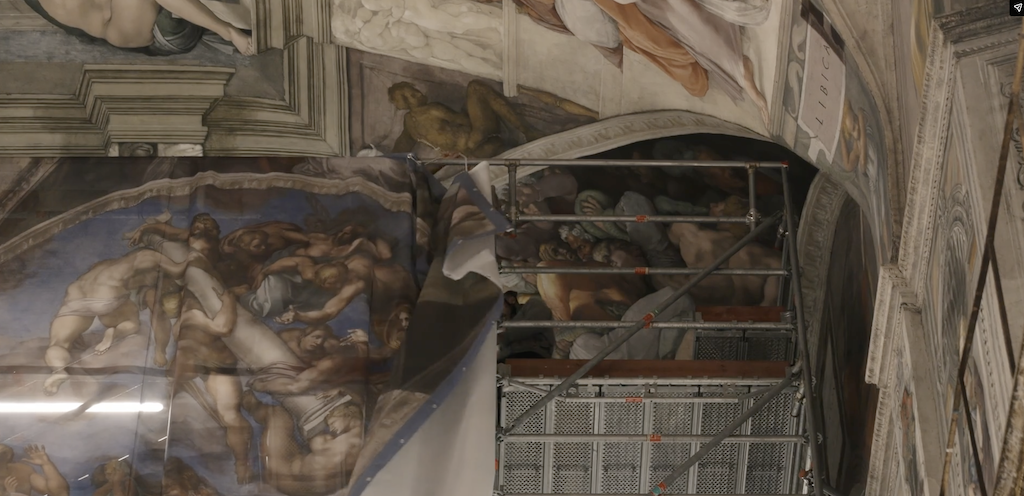
Although the delicate cleaning of Michelangelo's magnificent fresco has officially commenced and is expected to be completed by Holy Week, Barbara Jatta, Director of the Vatican Museums and Cultural Heritage, has announced the Sistine Chapel will continue welcoming the faithful and its many visitors while the restoration work takes place. As a result, while restorers of the Vatican Museums' Painting and Wood Materials Restoration Laboratory devote themselves to the intricate work of conservation by using the temporary scaffolding for the purpose of restoring Michelangelo’s fresco depicting the Second Coming of Christ and the final judgment of God (Giudizio Universale) that covers the entire altar wall of the Sistine Chapel.
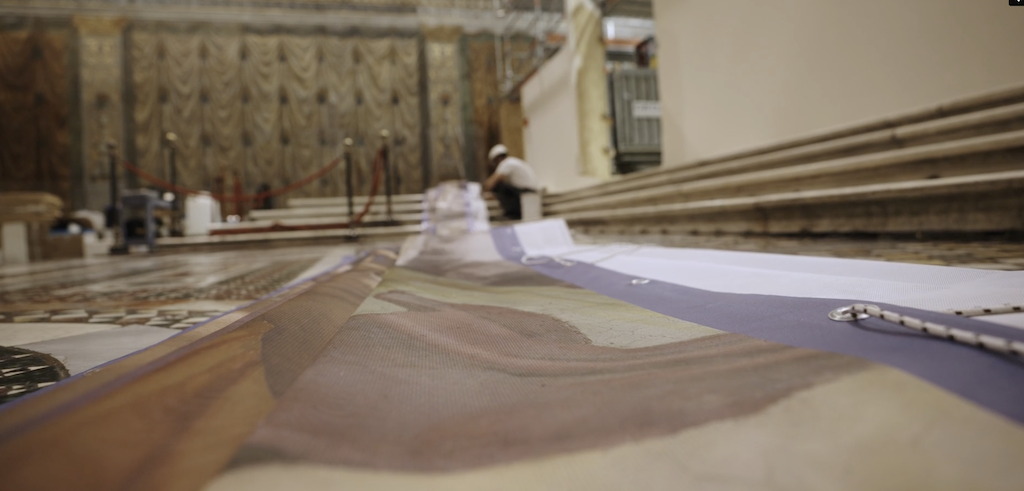
In order for visitors to imagine Michelangelo’s original and powerful artwork enclosed by scaffolding, a screen reproduction of the Last Judgment, highlighted by illumination, drapes the area of restoration and the restorers. The complex installation of the scaffolding, lighting and artistic imaging was organized by the expertise of the Directorate of Infrastructure and Services, led by Engineer Salvatore Farina for the Governorate of Vatican City State, and creates a memorable experience for those entering the Sistine Chapel. Moreover, the complex and extraordinary maintenance intervention of the Last Judgment is supported by the Florida Chapter of the Patrons of the Arts in the Vatican Museums, chaired by Mary Viator, who have generously financed this most important project for the sake of its religious, artistic and cultural importance.
In presenting this major project, the Director of the Museums has noted: “…all phases of the intervention will be documented by the Vatican Museums' Photographic Laboratory, creating a valuable record of the cleaning which, by removing a slight patina invisible to the naked eye, will restore Michelangelo's colors to their full splendor. Nearly thirty years after the last conservation intervention, completed in 1994 under the supervision of Director General Carlo Pietrangeli and carried out by Chief Restorer Gianluigi Colalucci of the Vatican Museums' Painting and Wood Materials Restoration Laboratory, it will once again be possible to admire Michelangelo's supreme masterpiece in all the power of his vision."
In the Vatican Museums’ communication on February 23, 2026, describing the importance and methodology of this significant extraordinary maintenance project, many of those involved have given further insight into its significance.
Fabrizio Biferali, Curator of the Department of 15th–16th Century Art, explained “…the fresco of the Last Judgment was begun in 1536 under Paul III Farnese and completed in 1541. According to Ascanio Condivi’s Life of Michelangelo Buonorrati:’… when the fresco was finally unveiled, it was said that Paul III was so overwhelmed that he fell to his knees and implored divine forgiveness on the last day.’ ”
"Today's intervention,” according to Paolo Violini, Chief Restorer of the Paintings and Wooden Materials Conservation Laboratory, "became necessary due to the presence of a widespread whitish veil on the painted surface, which has caused a reduction in chiaroscuro values and a consequent alteration in the chromatic legibility of the fresco. The removal of this patina is carried out through the controlled application, by brush, of deionized water, applied through a double layer of Japanese tissue paper. The water enables the complete solubilization of deposits and extraneous substances, bringing the original paint layer back to light while respecting its authentic state of conservation. The intervention is preceded by thorough preliminary scientific investigations, detailed photographic documentation, and a precise survey of the work's state of conservation, aimed at acquiring data and verifying the compatibility of the operational procedures adopted."
The Head of the Conservator's Office Marco Maggi, publicly notes: “…from 2010 onward, the Directorate of the Vatican Museums launched the Ordinary Maintenance Plan for the Sistine Chapel…on evenings during the months of January and February, when the Museums are closed to the public, painting and marble restorers, diagnostics and conservation specialists, logistics operators, technical staff from the Museums and the Directorate of Infrastructure and Services have taken turns ensuring the preservation of the Chapel's frescoes and decorative elements - by thorough dusting and rigorous visual and instrumental checks - and verifying the proper functioning of the air conditioning and lighting systems, active since 2014 and essential for the stability of environmental conditions and the optimal enjoyment of the Sistine environment."
Reflecting upon the current need for intervention, Fabio Morresi, Head of the Scientific Research Laboratory, observes: "…we are once again touching and closely observing Michelangelo's work. Over these years, monitoring of the paint layer has been constant, and we have been able to observe, in addition to a slight deposition of particulate matter, some localized whitening phenomena. These phenomena were immediately analyzed to define their exact nature and, consequently, the cause of their appearance. A series of in-depth scientific analyses enabled the correct molecular identification of this substance: calcium lactate. This salt is stratified only on the outermost surface of the paint and is highly soluble in water. This chemical-physical property makes its removal straightforward, ensuring minimal interaction with the underlying pigments.”
The importance of Michelangelo’s The Last Judgment cannot be underestimated. Now, after much study and analyses, the installation of a special scaffold close to the Last Judgment wall will allow our restorers to carry out, in complete safety and with the Sistine Chapel remaining open, an extraordinary maintenance intervention on the entire painted surface that will allow generations to come to view one of the world’s most significant masterpieces.
Monsignor Terence Hogan
Coordinator of the Office of Relations with Patrons of the Arts in the Vatican Museums