


Sistine Chapel: Michelangelo’s “Last Judgment” Undergoing Extraordinary Maintenance

With the support of the Florida Chapter of the Patrons of the Arts in the Vatican Museums
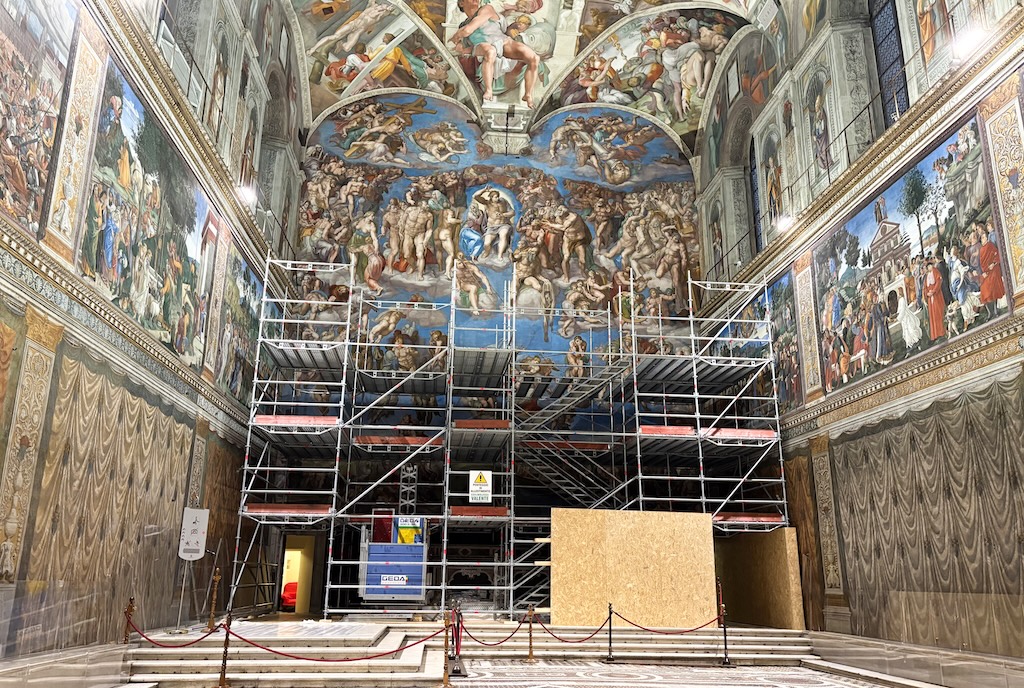
To remove surface deposits and restore the chromatic and luminous qualities intended by Michelangelo, the monumental fresco Last Judgment, preserved on the altar wall of the Sistine Chapel, will undergo extraordinary maintenance. For approximately three months, Michelangelo’s masterpiece will be the focus of a cleaning intervention.
This intervention will fully restore the formal and expressive complexity of the painting and renew—some thirty years on—the sense of wonder that accompanied the completion of the major twentieth-century restoration.
The assembly of the scaffolding has already begun, while the Sistine Chapel will remain open to the public, continuing to welcome worshippers and visitors at all times,. The restorers of the Vatican Museums’ Laboratory for the Restoration of Paintings and Wooden Materials will carry out the cleaning operations behind a high-definition screen reproducing the image of the Last Judgment itself.
As stated by Barbara Jatta, Director of the Vatican Museums and Cultural Heritage: “About thirty years after the last conservation intervention on the Last Judgment in the Sistine Chapel—completed in 1994 under the supervision of Director General Carlo Pietrangeli and carried out by Gianluigi Colalucci, Chief Restorer of the Vatican Museums paintings—an extraordinary maintenance campaign will begin, lasting approximately three months, on this masterpiece from Michelangelo’s mature period.”
Fabrizio Biferali, Curator of the Department for Fifteenth- and Sixteenth-Century Art, emphasized that the Last Judgment was commissioned from Michelangelo Buonarroti in 1533 by Pope Clement VII for the altar wall of the Sistine Chapel. It was begun, he explained, “only under the new Pontiff Paul III, who appointed the Tuscan artist supremum architectum, sculptorem et pictorem of the Apostolic Palace, releasing him from previous contractual obligations for the tomb of Julius II so that he could devote himself exclusively to the Sistine enterprise. Michelangelo began painting the scene in the summer of 1536 and completed the immense work (approximately 180 square meters in surface area and 391 figures) in the autumn of 1541. On 31 October of that year, Pope Paul III was able to celebrate solemn Vespers before that extraordinary painting which, as Giorgio Vasari would write, ‘filled all of Rome with awe and wonder.’”
Paolo Violini, Chief Restorer today of the Laboratory for the Restoration of Paintings and Wooden Materials, also noted that the Last Judgment “is now at the center of a specific maintenance campaign, made necessary by the presence of a widespread whitish film produced by the deposition of microparticles of extraneous substances carried by air movements, which over time has reduced chiaroscuro contrasts and evened out the original colors of the fresco.”
To safeguard the frescoed surfaces, the Restoration Laboratory has therefore promoted a program of preventive maintenance for the entire decorative complex, involving the systematic removal of deposits accumulated over time.
The extraordinary maintenance intervention—which also involves the Scientific Research Cabinet, the Office of the Conservator and the Photographic Laboratory—is made possible thanks to the generous contribution of the Florida Chapter of the Patrons of the Arts in the Vatican Museums.