


Interview with Engineer Salvatore Farina, Director of Infrastructure and Services, on planning for 2026
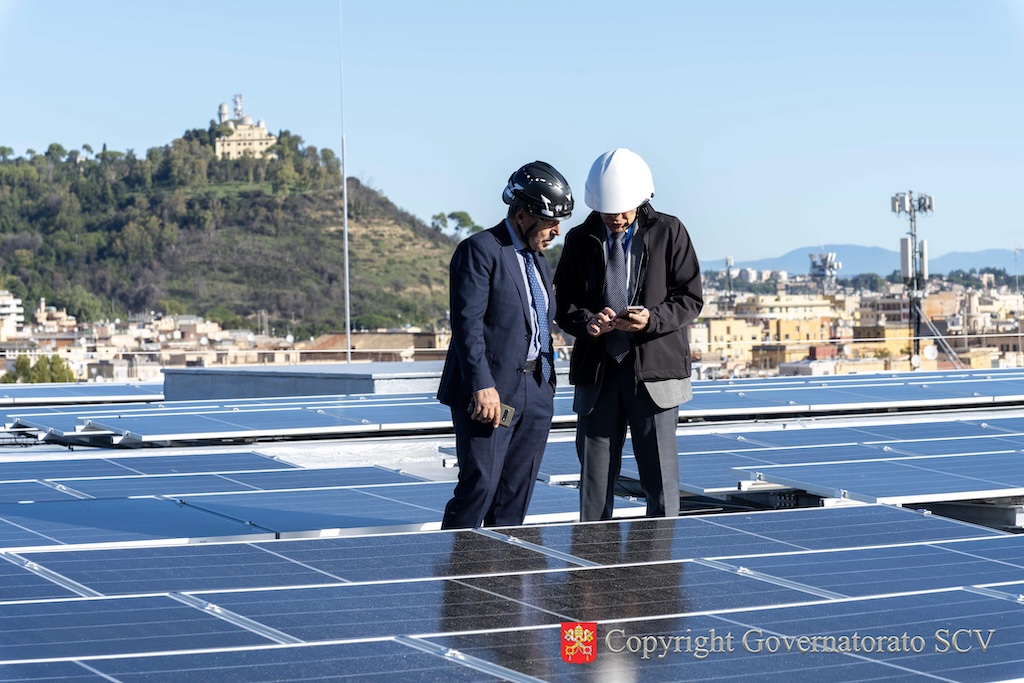

During 2026, renovation, modernization, and upgrading works will be completed at the barracks of the Corps of Gendarmerie of the Vatican City State and those of the Vatican Fire Brigade. New security systems will also be installed in the Vatican Museums, along with new air-conditioning systems for the Upper Galleries and the Vatican Pinacoteca.
In addition, a new low-consumption lighting system will be implemented in the Paul VI Audience Hall, the façades of the courtyard of the Vatican Apostolic Library will be renovated, and the potable water and fire-fighting network throughout the State will be progressively modernized. These are some of the projects of the Directorate for Infrastructure and Services of the Governorate of the Vatican City State, which will be launched and carried out over the course of the year. Engineer Salvatore Farina, Director of the Directorate, discusses them in detail in this interview below with www.vaticanstate.va.
What are the strategic priorities of the Directorate for Infrastructure and Services for 2026?
The focus of the current year will be the continuation of energy efficiency improvements to existing systems in the State, strengthening the transition—already initiated over the past two years—towards renewable energy sources. Central importance will also be given to consolidating the environmental protection plan and enhancing services that support the project’s implementation. Priority attention will continue to be devoted to the care of the Vatican Gardens, with particular emphasis on optimizing water resources.
By the end of 2026, it is also planned to complete the digitalization of the use of IT platforms for all administrative and related activities.
Last, but certainly not least, is the strong emphasis placed on the continuous updating of professional skills for all personnel, together with the implementation of all measures aimed at ensuring maximum workplace safety. During the year, following the formalization of the general Risk Assessment Document (DVR), work will proceed on drafting the same document for each Department within the Directorate.
The strategic priorities for 2026 fall within the framework of guidelines set by the governing bodies and aim to ensure the full functionality, safety, and enhancement of the State’s infrastructure assets. This will be achieved through actions that guarantee continuity of essential services and strengthen related technical and operational support. The Directorate continues, confirms, and reinforces its commitment to the routine and extraordinary maintenance of all buildings, structures and infrastructure within the Vatican City State, as well as in extraterritorial areas, including technical interventions on the major Papal Basilicas and in the area of Castel Gandolfo.
What are the main infrastructure projects planned for 2026?
The year 2026 promises to be particularly full and significant, both in terms of the number and type of structural interventions planned. We foresee not only the completion of the renovation, modernization, and upgrading of the barracks of the Corps of Gendarmerie of the Vatican City State, but also the completion of the renovation of the Fire Brigade barracks.
Among the main areas of intervention, both extraordinary maintenance and modernization of the structures of the Pontifical Villas of Castel Gandolfo will play a central role.
In collaboration with other Directorates of the Governorate, the multi-year project to install new security systems in the Vatican Museums will continue. Considerable effort will also be devoted to the complex climate control project (with the installation of new air-conditioning systems) for the Upper Galleries and the Vatican Pinacoteca. In the same area, we also expect to complete by April 2026 the restoration works that have been ongoing for about a year and a half in the Courtyard of the Pinecone. At the Vatican Museums, the construction of the new Polymaterial Laboratory will be completed, and modernization works at the Ethnological Museum Anima Mundi will continue, with the start of activities in the Far/Middle East and India/Southeast Asia sections and the Entrance (Wunderkammer).
In the first half of the year, the Directorate will also provide support for the assembly of scaffolding for the restoration works of the Second Loggia of the Apostolic Palace. In addition, work is expected to begin on the conservation-oriented replacement of window frames in the Courtyard of San Damaso, subject to approval of a prototype.
The list of major infrastructure projects planned for 2026 also includes the continued installation of electric vehicle charging stations, modernization of the electrical and lighting network with new substations, installation of a new low-consumption lighting system in the Paul VI Audience Hall along with the upgrading of multimedia systems in the New Synod Hall, renovation of the façades of the courtyard of the Vatican Apostolic Library, and the gradual modernization of the potable water and fire-fighting network throughout the State.
Alongside these projects, the Directorate will continue to provide technical support for initiatives of particular complexity and symbolic value, as already occurred at the beginning of February for the assembly of scaffolding and the setup of operational infrastructure necessary for the extraordinary maintenance of The Last Judgment fresco by Michelangelo in the Sistine Chapel. These are activities that require not only high technical expertise but also deep cultural and institutional sensitivity.
What criteria were used to prioritize the projects?
Project priorities are defined based on strategic guidelines provided by the governing bodies and on objective, shared criteria such as the level of infrastructure criticality, the historical and patrimonial value of the assets involved, safety requirements, compliance with new regulatory standards, and improved energy efficiency.
A key role is played by multi-year planning, which makes it possible to move beyond an emergency-driven approach and adopt a model of planned, sustainable, and responsible maintenance, capable of ensuring operational continuity and long-term preservation of assets.
Are new services planned or existing ones being modernized?
As of January 1, the reorganization of the Environmental Service has begun, with the establishment of a new independent Environmental Section coordinated by the Deputy Administrative Director according to the Directorate’s guidelines.
The 2026 program also includes the strengthening and modernization of existing services. These interventions will particularly concern the management of technological systems, energy services, building maintenance, care of the Vatican Gardens, environmental management, and the system for collection, disposal, and treatment of waste, both within Vatican territory and in extraterritorial areas. The aim is to ensure increasingly integrated, sustainable services aligned with the operational needs of the various Directorates, in compliance with regulations and in the spirit of the Encyclical Laudato si’.
What role do digitalization and smart technologies play in the 2026 program?
Digitalization and smart technologies represent a strategic asset of the 2026 program. They are a fundamental tool for modernizing infrastructure management processes. Examples include remote control systems for electrical, hydraulic, heating, and air-conditioning networks, as well as remote monitoring and control of recently installed photovoltaic systems, such as those in the Paul VI Hall, the Vatican Museums, and the Vignaccia Warehouse.
By promoting preventive and predictive maintenance models—with significant benefits in terms of safety and resource optimization—digitalization also enables the automation of reporting, budgeting, project management, procurement processes, and the storage/inventory management of the Central Warehouse. Smart technologies are also highly valuable in design, monitoring, diagnostics, and in updating the State’s cadastral and architectural archives. The goal is to develop an “intelligent infrastructure” model capable of integrating data, systems, and expertise, enabling more effective, transparent management oriented toward continuous improvement.
What actions are planned for environmental sustainability of infrastructure?
Environmental sustainability is a cross-cutting principle of the Directorate’s entire planning process.
In 2026, energy efficiency measures will continue, along with reductions in consumption and emissions, the use of low-impact technologies, the progressive integration of renewable energy sources, improvements in waste management systems, and the adoption of design solutions compatible with the protection of the historical, artistic, and landscape heritage of the Vatican City State. Concretely, progress will continue on the “Ecological Conversion 2035” Program, launched in 2022 and aimed at achieving zero CO₂ emissions.
Additionally, environmentally sustainable construction materials and system components have already been introduced. The renewal of the Refrigeration Plant of the Maggiordomato [residential areas of the papal household] will be one of the main objectives of the maintenance program for the State’s technical assets. Authorized projects also include the upgrading of certain thermal substations within Vatican territory and the progressive renewal of temperature regulation systems. New water networks, both for drinking water and technical water, are also under study.
The Directorate of Infrastructure and Services of the Governorate of Vatican City confirms its character as a cohesive “working community,” whose teams are constantly striving for further improvement both in the technical field and in their commitment to service, above all in the sphere of collaboration and interpersonal relationships, in keeping with the spirit that has been guiding the Directorate in recent years, under the motto “more, together.”