


Embassy of Spain to the Holy See: Conference on the Vatican Observatory

At the service of faith and science
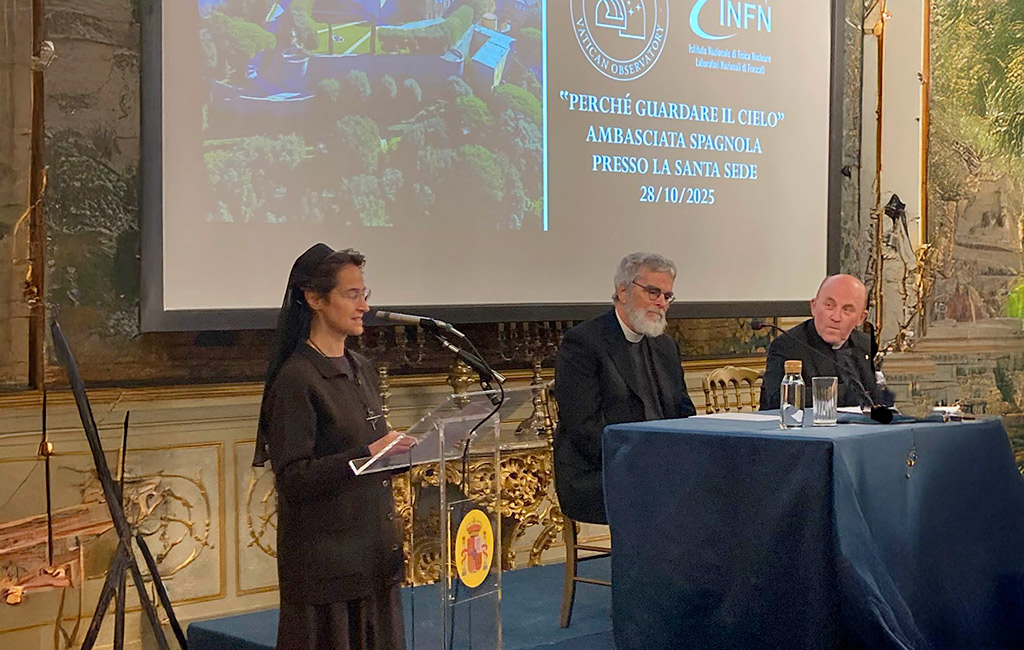
“Why do you stand looking at the sky?” (Acts 1:11). This was the theme of the conference held on Tuesday afternoon, 28 October, at the Embassy of Spain to the Holy See in Rome.
The event, organized by H.E. the Ambassador of Spain to the Holy See, Mrs. Isabel Celaá, was attended by Sr. Raffaella Petrini, President of the Governorate of Vatican City State, the Jesuits Fr. Gabriele Gionti, Deputy Director of the Vatican Observatory and Br. Guy Consolmagno, former Director, Fr. Richard D’Souza, the new Director, and several confreres from the Jesuit community of Castel Gandolfo.
Below is the speech delivered in Spanish by the President of the Governorate:
I warmly greet the Ambassador of Spain to the Holy See, Her Excellency Mrs. María Isabel Celaá Diéguez, and together with her the entire Diplomatic Delegation. I thank you for your welcome and for your interest in the Governorate of Vatican City State. I also greet Father Richard Anthony D’Souza and Brother Guy Consolmagno, Director and Director Emeritus respectively of the Vatican Observatory, and Father Gabriele Gionti, its Deputy Director.
Allow me to briefly outline the role of the Vatican Observatory and its importance as the Pope’s astronomical observatory. It is a scientific research institute that depends directly on the Governorate of Vatican City State.
It can be considered one of the oldest astronomical observatories in the world. It was Pope Gregory XIII who had it established in the Vatican in 1578, precisely in the Tower of the Winds inside the Vatican, and invited the Jesuit astronomers and mathematicians of the Roman College to prepare the reform of the calendar promulgated in 1582. Throughout the centuries, the Holy See has consistently shown interest in and support for astronomical research. On 14 March 1891, Pope Leo XIII founded the Observatory on the Vatican hill behind St. Peter’s Basilica. His intention was to counter persistent accusations that the Church was opposed to scientific progress.
With directors and staff provided by various religious orders—Barnabites, Oratorians, Augustinians, and Jesuits—the Observatory worked at the Vatican for a little over 40 years, focusing mainly on implementing, together with other observatories, the great international program of the Photographic Map of the Sky. In 1910, Pope St. Pius X assigned to the Observatory the villa that Leo XIII had built in the Vatican Gardens and appointed the Jesuit Father G. Hagen as Director.
In the 1930s, due to the increase in electric lighting, the sky over Rome was no longer suitable for astronomical observation. Thus, Pius XI arranged for the Observatory to be moved to his summer residence in Castel Gandolfo, in the Alban Hills. Around 1935, it was refounded and entrusted to the Jesuits as a modern observatory with three new telescopes and an astrophysics laboratory for spectrochemical analysis.
In 1957, with the installation of a large-field Schmidt-type telescope and the addition of a modern computing center, research could be extended to new areas, such as the development of new techniques for classifying stars by their spectra—research that continues at the Observatory today.
Later, even the sky above Castel Gandolfo became less suitable for observing the stars. Thus, in 1981, the Observatory founded a second research center, the Vatican Observatory Research Group (VORG), in Tucson, Arizona, in the United States.
In this way, Vatican astronomers have their offices at the Steward Observatory of the University of Arizona and, on the basis of full equality in the review of their observatory proposals, can access all modern telescopes located in the area.
In the late 1980s, the Vatican Observatory took a bold step: it decided to build and maintain an advanced-technology telescope. In 1993, the Observatory, in collaboration with the Steward Observatory, completed the construction of the Vatican Advanced Technology Telescope (VATT), the first optical-infrared telescope of its kind, located on Mount Graham (Arizona), deemed the best astronomical site in North America.
Thus, from its two centers, Castel Gandolfo and Tucson, the Vatican Observatory continues its studies. The Observatory conducts programs in collaboration with many astronomical institutes in other countries, such as Argentina, Brazil, Canada, Chile, Finland, Italy, Lithuania, South Africa, and the United States of America, and is a member of the International Astronomical Union (IAU) and the International Center for Relativistic Astrophysics (ICRA).
In Castel Gandolfo, the Library, with about 22,000 volumes, holds a valuable collection of ancient books, including works by Copernicus, Galileo, Newton, Kepler, Brahe, Clavius, and Secchi; it also houses an important collection of meteorites, valuable for the information they provide about the origins of the solar system.
The Observatory is funded annually by the Governorate of Vatican City State; however, for the implementation of specific programs such as the VATT, it relies on the help of friends and benefactors and for this purpose the “Vatican Observatory Foundation” (VOF) was established in the State of Arizona. The VOF is a nonprofit organization created to support the scientific and educational efforts of the Vatican Observatory, including the maintenance and modernization of the Vatican Advanced Technology Telescope (VATT).
Through fundraising initiatives and educational outreach activities such as trips, newsletters, and seminars, the Foundation offers the general public a way to learn about the Vatican Observatory and participate actively in its mission. While funding for salaries and administrative expenses of the Vatican Observatory comes directly from the Governorate, funding for the telescope and educational initiatives comes from the generous support of Vatican benefactors.
Today, the Foundation is the main source of funding for the Vatican Observatory’s world-renowned Summer Schools, created in 1986 and held every two years at the Observatory’s headquarters in Castel Gandolfo. There, 25 students from around the world, most from developing countries, immerse themselves in four weeks of intensive study on aspects of astrophysics taught by global experts.
Since the first edition, more than 450 students have attended these summer schools. They are open to master’s and doctoral students worldwide. Economic circumstances are not taken into account in the selection process, as there is no registration fee and additional financial support for travel and lodging is provided by benefactors through the Vatican Observatory Foundation. In this way, all admitted students are guaranteed the opportunity to participate. More than 85% of VOSS alumni continue to work as professional astronomers, including some of the most important figures in contemporary astronomy.
This is the reality of the Vatican Observatory, at the service of faith, of science, and under the patronage of the Pope. It owes much to the Society of Jesus, which throughout the centuries has offered its best scientists and religious, such as Brother Consolmagno and all the Directors who have succeeded one another.
Thank you all.