

The President of the Governorate gives a Lecture for Inauguration of the 2025–2026 Academic Year at the University of Tor Vergata in Rome

The Managerial Approach of Care
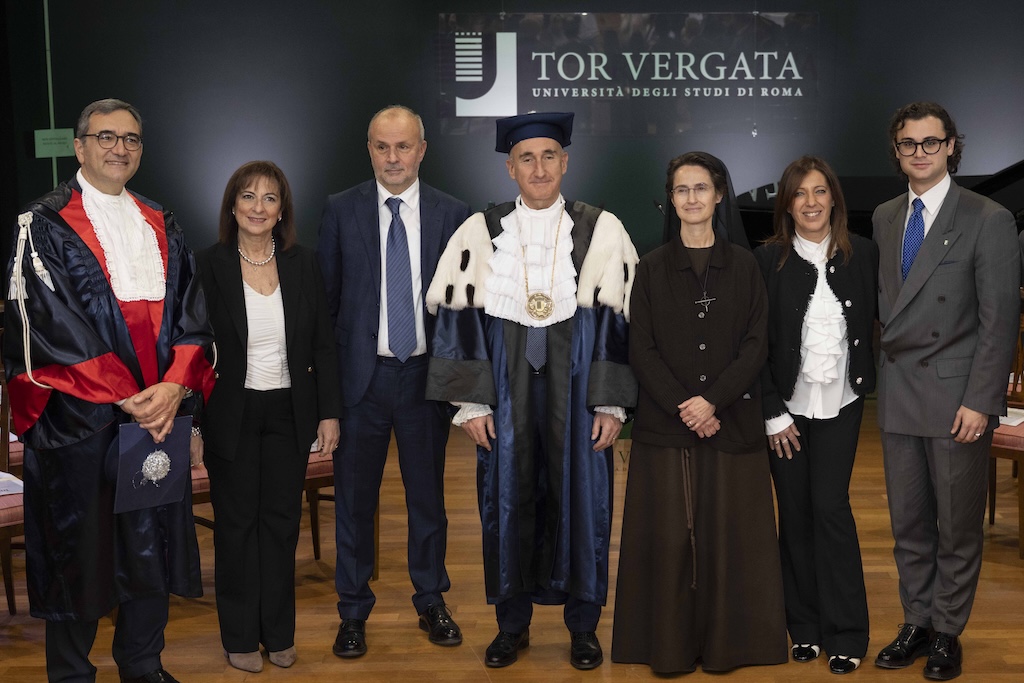
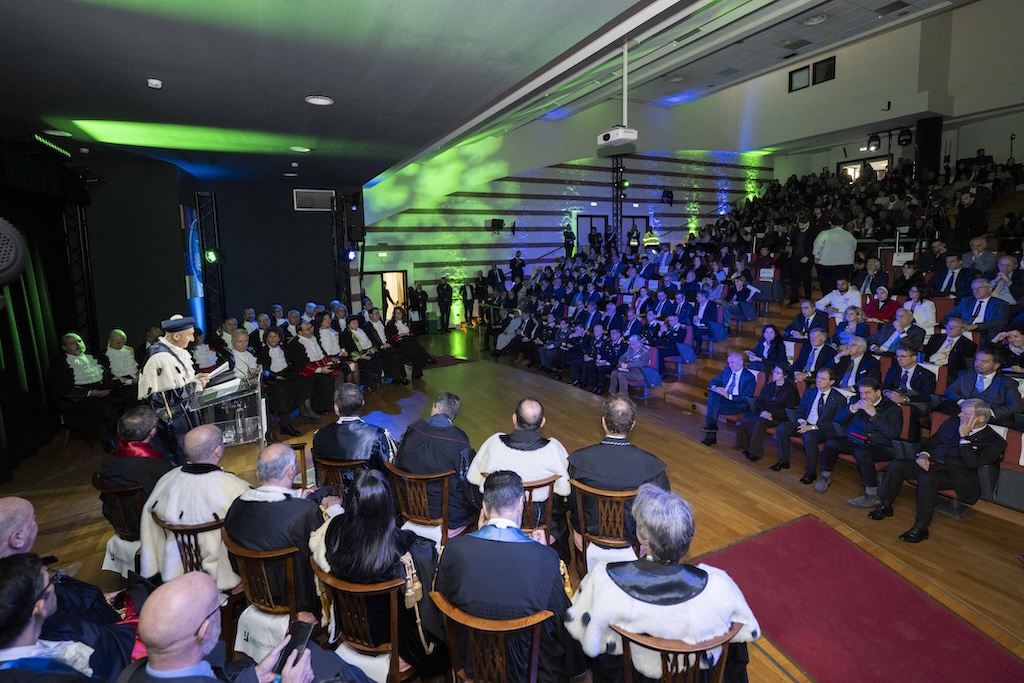
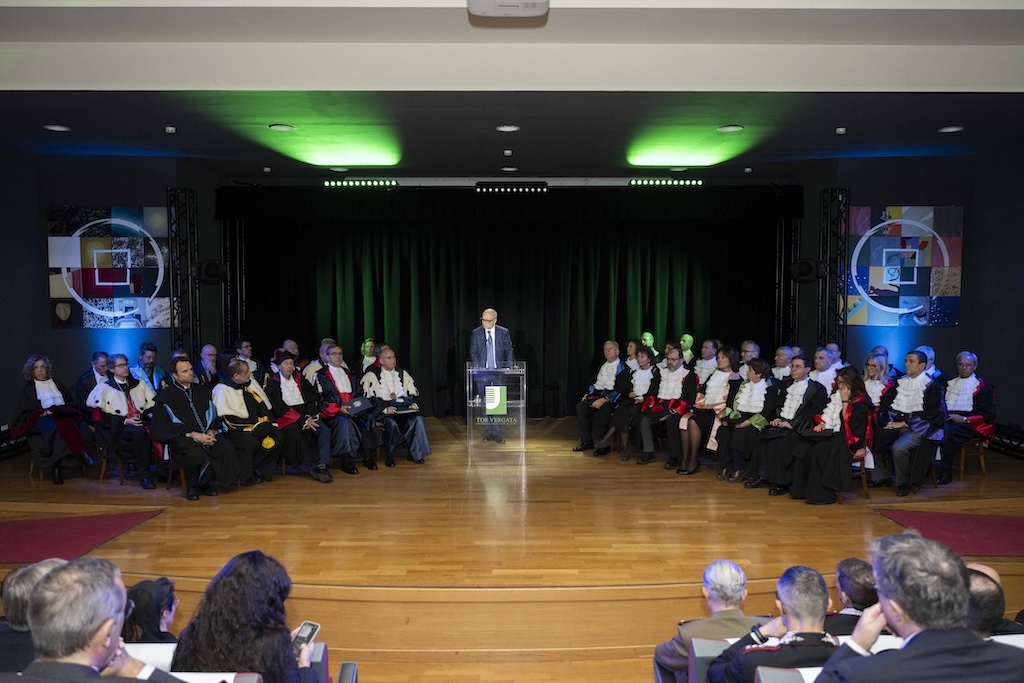
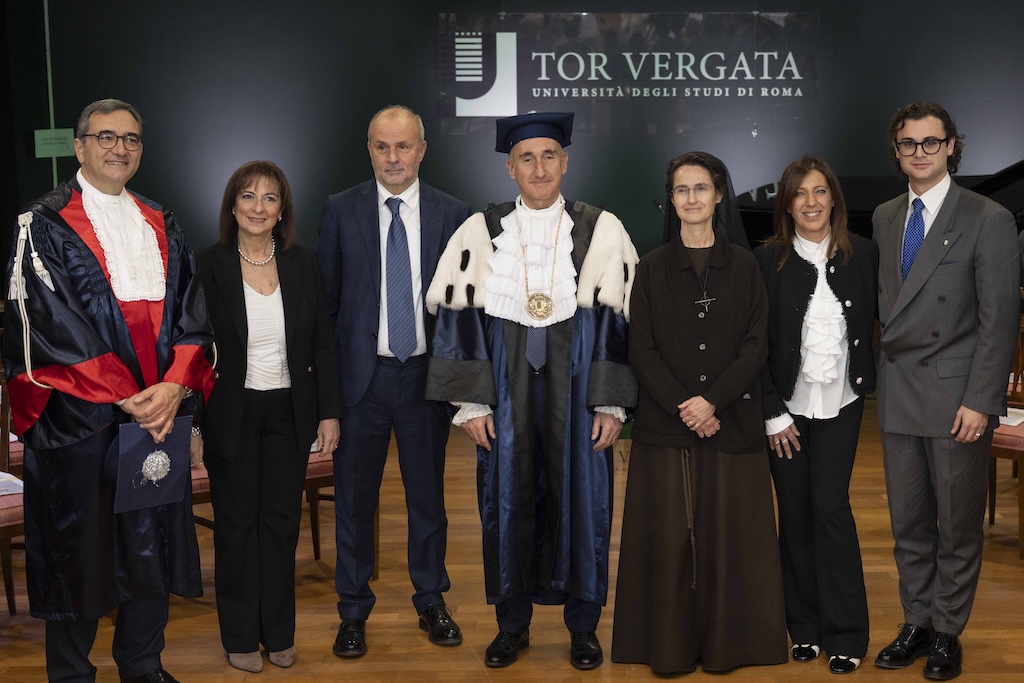
A management model inspired by humanism requires “the contribution of leaders capable of building relationships of trust, showing interest in people’s personal stories and circumstances, and willing to accompany their collaborators through the inevitable challenges that every organization faces.” With these words, Sr. Raffaella Petrini, President of the Governorate of Vatican City State, delivered the Lectio Magistralis for the inauguration of the 43rd academic year of the University of Tor Vergata in Rome. The ceremony took place on Friday, 21 November, in the Ennio Morricone Auditorium of the School of Humanities and Philosophy.
The President went on to define this approach as a form of “managerial care,” understood both as a virtue and as a method capable of generating value on an ethical level as well, thanks to relationships of reciprocity that strengthen the shared mission of an organization.
In recognition of her role and her contribution, the University awarded Sr. Petrini a Certificate of Merit and the University Medal.
Speakers included, among others, the Minister of Health, Orazio Schillaci, and the Rector, Professor Nathan Levialdi Ghiron, who opened the event with his inaugural address.
The Rector recalled: “In an age marked by rapid acceleration and fragility, the university represents one of the institutional spaces in which the present can be understood and the future can be prepared with seriousness and foresight.” The theme of the day, “A future to be shaped within the space of the community,” underscored the value of knowledge as a lever for building a shared future, based on co-responsibility and collective commitment.
The Minister of Health, Orazio Schillaci, highlighted his deep connection with the University, saying: “Investing in knowledge is always an investment in the health of society. Every laboratory, every clinical department, every classroom of this University is a space where the future of the Nation is being built: the future of a healthcare system that is more equitable, more innovative, and closer to people’s needs.”
The ceremony opened with the academic procession, made up of rectors from seventeen Italian universities, followed by a performance of the University’s Gospel Choir, directed by Maestro Alberto Annarilli.
The gathering concluded with the solemn proclamation of the opening of the new academic year, delivered by Rector Levialdi Ghiron, who renewed the University’s commitment to promoting knowledge as a common good and to continuing to build—together with its community—a future open to dialogue, shared responsibility, and active participation.
Magistral Lecture of the President of the Governorate:
Lectio Magistralis
I extend my warm greetings and heartfelt thanks to the Rector of this University for the invitation, of which I am honored and gladly accepted; I greet the Minister of Health, Prof. Orazio Schillaci, and the other Authorities present; I greet the many distinguished Rectors, the esteemed faculty members, and the administrative staff; lastly, a special greeting to all the students taking part in this important inauguration today.
- Introduction
On 15 May 1891, in a Europe marked by the tensions of the Industrial Revolution and the mechanization of production processes, Pope Leo XIII published the first social encyclical, Rerum Novarum—On New Things—the Magna Charta of Catholic social teaching, which formally marks its beginning and would radically change the relationship between the Church and society[1].
The Pope, in fact, while reaffirming his predecessors’ concerns about certain aspects and developments of modernity, clearly expressed his desire to deepen and clarify the meaning and implications of the so-called “social question,” wishing to present the image of “a Church willing to serve the world,”[2] more open to dialogue with the political, social and economic realities of its time.
It was already evident, moreover, that industrialization risked placing the human person at the service of the market. Entire populations had moved from the countryside to the cities, causing the rapid and disproportionate expansion of peripheral urban areas, often lacking basic services. Faced with this difficult reality, a diverse charitable movement began to develop, thanks to the commitment of clergy, religious, and lay people—not focused on class-based social redemption, but rather on the direct care of individuals.
- The Evolution of the “Social Question”
If the “social question” erupted as a result of the transformations at the end of the 19th century in production processes and labor organization, it evolved over time, shaped by the profound cultural and socio-political changes that characterized the following century.
The most recent phase of this evolution (from 1978 to today) is marked by deep cultural shifts in the understanding of the human person. The “social question” is no longer merely quantitative, but directly concerns the quality of life. Imbalances significantly affect people’s existence, as well as fundamental freedoms and human rights. As Pope Benedict XVI clearly affirmed in the social encyclical Caritas in Veritate, today “the social question has become a radically anthropological question,” especially given the ways in which human life can be manipulated or transformed by technology.[3] The renewed emphasis on the anthropological nature of the “social question” draws attention to the deeper meaning of human development. Taking as a starting point Pope Paul VI’s well-known definition of “full” and “authentic” development as development “of each person and of the whole person,”[4] Pope Benedict XVI reiterated that such development “concerns the whole of the person in every single dimension,”[5] for development is truly multidimensional: personal and social, spiritual and bodily, historical and transcendent.[6]
Integral development therefore includes the socio-relational and spiritual dimensions of human existence—more difficult to quantify, yet closely linked to the “higher needs” identified by Abraham Maslow.[7] Within any organization, a model of leadership that intends to contribute to this type of development must safeguard all these dimensions, because beyond structures, the first capital to be preserved and valued remains the human person in his or her integrity.[8]
This is even more true within educational institutions, where academic and cultural formation should offer those who learn, those who teach, and those who work there “a vital space that embraces life and speaks to life”[9] — a place of encounter and interaction dedicated to dialogue among persons and among disciplines.
- The Care of Relationships
Within this trajectory of development, immediately upon his election to the papacy, Pope Leo XIV, in explaining his choice of name inspired by the illustrious predecessor, reaffirmed the importance of the heritage of Catholic social doctrine in responding to the challenges posed by the “new industrial revolution” to human dignity, justice, and labor.[10]
“Artificial intelligence, biotechnology, the data economy, and social media are profoundly transforming our perception and experience of life,” the new Pontiff observes—“In this scenario human dignity risks being diminished or forgotten, substituted by functions, automatisms, simulations. But the person is not a system of algorithms: he or she is a creature, relationship, mystery.”[11] Hence his call for a renewed reflection on the humanum, “in its corporeality, its vulnerability, its thirst for the infinite, and its capacity for relationship,”[12] so that ethics may not become disembodied. The person returns to the center, especially here—where we gather today—because no one educates alone, and the educating community is “a ‘we’ in which all involved agents, including civil society, converge to generate life.”[13]
The centrality of the person, in his essentially relational nature, was highlighted by Pope Leo XIV precisely here at Tor Vergata, when he reminded young people that “human relationships—our relationships with others—are indispensable for each of us … Our life begins thanks to a bond, and it is through bonds that we grow.”[14] The care of relationships belongs as much to the private sphere of individuals as to the social and professional spheres. Attention to the other is a foundational principle even in the management of complex organizations. Indeed, modern leadership recognizes a profound paradigm shift, attributing greater operational effectiveness to leaders who are oriented not only toward guiding but also toward serving their collaborators. The practical focus of management shifts from traditional shareholder-value maximization to the ability to improve the quality of life of collaborators—physically, emotionally, and cognitively.[15]
- The Priority of Human Capital
It should be noted that the Christian virtue of hope, which we celebrate in this Jubilee Year, also manifests itself in the lives of individuals within organizational structures that mediate their interaction with the surrounding environment, because the human being is needy by nature and requires tools, systems, and above all other people in order to meet his needs.[16] In this way, hope becomes performative[17]: it regenerates and concretely transforms existence, guiding reason and free will in a shared search for happiness.
In the face of cultural fragmentation and polarizing logics of closure—which foster mistrust and impoverish society—hope contrasts with disenchantment and draws from the “reserves of good that exist in the hearts of people, despite everything.”[18] In this sense, especially in the educational sphere, management strategies grounded in the humanum have the potential to unleash renewed relational, intellectual, and spiritual energies, deriving their strength precisely from these “reserves.”
Structures able to organize themselves according to principles of valuing and caring for their human capital will in turn be better prepared to welcome those they are called to serve. This vision, strengthened by the ability to foster relationships of trust, encourages us “to think and act in terms of community,”[19] so as to feel “co-responsible for improving the world.”[20]
Within this perspective, the academic context—both a place of study and work—becomes the primary environment in which to cultivate “social friendship,”[21] grounded in the ability to value everyone’s contribution, even in diversity, toward the pursuit of the common good.
Leaders are called to prepare the ground so that people may grow in awareness of their own limitations, remain open to others who help us grow and enrich us at every age, and cultivate “hearts that allow themselves to be complemented.”[22] This is especially relevant here, where the dialogue between persons and between disciplines becomes a privileged instrument for integral human development.
Furthermore, the purpose of education is always the building of a community—not one shaped to satisfy individual needs, but one that provides space for defining common goals.[23] In this sense, educational activity becomes an essential instrument of integration; it reaches its ultimate aim when it forms people capable of walking together, understanding and respecting one another, attentive to the most vulnerable, to those who struggle to keep pace.[24]
In an educational context, Pope Leo XIV states, one must not “raise the banner of possessing the truth—neither in the analysis of problems nor in their resolution”; rather, it is more important “to know how to draw near,” learning to face complex and ever-changing challenges together.[25] This kind of human and academic formation is a force for peace, helping to heal fractures and bridge cultural and generational divides.
The application of a “humanistic” leadership style within organizations[26] —including educational ones—fosters an ethic, or attitude, of caring for people and things, which we are called to manage rather than possess.[27] It is an attitude rooted in the Christian principle of mutual dependence, as well as in the awareness that throughout our lives, all of us—without exception—are both subjects (active) and objects (passive) of care.
Practices of hope in organizations are therefore those enacted by “humanistic” managers—attentive not only to professional tools, techniques and results but also sensitive to the care of their collaborators. These are managers who prove to be experts “in humanity,” ready to respond to the natural human need for esteem and recognition.[28]
Without minimizing the importance of professional competencies—hard skills—which are taught and learned here, it is important to renew the emphasis on human, moral, and character-based qualities—soft skills—which are essential for advancing the paradigm shift described earlier.
Understanding and empathy are now recognized as key factors in effective management, as they enable leaders to alleviate stress levels among their teams. This is even more necessary in light of the negative effects that “incivility and lack of kindness” can produce in interactions, including professional ones.[29] Research confirms how significantly these factors influence people’s well-being.
Traditional aspects of care within organizations include precisely the willingness to see the needs of others and to assume responsibility for trying to meet them—promoting an atmosphere of calm and mutual respect.[30]
A “humanistic” management model requires leaders capable of building relationships of trust, showing interest in personal stories, and accompanying collaborators through the inevitable difficulties every organization experiences.[31] This is the form of management that I like to define as “the management of care,”[32] understood as both practice and virtue—aimed at generating value within an organization, including moral value, by fostering relationships of reciprocity that strengthen its shared mission.[33]
- Concluding Reflections
The primacy of care in the management of complex organizations—including educational ones—shapes a model of management that is centered on the human person, attentive first and foremost to respecting the dignity of human nature, both bodily and spiritual, and also oriented toward improving quality of life in the professional and formative contexts.[34] A management model based on service and multidisciplinarity, on the care of people and things, on cultivating relationships of reciprocity, and on supporting the integral development of human capital[35] can serve as an ethical benchmark even within academia, as a tool for responding to the challenges posed by the new “social question.”
The practice of care in management, lived also as a practice of the virtue of hope that marks this Jubilee Year, fulfills the common human aspiration for happiness—an aspiration that nourishes the desires of the heart and inspires human activity, directing it toward a higher good and sustaining it against discouragement.[36] For educators, it is a practice that also prevents the risk of falling into a “soulless rationalism,” [37] shaped by technocratic culture, and instead cultivates the ability to think and reflect on the reality of human existence in its fullness. It is an essentially communal practice, animated by the shared commitment to form persons —above all through example—willing to cultivate fraternity, to allow solidarity to prevail over competition, to protect the weakest, to build bridges and reconcile differences, to coexist peacefully with diversity[38] —in short, to feel themselves members of a single human family.
In this way, the University embodies its “great mission” of expanding the boundaries of knowledge, becoming “an open space for humanity and for society,”[39] where truth is sought together, freedom is exercised through responsible engagement, and authority is expressed in service.[40]
On these foundations, as the current Pontiff encourages us to reflect, the value of education is not measured solely in terms of efficiency, but in its respect for human dignity and its capacity to pursue the common good.[41]
Faced with the new “social question,” the practice of care in management ultimately aims to “humanize education”[42] —not only through the acquisition of competencies, study and scientific research, but also by drawing from the richness of our shared humanity, through the exchange of the talents and the vulnerabilities that each of us carries.
[1] W. McCormick S.J., Before «Rerum Novarum»: five social encyclicals by Pope Leo XIII, «Civiltà Cattolica», 3 (2025) 183.
[2] Ibid, 184.
[3] BENEDICT XVI, Caritas in Veritate, Vatican City 2009, 75, original italics.
In the social encyclical Laudato si’ (2015), Pope Francis speaks of the greatest threat posed by the “technocratic paradigm” (nn. 106–114). Technology and its rapid development have become an “undifferentiated and one-dimensional paradigm” that leads human beings to try to extract everything possible from things, while frequently ignoring or forgetting the reality before them. The “technocratic paradigm” exalts the idea of a subject who takes control and has the ability to manipulate another external object, transforming it through the use of technical, logical, and rational procedures. In Laudate Deum (2023), the Pope warns against adopting “the idea of a human being without limits,” whose capacities can be expanded infinitely through technology (21).
[4] PAUL VI, Populorum progressio, 14.
[5] Benedict XVI, op. cit., 29.
[6] Pontifical Council for Justice and Peace, Compendium of the Social Doctrine of the Church, 2004, 38.
[7] Here it refers to the well-known hierarchy of needs proposed by the American psychologist Abraham Maslow in his 1943 article A Theory of Human Motivation, published in Psychological Review, no. 50, pp. 370–396.
[8] Cfr. Benedict XVI, op. cit., 25.
[9] Francis, Meeting with University Professors, Apostolic Journey to Luxembourg and Belgium, 27 September 2024.
[10] Leo XIV, Speech to the College of Cardinals, 10 May 2025.
[11] Id., Speech to Italian Bishops, 17 June 2025.
[12] Ibid.
[13] Leo XIV, Apostolic Letter Drawing New Maps of Hope, LEV, Vatican City 2025, 3.1.
[14] ID., Prayer Vigil, Jubilee of Young People, Tor Vergata, 2 August 2025.
[15] Cfr. McKinsey & Company, What is leadership?, in www.mckinsey.com/featured-insights/mckinsey-explainers/what-is-leadership#/ (visto il 28 dicembre 2024); T. Allas – B. Schaninger, The boss factor: Making the world a better place through workplace relationships, in www.mckinsey.com/capabilities/people-and-organizational-performance/our-insights/the-boss-factor-making-the-world-a-better-place-through-workplace-relationships (visto il 29 dicembre 2024).
[16] Cfr. R. Petrini – A. Sacco, Arricchirsi, La Cittadella, Assisi 2024, 17.
[17] Cfr. Benedict XVI, Encyclical Letter Spe Salvi, LEV, Vatican City 2007, 2.
[18] Francis, Lettera Encyclical Letter Fratelli tutti, LEV, Vatican City 2020, 196.
[19] Ibid, 116
[20] Ibid, 162
[21] Ibid, 99
[22] Ibid, 89
[23] Leo IV, Apostolic Letter Tracing New Maps of Hope, op. cit., 3.1; cf. Francis, Meeting with university students at the Université Catholique de Louvain, 28 September 2024.
[24] Leo XIV, Apostolic Letter Drawing New Maps of Hope, LEV, Vatican City 2025, 3.1
[25] Ibid, 4.3
[26] L. Bruni, Il mercato e il dono, Egea, Milano 2015, 50-56; cfr. anche D. Melé, Understanding Humanistic Management, «The Humanistic Management Journal» 1 (2016) 33-55.
[27] It is with reference to this orientation, in particular, that Pope Francis’s Motu Proprio Il Diritto Nativo, issued on 20 February 2023 concerning the patrimony of the Apostolic See, states that “the universal destination of the goods of the Holy See gives them an ecclesiastical public character. The entities of the Holy See acquire and use them not for themselves, like a private owner, but in the name and by the authority of the Roman Pontiff, for the pursuit of their institutional aims—also public—and therefore for the common good and in service to the Universal Church.”
[28] L. Bruni, Il mercato e il dono, 43; cfr. D. Melé, Human Quality Treatment: Five Organizational Levels, «Journal of Business Ethics» 120 (2014) 457–471; G. Manzone, Teologia Morale Economica, Queriniana, Brescia 2016, 311-320.
[29] Cf. C. Porath, The Price of Incivility, “Harvard Business Review” 91 (2013) 114–121; see also T. Brower, Empathy Is The Most Important Leadership Skill According To Research, “Forbes”, 19 September 2021; I. De Vivo – D. Lumera, Biologia della gentilezza, Mondadori, Milan 2021, 23–37.
[30] Cf. V. Held, The Ethics of Care: Personal, Political, and Global, 649–682; S. BROTTO, Etica della cura, 69–71; M. HAMINGTON – M. SANDER-STAUDT, Introduction: Care Ethics and Business Ethics, in ID. (eds.), Applying Care Ethics to Business, 221.
[31] Cf. L. Bruni, Il mercato e il dono, op. cit., 63.
[32] Cf. R. Petrini, Integral Human Development Through a Leadership of Care, Terrence R. Keeley Vatican Lecture, Nanovic Institute for European Studies, University of Notre Dame, South Bend, 1 November 2023; see also R. PETRINI, Il protagonismo delle donne per il futuro della Chiesa, X Course of Specialization in Religious Information, Pontifical University of the Holy Cross, Rome, 8 March 2023.
[33] Cf. V. Held, The Ethics of Care: Personal, Political, and Global, Oxford University Press [digital ed.], New York 2006, 649; T. F. HAWK, An Ethic of Care: A Relational Ethic for the Relational Characteristics of Organizations, in M. HAMINGTON – M. SANDER-STAUDT (eds.), Applying Care Ethics to Business, Springer [digital ed.], New York 2011, 609–629; S. BROTTO, Etica della cura, Orthotes, Naples 2013, 69; I. UNGVÁRI ZRÍNYI, Authentic Human Relations and the Economy, in O. SETTER – L. ZSOLNAI (eds.), Caring Management in the New Economy, Palgrave Macmillan, Cham 2019, 51–60; H. R. YOUNGER, The Art of Caring Leadership, Berrett-Koehler Publishers Inc. [digital ed.], Oakland 2021, 1478–1605.
[34] Cf. B. SORGE, Introduzione alla Dottrina Sociale della Chiesa, 82–87.
[35] The Polish sociologist Zygmunt Bauman (1925–2017) stated that the central dilemma of human freedom in modern civilization is the alternative choice between competition and solidarity (cf. Z. BAUMAN – C. GIACCARDI – M. MAGATTI, Il destino della libertà, Città Nuova, Rome 2016, 37). If competition leads people to advance their own positions by imposing their needs and interests on others, solidarity presupposes that men and women can live together collaboratively and all be happier
[36] Cf. Ibid., 1818.
[37] Francis, Meeting with University Professors, Apostolic Journey to Luxembourg and Belgium, 27 September 2024, original italics.
[38] Leo XIV, Jubilee Audience, 25 October 2025.
[39] Francis, Meeting with University Professors, op. cit.
[40] Cf. Leo IV, Apostolic Letter Disegnare nuove mappe di speranza, op. cit., 4.3.
[41] Ibid
[42] Francis, Address to Participants in the Plenary Session of the Congregation for Catholic Education, 9 February 2017.