

The Nativity Scenes Set Up at the Governorate


Jesus is born amid the flora of the Vatican Gardens
Before drones crossed the sky—when only the stars guided travelers along their way—Jesus was born in Bethlehem. The Prince of Peace came into the world in silence, humility and unknown.
So that this event might not remain merely a memory but continue as a decisive moment in human history, from 1223 onward—since Saint Francis of Assisi enlisted the inhabitants of Greccio to create the first representation of the Nativity—the Christian tradition has prepared Nativity scenes in celebration of Christmas.
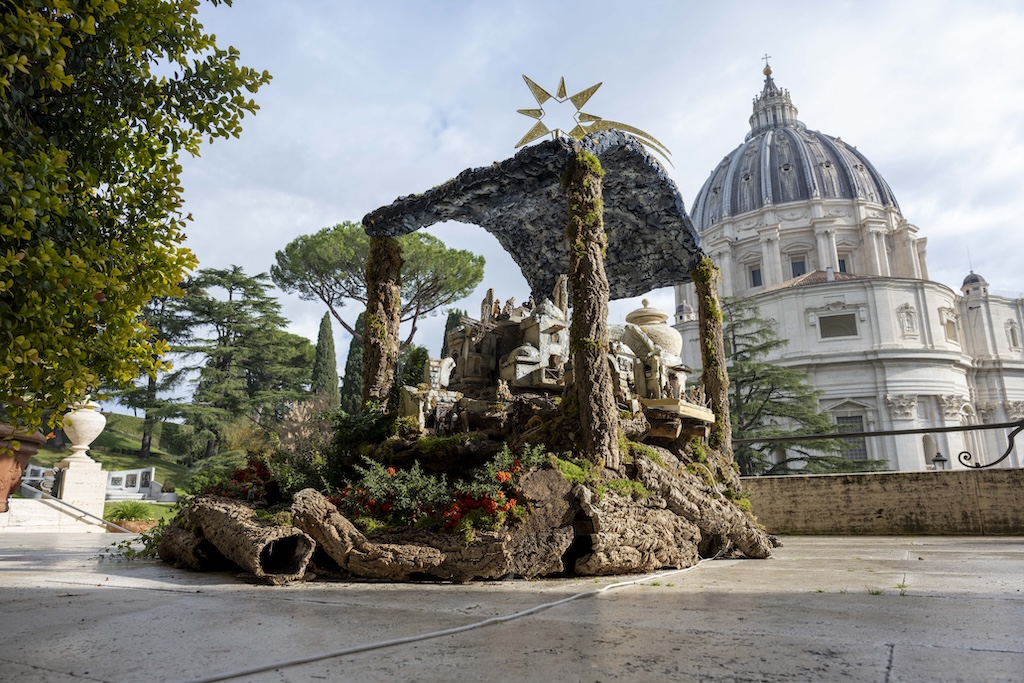
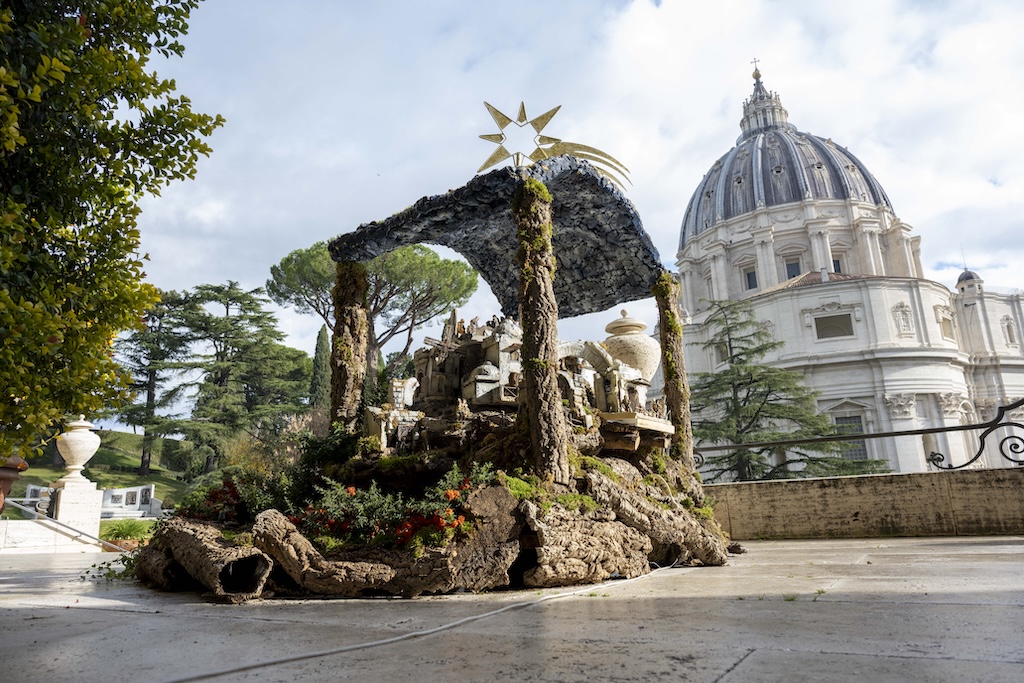
Just as in the Sacred Valley of Rieti, surrounded by the peaks of the Apennines, green hills, and abundant streams, so too in the Vatican Gardens and throughout the Vatican State, the lush vegetation and diverse environments become settings for displaying Nativity scenes. Indeed, the intent of the creators—Augusto Minosse, Fabio Frezza, and Vincenzo Caputo of the Gardens and Environment Service of the Directorate of Infrastructure and Services, with the collaboration of the Electrical Laboratory staff—was to reproduce, on a small scale within the Nativity, part of the flora found in the Vatican Gardens. The variety of plants and flowers thus becomes an invitation to respect creation, to delight in the beauty of nature, as a hymn to the Creator. It also recalls the eighth centenary of the composition of the Canticle of the Sun by Saint Francis of Assisi, who, in the spring of 1225—some months after the experience on Mount La Verna—spent fifty days at the monastery of San Damiano, home to Saint Clare and her Sisters. In a night of grace and suffering, Saint Francis composed the famous hymn of praise and thanksgiving to God.
Plants such as Buxus pumila, pyracantha, lily of the valley, pittosporum, Helichrysum italicum, Myrsine africana, Chamaecyparis, ivy, lichen, and moss form the backdrop to the Nativity. All are set upon a cork trunk, while once again the Holy Door stands open to recall the ongoing Jubilee, which will conclude on 6 January 2026, the Feast of the Epiphany of the Lord.
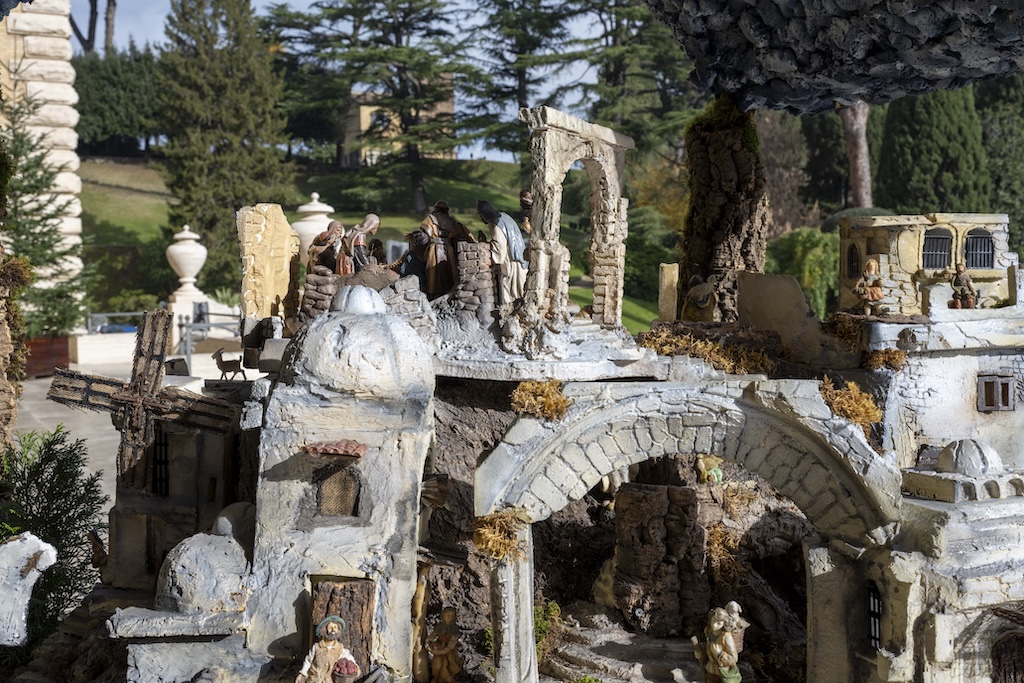
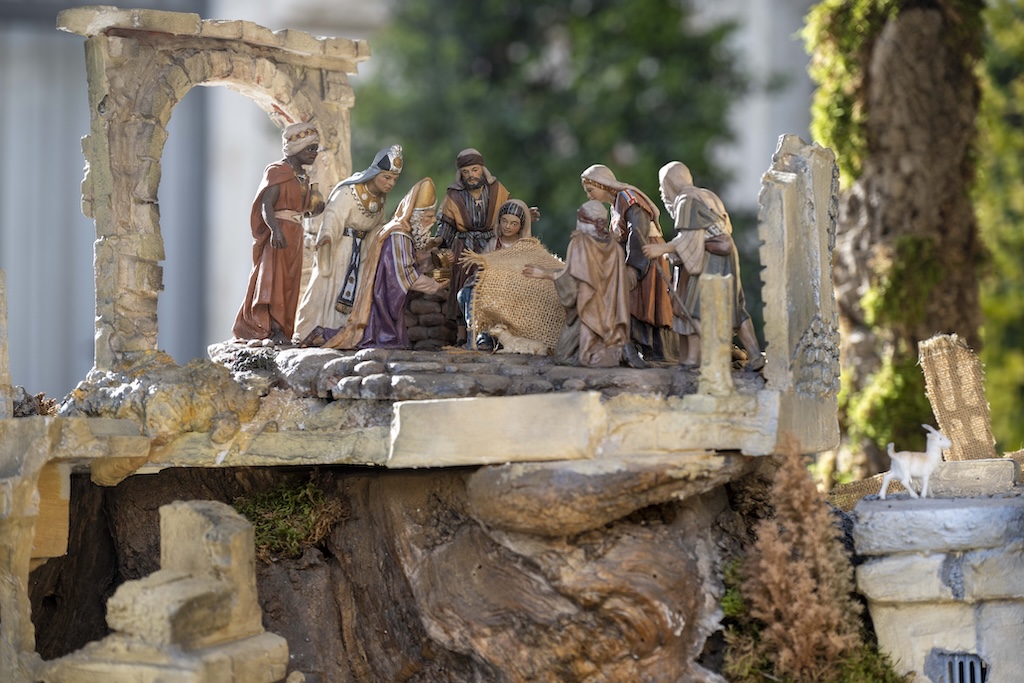
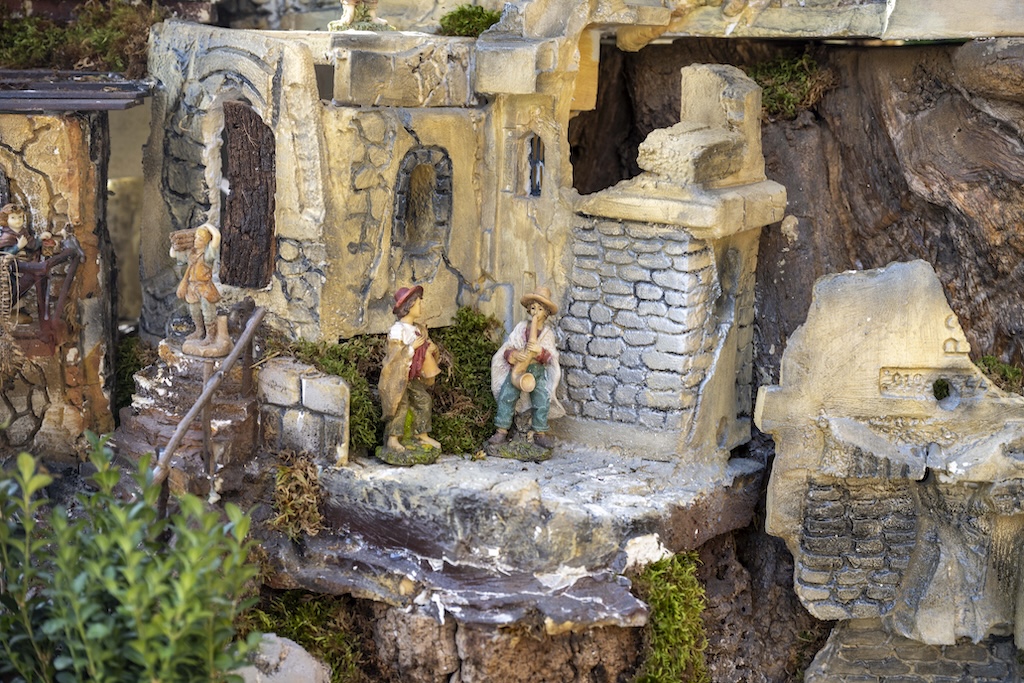
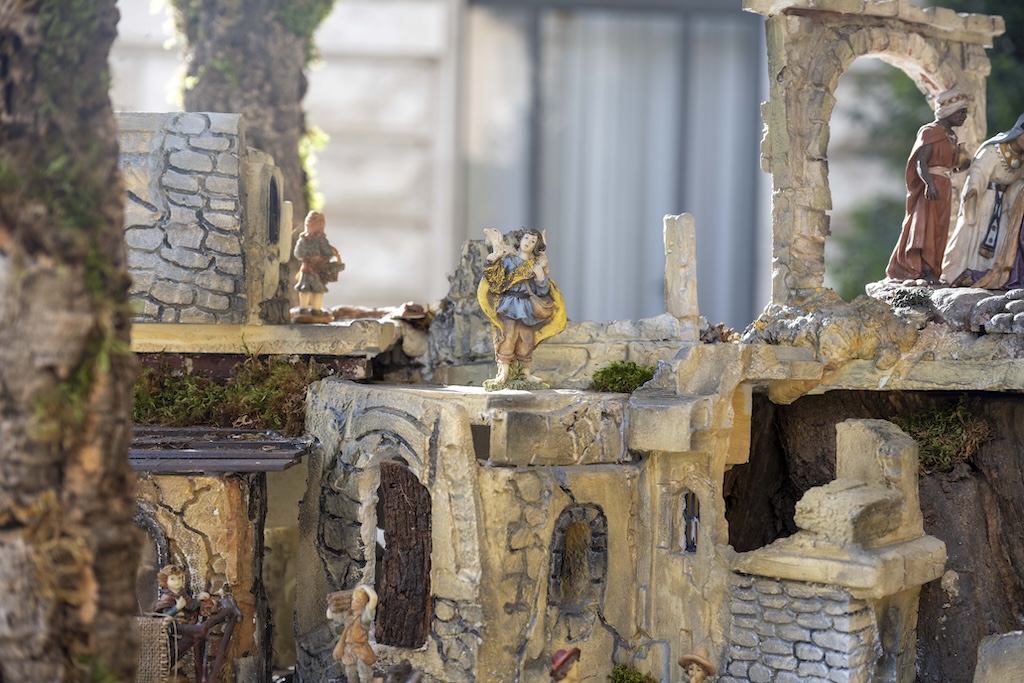
The Nativity scene is constructed so that it is complete from any vantage point—truly a 360-degree display. It rises on an elevated hill, at the top of which lies the central scene with the Child, Mary, Joseph, surrounded by shepherds and the Magi, adorned in their magnificent garments and bearing their traditional gifts. Above the structure is a large star that turns with the direction of the wind. It shows those far away the place where Jesus was born. It points Him out to many people immersed in the passing of their daily lives, busy with their tasks. Some figures are eyewitnesses to the Savior’s birth. Others remain distant, on the sidelines—at times indifferent, at times unaware. But Jesus was born for them as well. This is expressed in the place where He lies in the manger: elevated above everything else, open—indeed wide open—with no roof for shelter. Only to the side can one glimpse a stone arch and some remnants of a wall. There is no roof because there are no barriers to God’s grace; it reaches all creatures. The arch symbolizes Christ, the Gate through which one enters Heaven, and the ruined wall symbolizes the fragility of human things, which only in the Savior can find hope and eternity.
He who cannot be contained by the universe, who is outside of time and immortal, stoops down to become a creature. Saint Augustine emphasizes this when he writes:
“He lies in a manger, yet contains the whole universe; He nurses at a breast, yet is the bread of angels; He is wrapped in swaddling cloths, yet clothes us with everlasting life; He is fed, yet is adored; He finds no shelter in an inn, yet builds a temple in the hearts of His faithful.” (Sermon 190, 4).
This is the meaning of Christ’s birth atop a hill without shelter: His redemption is universal. He came to save the lost and to call disciples, making them fishers of men. Hence the fishing nets, recalling Peter and Andrew, and also the shepherds with their flocks, symbol of the Good Shepherd who lays down His life for His sheep.
Not only does the flora of the Vatican Gardens play a central role in the Nativity scene, but particular attention has also been given to recycling and conservation, using leftover packaging materials and cardboard recovered from the ecological depot.
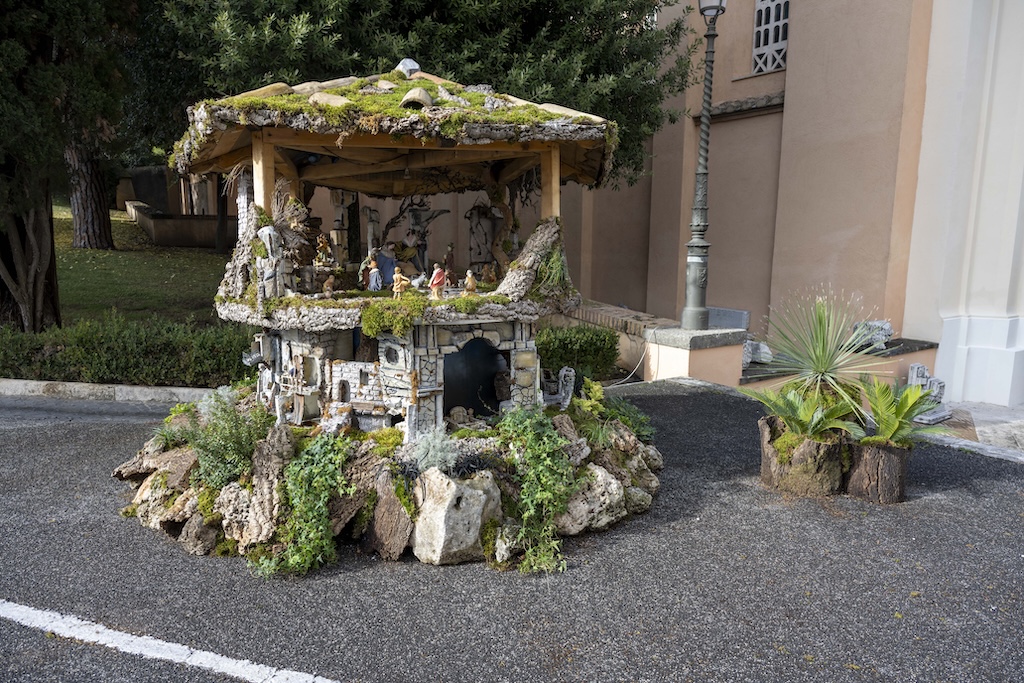
Another Nativity scene adorning the streets of the State is the one set up in Piazza Santa Marta, in front of the Church of Santo Stefano degli Abissini. It is built atop a telephone-cable spool. At its base are cork-wood logs and various plants—the same ones used in the Nativity at the Governorate building—plus euonymus and Cycas revoluta.
A tree trunk from the forests of the Vatican Gardens—wood otherwise destined for disposal—supports the scene where the Child, Mary, and Joseph are placed. The Holy Family is sheltered beneath a wooden truss roof covered with tiles. Everything is made from recycled materials salvaged from construction platforms.
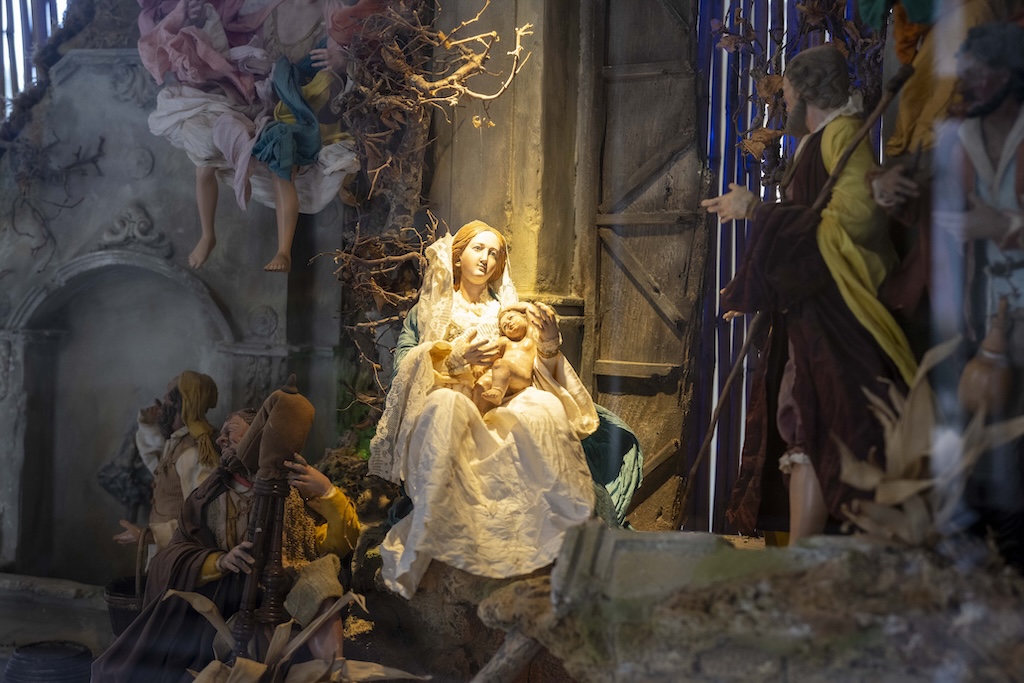
At the entrance of the Governorate stands a grand Nativity scene in the Neapolitan tradition. More Nativity scenes have been set up by the same curators on the first floor of the building . One is located at the entrance of the General Secretariat and depicts the landscape of the Holy Land at the time of Jesus. Among the characteristic dwellings, surrounded by palms and shrubs typical of the local flora, camels and shepherds with their flocks can be seen. Other figures appear to move along the streets, while Jesus is born beneath a crumbling arch at the town’s periphery.