


22 March: Blessed Clemens August von Galen, Cardinal
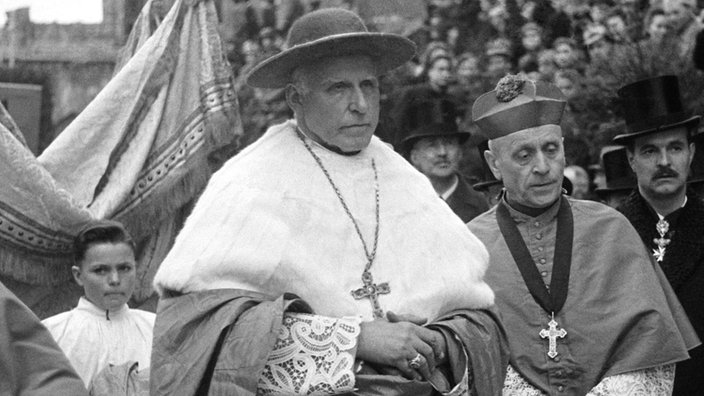

“The Lion of Münster”
Because of his courage during the Nazi dictatorship in Germany, he was called “the Lion of Münster.” He never tired of denouncing the abuses of the State and of defending the right to life, firmly condemning the Nazi theory of killing “unproductive and worthless lives.”
He was Count Clemens August von Galen, born on 16 March 1878 in Dinklage Castle in Oldenburg, Germany. He attended the Jesuit high school in Feldkirch and obtained his diploma in 1896 in Vechta. He studied in Freiburg (Switzerland), Innsbruck, and Münster, and was ordained a priest on 28 May 1904.
After a short period as capitular vicar in Münster, in 1906 he was appointed chaplain of St. Matthias Church in Berlin. He spent 23 years in what was then the capital of the Prussian Empire. In 1929 he was appointed parish priest of St. Lambert’s parish in Münster.
In 1933 he was elected Bishop of Münster and received episcopal ordination on 28 October. During Lent in 1934, in his first pastoral letter, he denounced the neo-pagan ideology of National Socialism. He never feared power or threats. In the following years he vigorously defended the freedom of the Church and of Catholic associations, as well as the teaching of religion.
In the spring of 1936, in a sermon in the cathedral of Xanten, he accused the National Socialist regime of discriminating against, imprisoning, and killing Christians. In January 1937, Pope Pius XII invited him to Rome to discuss the situation in Germany and to prepare the encyclical Mit Brennender Sorge. Three sermons delivered in St. Lambert’s Church on 13 July 1941 and 3 August 1941, as well as in the Church of Our Lady in Überwasser in Münster on 20 July 1941, became famous throughout the world. In these sermons he spoke out against state violence, the attack on the right to life, and in defense of freedom.
The Nazis wanted to arrest him but feared the public reaction. After the war he remained a point of reference for his compatriots, opposing the idea of collective guilt attributed to all Germans.
On 18 February 1946, Pope Pius XII created him Cardinal. He was acclaimed as the “Lion of Münster.” On 16 March 1946, upon his return to Münster, he was welcomed by a jubilant crowd. In front of the ruins of the destroyed cathedral he delivered his final speech. The following day he fell ill. He died on 22 March 1946 and was buried in the Ludgerus Chapel in the ruined cathedral.