


March 14: Saint Matilda, Queen
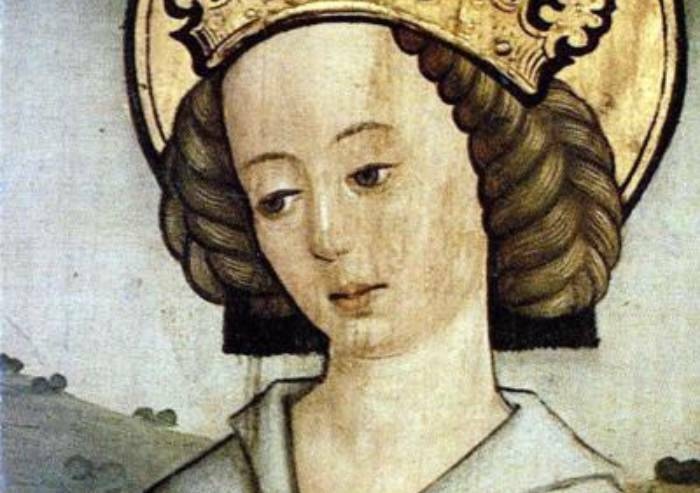

An Exemplary Consort
She was an virtuous queen, renowned for her deep piety and charity. She is Saint Matilda of Germany, also known as Matilda of Ringelheim. Born into a family of ancient nobility in Enger, Westphalia, around 895, her father was the Saxon count of Westphalia, Theodoric of Ringelheim, and her mother was Reinhild of Frisia.
She was educated at the monastery of Herford where her grandmother, Matilda I, served as abbess. She remained in the convent until 909 when her father betrothed her in marriage to Henry of Saxony, known as “the Fowler,” who was about twenty years older than she. Henry succeeded his father as Duke of Saxony in 912 and, in 919, upon the death of Conrad I of Franconia, he was elected King of the East Franks, whose territory largely corresponds to present-day Germany.
Five children were born of the marriage: Otto I, founder of the Ottonian dynasty and emperor from 962; Gerberga, wife of the King of France; Hedwig, mother of Hugh Capet, founder of the Capetian dynasty; Henry I, Duke of Bavaria; and Saint Bruno, Archbishop of Cologne.
Matilda set a great example of charity toward the poor, whom she personally visited to bring offerings. She lived a life of austerity and prayer, and through her humility, succeeded in softening her husband’s character. After Henry’s death in 936, she found herself mistress of many properties and later founded numerous monasteries. According to the Byzantine principle of the porphyrogenitus—by which a son born after his father’s accession to the throne was considered the legitimate heir, unlike older siblings born beforehand—she attempted to favor her younger son Henry over Otto, but without success.
When fratricidal conflict broke out between Henry and Otto, Matilda did everything possible to reconcile her sons. Soon after, she had to defend herself against their accusations of squandering the royal patrimony on works of charity. She therefore ceded her husband’s inheritance to them and withdrew to her native village. Nevertheless, her son Henry continued to cause her distress, and in 955 she saw him shortly before his death, urging him to repent.
In 962, during Otto’s journey to Rome to be crowned emperor, she served as regent of the Holy Roman Empire together with her son Saint Bruno. She spent her final years in the monasteries she had founded and, after a long illness, died with a reputation for holiness at the Abbey of Quedlinburg in 968, where she was buried beside her husband.