


April 21: Saint Anselm of Aosta, Doctor of the Church
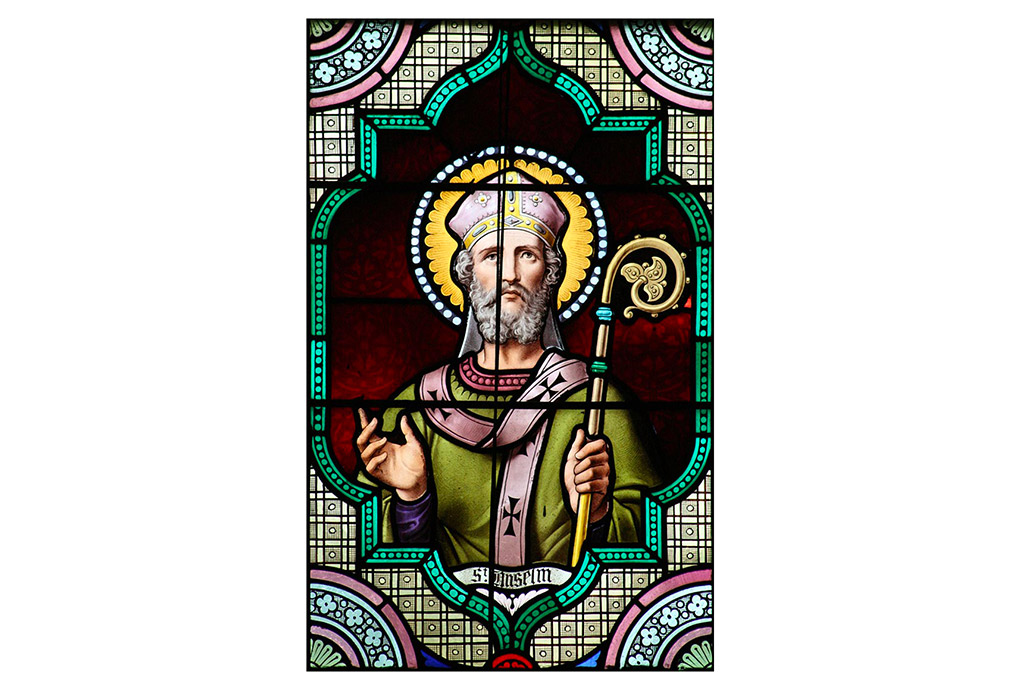

Father of Scholasticism
A Benedictine monk, later Abbot and Archbishop of Canterbury, and an eminent theologian, he was proclaimed a Doctor of the Church. This is Saint Anselm of Aosta, whose most famous work is the Proslogion (“Discourse”), known for its ontological argument for the existence of God. Born in Aosta in northern Italy, around 1033, he received both human and religious education from his mother, who later entrusted his formation to the Benedictines of a priory in Aosta.
At the age of 15, he wished to enter the Benedictine monastery, but his father Gundulf, a Lombard nobleman, was firmly opposed. A period of doubts and uncertainty followed, during which his mother—who had been a point of reference for him—also died.
After ongoing conflicts with his father, he renounced his inheritance and left Aosta for France to experience monastic life. He stopped at the Abbey of Notre-Dame du Bec in Normandy, where the Abbot, Lanfranc of Pavia, a man of great learning, persuaded him to stay. It was in 1060 that he became a monk and was ordained a priest. At the Abbey of Bec, he deepened his philosophical and biblical studies using a new method that would later develop into medieval scholasticism. He was first elected prior and then Abbot, dedicating himself to the formation of monks and to a return to the original spirit of the Rule.
In 1093 he was appointed Archbishop of Canterbury, succeeding Abbot Lanfranc. As Primate of England, he devoted all his efforts to securing the independence of the Church from interference by political power. For this reason, he was forced into exile twice, in 1098 and 1103. Each time he was received by the Popes in Rome. Nevertheless, his intervention spared King William II of England, known as William Rufus, from excommunication.
Returning to Canterbury in 1106, he devoted himself to the moral reform of the clergy. Despite pastoral concerns and political difficulties, he never abandoned his work as a philosopher and theologian. His spirituality is expressed in his Prayers—monologues with God, the Virgin, and the Saints—and in his Meditations.
Anselm died on April 21, 1109, and was canonized in 1170 by Pope Alexander III. In 1720, Pope Clement XI proclaimed him a Doctor of the Church.