


June 30: Holy Roman Protomartyrs
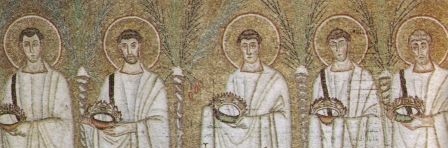

Faithful to Christ unto the ultimate sacrifice
The memory of the First Martyrs of the Church of Rome is celebrated immediately after the feast of Saints Peter and Paul. This commemoration has always been connected to the location of the Circus built by Emperor Caligula, later known as Nero’s Circus. It stood in the Gardens of Agrippina (Caligula’s mother), on the southern slope of the Vatican Hill, from where the Via Aurelia, Via Cornelia, and Via Triumphalis began.
Particularly remembered is the great fire of Rome, which occurred on July 16, 64 AD, and which the people attributed to Nero. To deflect suspicion from himself, Nero had many Christians arrested and condemned. According to the historian Tacitus (in Annals, Book XV, Chapter 44), these Christians were thrown to wild beasts or burned alive to illuminate the city at night. Tacitus recounts that Nero, in order to shift blame from himself, accused the Christians and subjected them to the cruelest of torture.
Initially, those who confessed to belonging to the Christian community were arrested. Then, based on their testimony, larger numbers were captured. They were punished not so much for setting the fire, but rather for being considered “enemies of the human race.”
The Hieronymian Martyrology already listed a large number of them (979) on June 29. Their veneration, originally limited to the small Church of Santa Maria della Pietà in the Teutonic Cemetery, was extended to the whole city of Rome in 1923, and to the entire Roman Rite Church in 1969.
Saint Clement, in his letter to the Corinthians written between 96 and 98 AD, also refers to these protomartyrs. Speaking of the martyrdom of Peter and Paul, he also mentions “a great multitude of the elect,” who endured torture and humiliation and left behind exemplary witness to their faith. Among them were also women, subjected to atrocious suffering.
In 1626, during the construction of the foundations for Bernini’s baldachin in St. Peter’s Basilica under Pope Urban VIII, tombs were discovered containing burned remains, ashes, and charcoal.
Their executions were turned into macabre public spectacles. Some, forcibly dressed in animal skins, were torn apart by dogs; others were crucified or burned alive to serve as night-time illumination. These atrocities took place in Nero’s gardens, where he offered the spectacle to the public.
The obelisk now standing at the center of St. Peter’s Square originally stood in the middle of the spina (central barrier) of Nero’s Circus, the long structure that divided the track where four-horse chariots raced. Pope Sixtus V had it moved to its current location directly in front of St. Peter’s Basilica.
The exact spot where the obelisk once stood is now marked by a stone slab on the ground, located to the left of the basilica, just beyond the narthex (the covered entrance). This plaque marks the site of the circus where, in 64 AD, Saint Peter and many other Christians were martyred.
On the right side of the circus, directly beneath today’s St. Peter’s Basilica, there was an open-air necropolis where Peter was buried after his martyrdom. In the last century, archaeologists uncovered part of this ancient necropolis and were able to identify the burial place of Peter, the first of the Apostles.