


15 February: Blessed Angelo Scarpetti, Augustinian

In the School of Saint Augustine
Angelo Scarpetti was born between 1230 and 1240, most likely in Sansepolcro, the Tuscan town where he lived and died. According to established tradition, in 1254 he entered the convent of the Bonite hermits of Sansepolcro, who followed the Rule of Saint Augustine. This community became involved in the great process of unifying eremitical movements promoted by Pope Alexander IV which, in 1256, led to the foundation of the Order of the Hermits of Saint Augustine.
From at least the seventeenth century, Angelo has been considered a member of the Scarpetti family, documented in Sansepolcro at a later time.
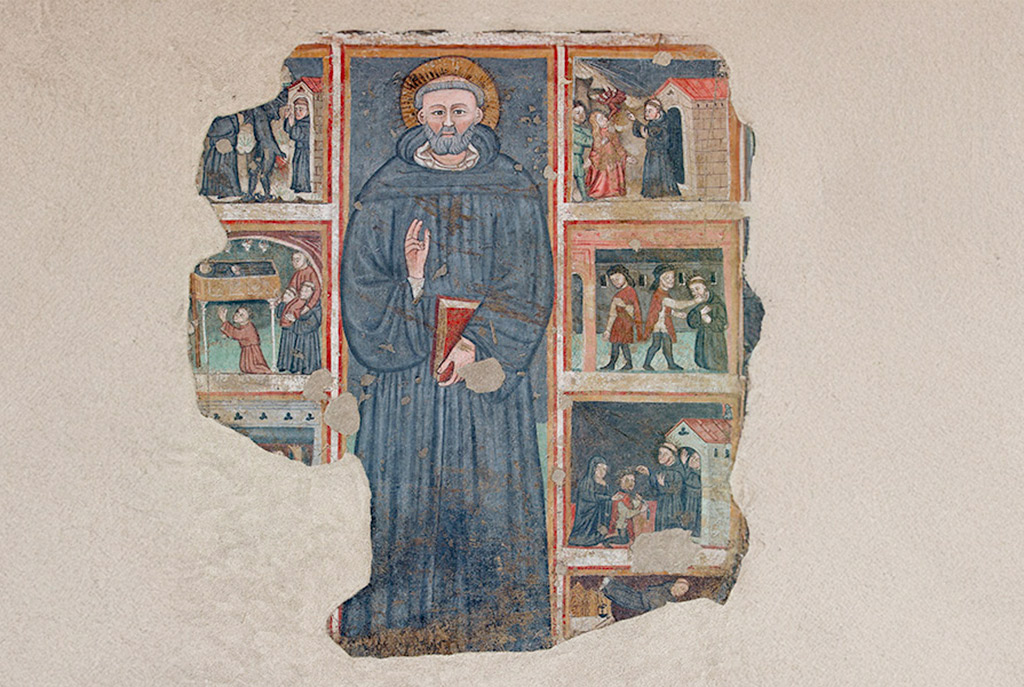
His death occurred before 1310, possibly in 1306. No ancient biography has survived, but the traditions about him are confirmed by figurative testimonies from the early fifteenth century. Miraculous episodes attributed to his intercession are recounted: the liberation of a possessed woman, the rescue of an innocent man condemned to death, and the healing of a paralytic at his tomb.
Unlike the scarcity of early narrative sources, the devotion to Friar Angelo in Sansepolcro is continuously affirmed. As early as 1310, members of a devotional confraternity dedicated to the Virgin and to the “glorious” Friar Angelo obtained the privilege of being buried beside the Hermit friars. In 1311, the Prior General of the Augustinian Order, Friar Giacomo da Orte, stated that God had granted Angelo the gift of performing numerous miracles.
Initially buried in the Augustinian church, in 1555 Angelo’s body was transferred to the town parish church of Santa Maria and placed beneath the high altar. The figure of Friar Angelo had by then become central to the convent of Sansepolcro, as confirmed by seventeenth-century documents archived in Italian convents.
In 1740, at the request of the Augustinians, the Bishop of Sansepolcro, Raimondo Pecchioli, opened a process to verify the authenticity of the relics. On that occasion, Angelo’s body was found to be incorrupt, further strengthening popular devotion to him.