


October 10: Saint Daniele Comboni
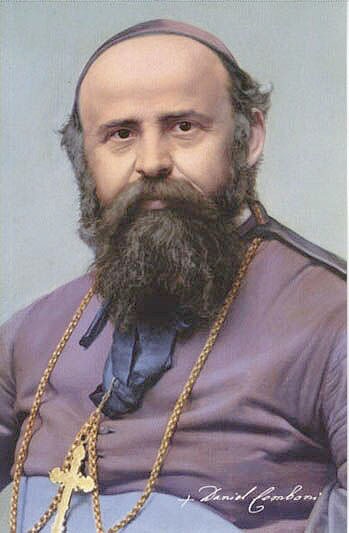

Saving Africa through Africa
Daniele Comboni, who became the first Bishop of Central Africa and founder of two missionary institutes, was born into humble circumstances. He was born on March 15, 1831, in Limone sul Garda, northern Italy, into a poor family of farmers working for a landowner. His parents, Luigi and Domenica, were deeply religious yet their lives were marked by continual sorrow: Daniele was the only one of their eight children to survive past infancy.
It was precisely his family’s difficult financial situation that drove him, while still very young, to move to Verona to study at the institute of Don Nicola Mazza, where he developed his vocation for the priesthood and discovered the missionary zeal. The experiences and testimonies of the first missionaries in Africa left a deep impression on his heart. After being ordained a priest in 1854, he left for his first mission in Africa three years later.
After four months of travel, Comboni and his companions arrived in Khartoum, the capital of Sudan. The reality they encountered was harsh: disease, extreme climate, hunger, loneliness, death. But these trials did not discourage him. Faced with so much suffering, his love for Africa grew. He wrote to his parents that to sweat and die for the salvation of souls was too sweet to abandon such a mission. When he lost a young companion, instead of giving in, he uttered the words that became his motto: “Africa or death.”
In 1864, while praying at the tomb of St. Peter, he received a profound spiritual insight: to evangelize Africa, Africans themselves needed to be directly involved. Thus was born the “Plan for the Regeneration of Africa,” based on the revolutionary idea to “Save Africa through Africa.”
Comboni often found himself isolated, misunderstood, even opposed, yet he persevered with determination in his mission. He launched an intense campaign across Europe to raise awareness in public opinion and in the Church about the African cause. He never hesitated to speak with kings, bishops or ordinary citizens to gather funds and prayers. He also founded a missionary magazine—the first in Italy—to inform and engage readers.
In 1867, he founded the Institute of Comboni Missionaries and in 1872, the Institute of Comboni Missionary Sisters—an innovative step as for the first time women religious were sent to Africa to work alongside priests. During the First Vatican Council, he became a spokesperson for the urgent need to evangelize the African continent, gathering the signatures of 70 bishops on a petition known as the Postulatum pro Nigris.
On July 2, 1877, he was appointed Apostolic Vicar of Central Africa and a month later was ordained a bishop. This was the official recognition of a mission many had deemed impossible.
In the final years of his life, Comboni faced even greater challenges: devastating famines, epidemics and the death of many collaborators and missionaries. Nevertheless, in 1880 he set out for Africa for the eighth time, determined to continue his fight against slavery and to strengthen the missionary presence among the poorest.
The following year, physically and spiritually worn out, he fell gravely ill and died on October 10, 1881 in Khartoum at the age of 50. He died among his people, leaving as his last words: “I am dying, but my work will not die.”
In 1996, he was beatified by Pope John Paul II, who canonized him in 2003.