

21 December: St. Peter Canisius
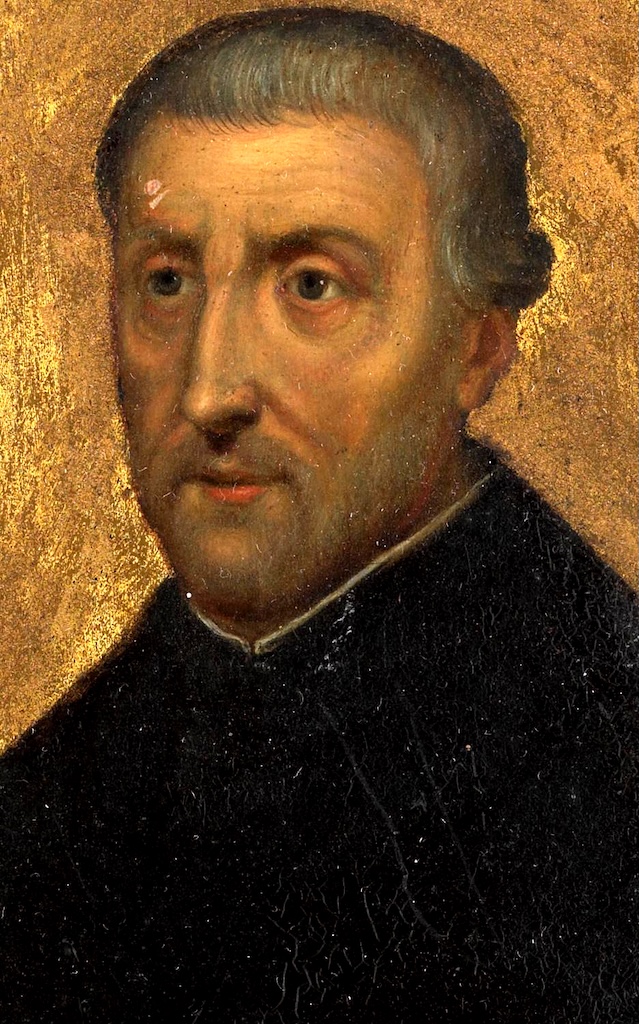

Promoter of the Church Reform
On 8 May 1521, in the Dutch town of Nijmegen—then part of Imperial Guelders and therefore of the Holy Roman Empire—was born the man who would become one of the decisive figures of the Catholic Reform.
In 1543, after making the Spiritual Exercises under the guidance of Peter Faber, he chose to embrace religious life in the Society of Jesus. A few years later he took part in two crucial sessions of the Council of Trent, in 1547 and in 1562, having been personally summoned by Cardinal Otto Truchsess von Waldburg, Bishop of Augsburg. It was in these contexts that he definitively adopted the Latin form of his name.
The renewal of Christian life advocated by the Council of Trent became the central focus of his apostolate: he worked tirelessly to rekindle faith both in individual consciences and within ecclesial communities. After a brief period in Rome and Messina, he was sent to Bavaria, where he held positions of great responsibility at the University of Ingolstadt—as dean, rector and vice-chancellor—and later, in Vienna, served as administrator of the diocese and as a much-loved preacher in St. Stephen’s Cathedral, as well as a frequent visitor to prisons and hospitals.
In 1556 he was appointed the first Provincial of the newly established Jesuit Province of Upper Germany. During those years he created a dense network of colleges and communities, essential instruments for the Catholic revival in the German-speaking lands. In the same spirit, he took part in delicate political negotiations, officially representing the Church. St. John Paul II, recalling him on the occasion of the fourth centenary of his death, observed that Providence “made him its messenger at a time when the voice of the Catholic faith risked being extinguished in those lands.”
His influence was also exercised through an intense editorial activity. He prepared complete editions of the works of Cyril of Alexandria and Leo the Great, collections of writings by St. Jerome, and the prayers of St. Nicholas of Flüe. He also published devotional texts in several languages, lives of Swiss saints and collections of sermons. His most famous works, however, were the three celebrated Catechisms, composed between 1555 and 1558: one for students capable of addressing basic theological content, one for children of the common people, and a third intended for pupils in middle and secondary schools. The truths of faith were presented with essential clarity, in the form of questions and answers, without polemics and with strong biblical grounding. During his lifetime alone, some two hundred editions were already in circulation.
Endowed with a courtesy that earned him the esteem of both Emperor Ferdinand I and Pope Gregory XIII, he preferred to highlight the beauty of Catholic doctrine rather than insist on the errors of others. In his final years, in 1580, he founded the College of St. Michael in Fribourg, which later had several locations, including Feldkirch and St. Blasien in the Black Forest. He died on 21 December 1597 and was buried in the university church of St. Michael in Fribourg, leaving a spiritual legacy destined to leave a profound mark on the religious history of Europe.