


June 25: Saint William Abbot
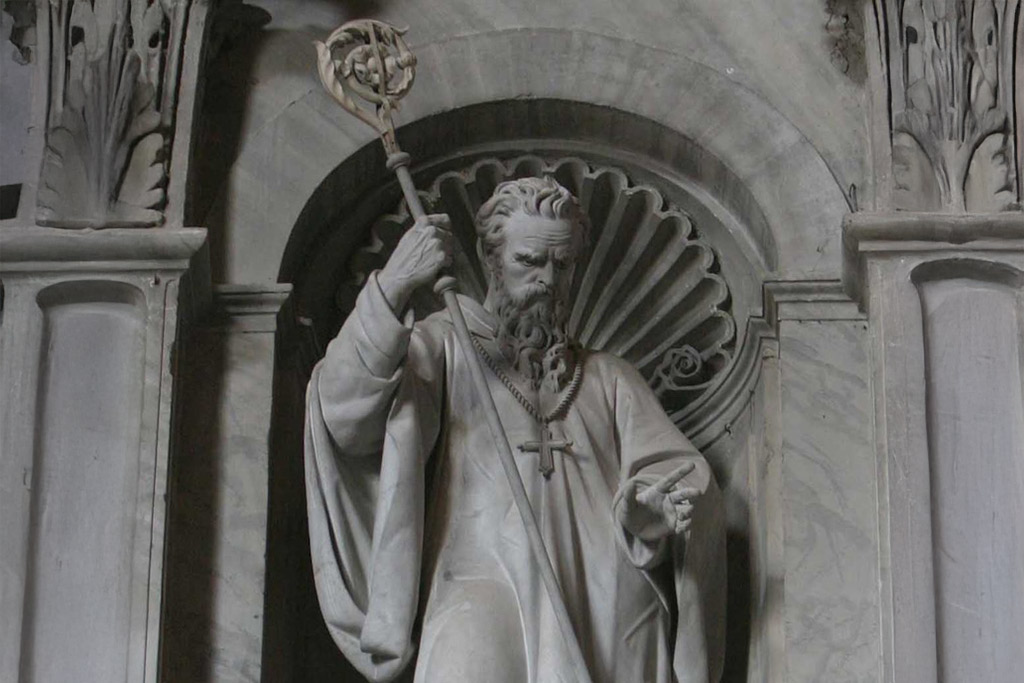

Pilgrim, founder of the Abbey of Montevergine and of the Benedictine Congregation closely linked to the monastery. He is known as William of Vercelli or William of Montevergine.
Born in Vercelli Italy around 1085 into a noble family, William began journeying across Europe at just 14 years old. He abandoned his noble garments, donned a simple cloak, and set out barefoot on a long pilgrimage to the Sanctuary of Saint James of Compostela in Spain.
This penitential journey lasted at least four years, during which he spoke of God to everyone he met, living in poverty and meditation. He led a very austere lifestyle: always walking barefoot despite his wounded feet, praying day and night, and often sleeping outdoors directly on the ground.
After returning from Spain, he continued his pilgrimages throughout Italy, visiting sanctuaries and holy sites. He also wanted to travel to Jerusalem and headed south to Apulia to embark for the Holy Land, but in Oria he was attacked by robbers who, finding him poor, beat him brutally and left him near death. William interpreted this event as a sign from God—perhaps it was not his destiny to reach the Holy Land. During his recovery, he sought advice from Saint John of Matera, who encouraged him to remain in Italy.
Soon after, William had a vision in which God revealed he would found a Congregation. He withdrew to live as a hermit, traveling through southern Italy in search of the right place to dedicate himself to prayer and solitary life.
In 1118, William arrived at the foot of Mount Partenio, in Irpinia, now in the province of Avellino in southern Italy. His deep spirituality inspired many to follow him, and in a short time, many men joined him to live according to his example.
Mindful of the harsh life of a pilgrim, William warmly welcomed these new companions. Even before the first church was consecrated, cells for the monks and a shelter for pilgrims had already been built. Thus, the man who had always lived alone found himself leading a monastic community. However, he never wrote specific rules; he simply led by example and gave occasional oral guidance.
But the pilgrim spirit that had driven him since youth resurfaced. He entrusted leadership of the Montevergine monastery to a faithful disciple, Father Alberto, and resumed his travels to spread his new religious community. In his final years, William journeyed through southern Italy, founding new monasteries.
His virtues and the miracles attributed to him gained him renown even among nobles and rulers. Norman princes and local lords supported him, donating lands and privileges to the new monasteries. A special friendship bonded William with the Norman king Roger II. Shortly before his death, William wished to see him one last time to bid farewell and offer counsel on governance.
William died in 1142 at the monastery of Goleto, near Nusco, which he had founded. On September 2, 1807, his remains were transferred to the Abbey of Montevergine. He was canonized by Pope Pius VI in 1785. In 1942, on the 800th anniversary of his death, Pope Pius XII proclaimed him the principal patron saint of the city of Irpinia.