


June 29: Saints Peter and Paul, Patrons of the Eternal City of Rome
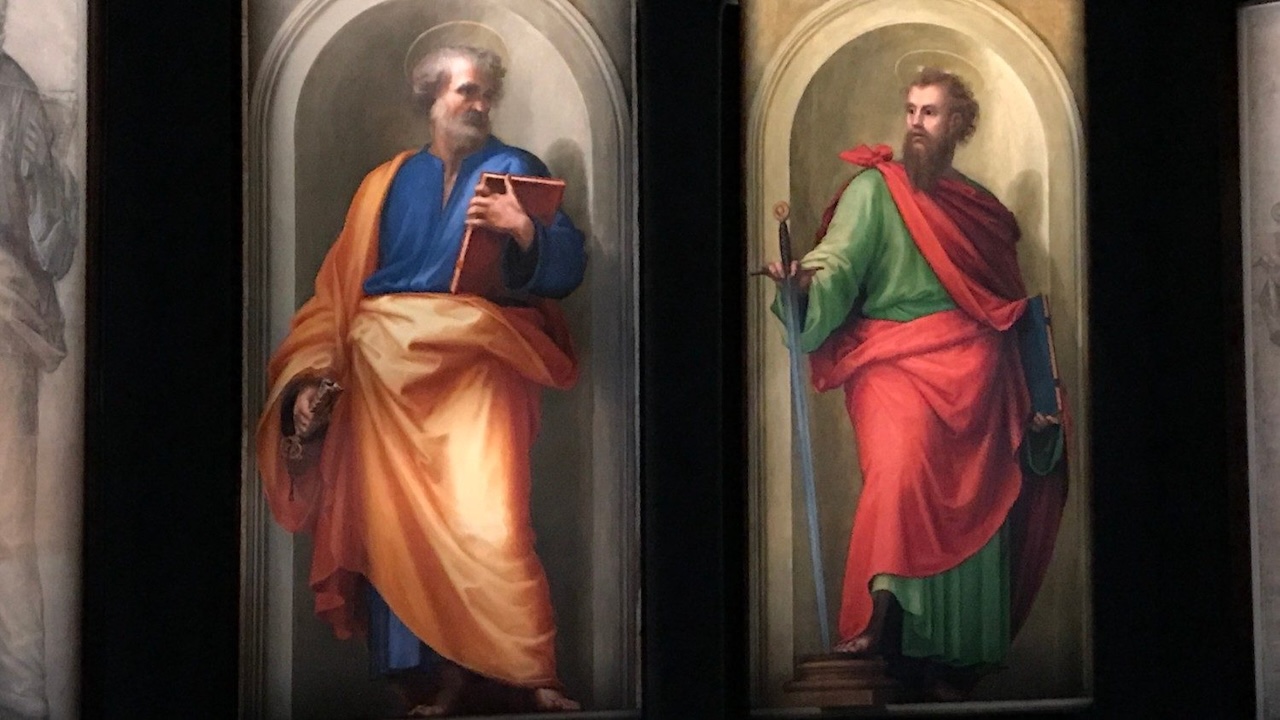

United in martyrdom for the love of Christ
“Basing itself on the tradition of the fathers, knows that they did not actually suffer in the course of the same day between sunrise and sunset. So Paul suffered on Peter's birthday (natalitium), not the day he emerged from his mother's womb to join the ranks of mankind, but the one on which he was released from the bonds of the flesh and born into the light of the angels.
And so it is, while each was given his own day of martyrdom, they are now both celebrated on the same day.
I see in this a great sign of harmony: he who was the last of the Apostles met with the first, who had been an apostle before him, because he was called on the same day as Peter, and on the same day received the crown. One was chosen before the Passion, the other after the Ascension: unequal in time, but equal in eternal happiness. One was made an apostle from being a fisherman, the other from being a persecutor; in the first, God chose what is weak in the world to confound the strong, in the other, sin abounded so that grace might abound all the more. In both, the grace of God was great and His glory shone, for God did not find merit in them, but created it."
— excerpt from St. Augustine, Sermon 381, On the Feast of the Apostles Peter and Paul
Peter and Paul cannot be separated: they are the two pillars of the Church. Christian tradition has always celebrated them together—never one without the other. The Church of Rome is especially linked to these two Apostles, who were direct witnesses of the life of Jesus.
Peter was a Galilean, a fisherman living in Capernaum on the Sea of Galilee, recognizable by his accent. Paul, on the other hand, was a Jew of the diaspora, born in Tarsus (in Asia Minor), trained as a Pharisee, but also a Roman citizen—an unusual status for that time.
Their lives were radically changed when they encountered Jesus. Peter, then called Simon, heard these words: “You are Simon, the son of John; you will be called Cephas (which is translated Peter)” (John 1:42). He left his boat, his fishing, and his family to follow the Master. Paul, then called Saul, heard the voice of Christ: “Saul, Saul, why are you persecuting me?” (Acts 9:4) and, from being a persecutor of Christians, became a servant of the Apostles.
Peter received, through the Holy Spirit, the revelation of Jesus’ true identity: “You are the Messiah, the Son of the living God” (Matthew 16:16). Paul had a mystical vision, was caught up to heaven, and heard words inexpressible in human language.
Peter, although he denied Jesus during His Passion, repented and declared: “Lord, you know everything; you know that I love you.” Paul, who had persecuted Christians, was completely transformed: “… I live, no longer I, but Christ lives in me” (Galatians 2:20).
To Peter was entrusted the leadership of the Church: “And so I say to you, you are Peter, and upon this rock I will build my church” (Matthew 16:18). Paul, meanwhile, became the Apostle to the Gentiles, bringing the Gospel to non-Jewish peoples.
Out of love for Christ, both died as martyrs in Rome. Peter was crucified, and Paul was beheaded.
Peter, symbolically represented with keys, and Paul with a sword, have always been united in the mission of the Church, in the liturgy, and, throughout the centuries, in art.