


July 4: Saint Elizabeth of Portugal
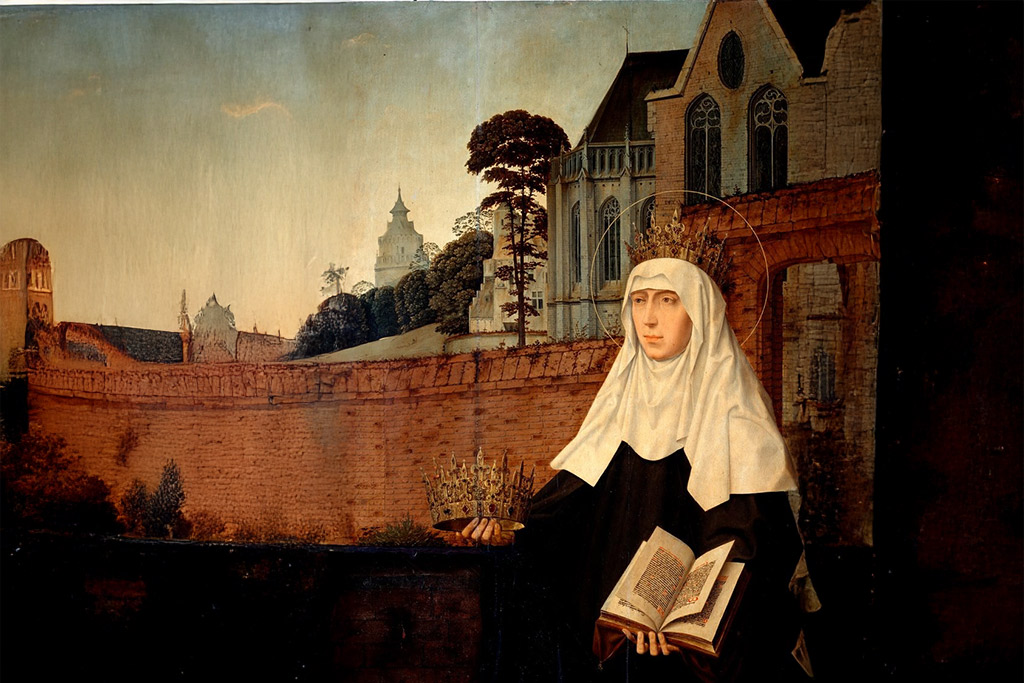

From the Royal Throne to Franciscan Poverty
Isabella of Aragon, Queen of Portugal, distinguished herself through her dedication to promoting peace among rulers and her generosity toward the poor. After the death of her husband, King Denis, she chose to consecrate her life to God by joining the Third Order of Saint Clare in the convent of Estremoz, which she herself had founded.
Isabella of Aragon, also known as Saint Elizabeth of Portugal (in Portuguese, Isabel de Aragão; in Catalan, Elisabet d'Aragó), was born in Zaragoza on January 4, 1271. She was the third daughter of King Peter III the Great, ruler of Aragon and Valencia and Count of Barcelona, and his wife Constance of Sicily.
She was the niece of Saint Elizabeth of Hungary, from whom she inherited her name, chosen in her honor. At just 12 years old, she was given in marriage to Denis, King of Portugal, with whom she had two children. The marriage was marked by the king's infidelities, but Elizabeth faced the situation with faith and Christian spirit—qualities that eventually led her to sainthood.
She was a deeply compassionate woman and a peacemaker, able to embody and witness the Franciscan spirituality in a unique way, even within the court—an environment often marked by pride, rivalry, and political tension.
She played an important mediating role within her own family and, as an advisor to the king, helped reduce political tensions between Aragon, Portugal, and Castile. During her reign, she commissioned the construction of hospitals, monasteries, and churches, cared for orphans, and instructed her almoner never to let a single poor person go without help or support.
Elizabeth also knew imprisonment: King Denis, misled by the slanders of hostile courtiers, had her confined for a time in a fortress, believing she was secretly supporting their son Afonso, who had rebelled out of fear of being disinherited. The conflict between father and son escalated into civil war. In 1323, with armies poised for battle near Lisbon, it was Elizabeth who prevented bloodshed by placing herself between the two sides. Through prayer and Christian patience, she was able to touch the heart of her husband, who reconciled with her and converted. Elizabeth remained by his side until his death in 1325.
After being widowed, Elizabeth gave her wealth to the poor and to convents and became a Franciscan tertiary. She made a pilgrimage to the Sanctuary of Santiago de Compostela, where she symbolically laid down her royal crown, and withdrew to the Poor Clare monastery in Coimbra, which she had founded.
She died on July 4, 1336, in Estremoz, Portugal. Her body was later transferred to the Monastery of Saint Clare in Coimbra. During an exhumation in 1612, as part of the canonization process, her body was found to be incorrupt.
She was canonized by Pope Urban VIII in 1625.