


July 15: St. Bonaventure of Bagnoregio, Bishop and Doctor of the Church
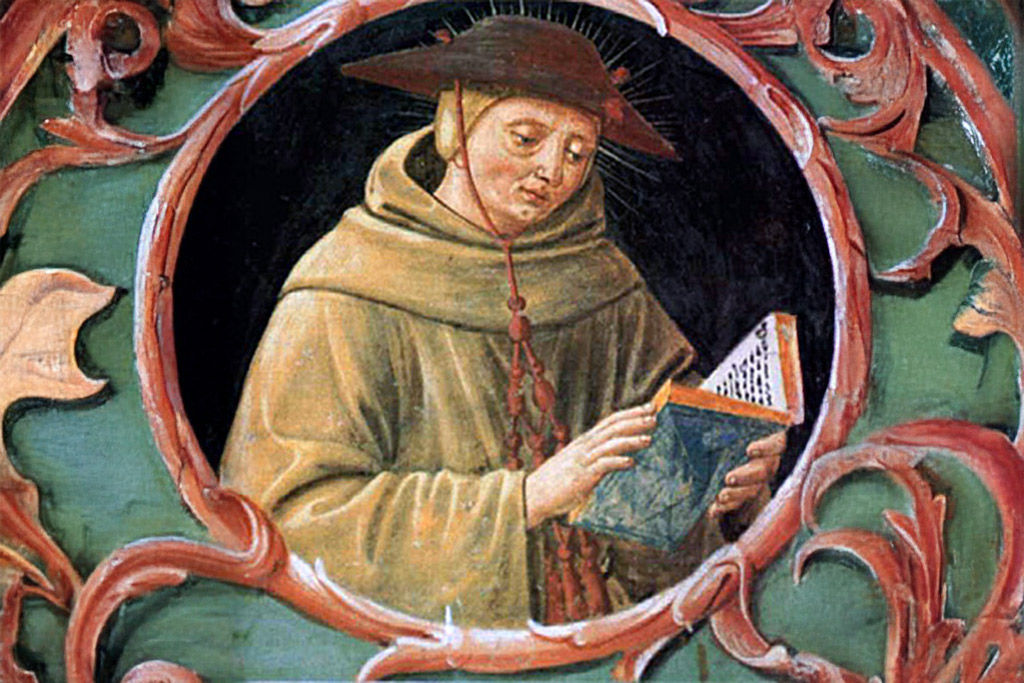

A Theologian Formed in the School of St. Francis of Assisi
St. Bonaventure was born around 1217 in the small town of Bagnoregio, in the region of Lazio. His baptismal name was Giovanni, the same as his father's, Giovanni Fidanza. Little is known about his early life, except that he was cured of a serious illness through the intercession of St. Francis of Assisi—a miracle he himself recounts in the prologue to the Legenda maior sancti Francisci.
In 1236, he moved to Paris to study. After earning a degree in the liberal arts in 1243, he decided to enter the Order of Friars Minor, taking the name Bonaventure. He began studying theology under Alexander of Hales, and after Alexander’s death in 1245, continued under Odo Rigaud and William of Melitona. In 1248, he earned a baccalaureate in biblical studies and began commenting on Biblical texts. Between 1250 and 1252, he focused on Peter Lombard’s Sentences.
In 1253–1254, he earned the title of magister (master) and completed several important theological works. In 1254, he was appointed magister regens (official teacher of the friars), but it wasn't until 1257 that he was officially recognized as a university professor, alongside St. Thomas Aquinas.
On February 2, 1257, while in Paris, he was elected Minister General of the Order during a Chapter held in Rome under Pope Alexander IV. He was about 40 years old. One of his main tasks was to unify the Order’s rules, which led to the drafting of the General Constitutions of Narbonne (1260), a foundational document for the future organization of the Franciscan Order.
He was also asked to write a new official biography of St. Francis, which he presented at the 1263 Chapter in Pisa, titled the Legenda maior. He also prepared a shorter version for liturgical use (Legenda minor). These became the official texts for the entire Franciscan family. Some scholars view these two works as the foundation of Bonaventure’s reform: one legal, the other spiritual and theological.
In addition to leading the Order, Bonaventure was also an active preacher, addressing both religious communities and the general public. His many travels reflect his dedication: between 1257 and 1259, he visited Umbria, Viterbo, Paris, England (Oxford and Lincoln), France (Saint-Omer), and Germany, even reaching Mount La Verna. His reputation grew so much that in 1265, Pope Clement IV offered him the position of Archbishop of York, which he declined.
Despite his many responsibilities, he continued to write spiritual and theological works between 1257 and 1267, including Itinerarium mentis in Deum (The Journey of the Mind into God), Lignum vitae, De regimine animae, Collationes de decem praeceptis, and Collationes de septem donis Spiritus Sancti.
In 1272, Pope Gregory X asked him to help prepare for the Second Council of Lyon, which focused on Church reform, the Holy Land, and relations with the Greek Church. Bonaventure was tasked with sending a delegation to Constantinople to maintain contact with Emperor Michael VIII Palaiologos.
Between April and May of 1273, he delivered his final lectures at the University of Paris (Collationes in Hexaëmeron), which he was unable to complete, as Pope Gregory X made him a Cardinal on June 3, 1273. He died on July 15, 1274, during the fourth session of the Council of Lyon. In 1482, Pope Sixtus IV canonized him, and in 1588, Sixtus V declared him a Doctor of the Church.