


August 1st: Saint Alphonsus Maria de’ Liguori, Bishop and Doctor of the Church
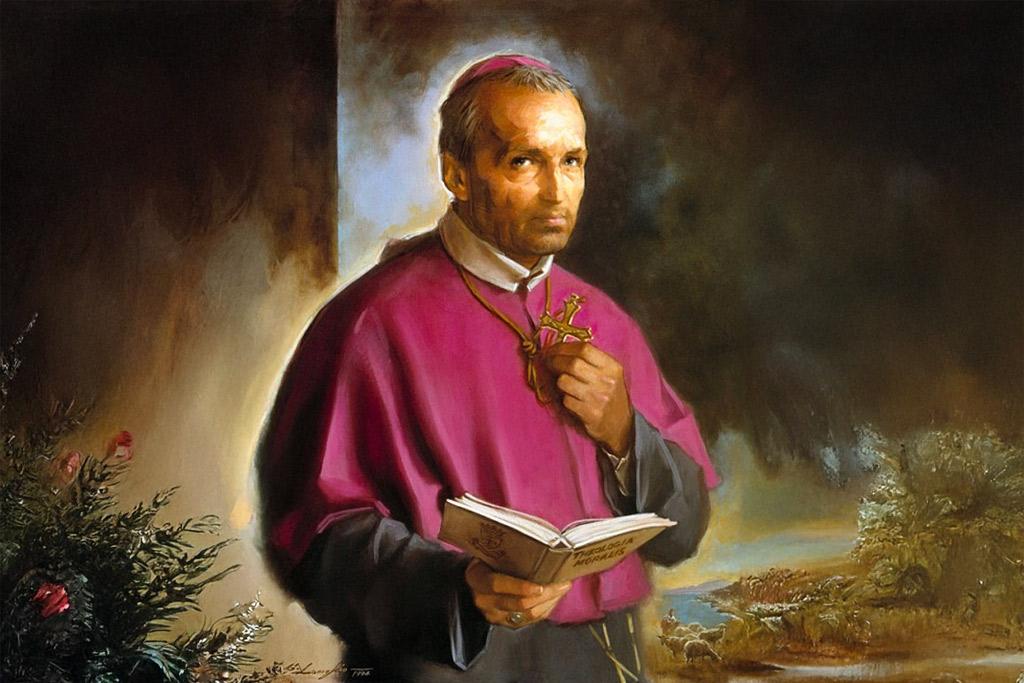

Theological Reflection in Service of the Human Person
Proclaiming the Word of God “to the most abandoned and spiritually neglected” was the mission and charism of Saint Alphonsus Maria de’ Liguori. A man of broad culture in the humanities, law, theology, and philosophy, he was a fervent Christian layman before becoming a priest.
He devoted himself passionately to the religious, moral, and civic reform of the Neapolitan people. He was a missionary, founder, bishop, author, and a multifaceted artist (he also composed the well-known Italian Christmas hymn Tu scendi dalle stelle).
Alphonsus Maria de’ Liguori was born in Marianella (Naples) on September 27, 1696. The eldest son of a noble Neapolitan family, he earned a doctorate in law at the age of 16 and became a brilliant lawyer by 20. In 1723, after a deeply disheartening legal defeat, he chose to abandon his legal career and become a priest.
Ordained in 1726, he carried out his ministry in Naples' poorest neighborhoods. He communicated through speech and through his writings, publishing no fewer than 111 works. His greatest legacy lies in the field of moral theology; with his work Moral Theology, he opposed the legalism and rigorism of his time, promoting a theology attentive to conscience and evangelical mercy. His balanced and prudent thought gradually became official Church doctrine.
On November 9, 1732, in Scala near Amalfi, he founded the Congregation of the Most Holy Redeemer. Its members, known as the Redemptorists, focused on evangelizing rural and marginalized populations.
He was also a master of spirituality, writing ascetical works for all people, insisting that holiness is attainable in every state of life, not just for the religious. Among his best-known spiritual works are The Glories of Mary, The Practice of the Love of Jesus Christ, and Visits to the Blessed Sacrament and to the Blessed Virgin Mary.
Deeply connected to the common people, he devoted himself especially to the poor, preaching missions in villages and impoverished neighborhoods. He founded the “Evening Chapels”—places of evening prayer and catechesis for artisans and common folk—which quickly spread as centers for moral and civil renewal.
In 1762, he was appointed Bishop of Sant’Agata dei Goti, where he promoted religious and social reform, encouraging priests to live a holy and educated life. During the famine of 1763–64, he stood out for his heroic charity.
In 1775, elderly and ill, he retired to Pagani, where he continued to lead the Redemptorist congregation he had founded in 1732 and to write. He died on August 1, 1787, at the age of 91.
He was canonized in 1839 by Pope Gregory XVI, declared a Doctor of the Church by Pope Pius IX in 1871, and proclaimed Patron of confessors and moral theologians by Pope Pius XII in 1950.