

August 2: Saint Peter Julian Eymard
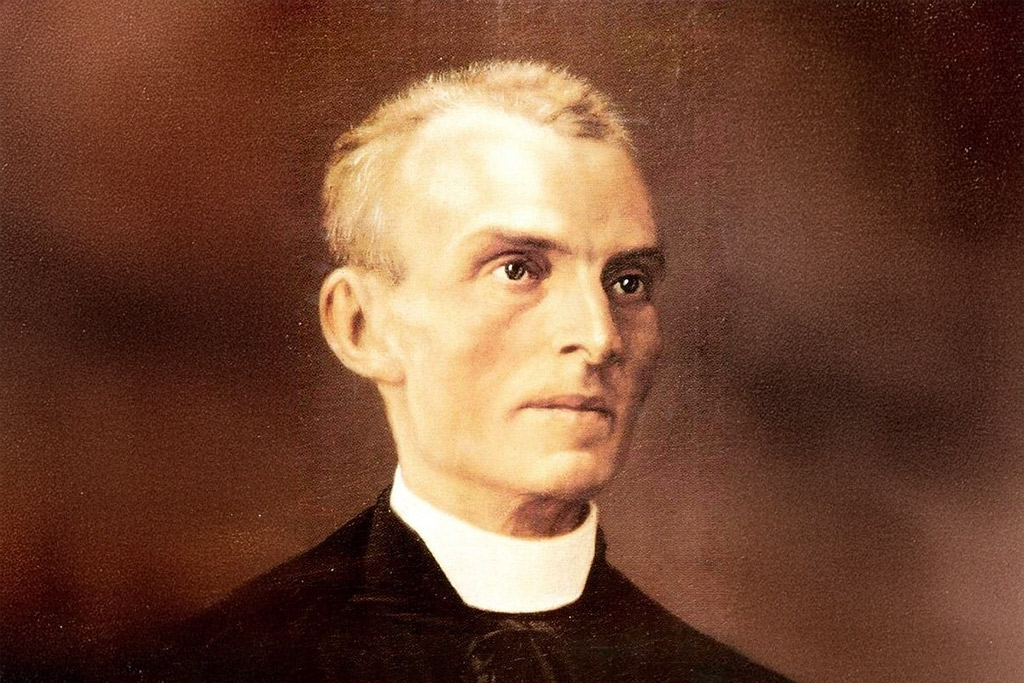

The Apostle of the Eucharist
Pierre-Julien Eymard was born in France, on February 4, 1811, in La Mure (Isère), into a modest and devout Christian family. From a young age, he demonstrated a deep devotion to the Blessed Sacrament and aspired to become a priest, though his father initially opposed the idea.
He found spiritual solace at Notre-Dame du Laus and, while working in his father's workshop, secretly studied Latin. After his father's death in 1831, he entered the seminary in Grenoble and was ordained a priest in 1834.
He began his ministry in Chatte and later became parish priest in Monteynard. Eymard devoted himself intensely to preaching and to his own personal and spiritual formation, maintaining an austere lifestyle influenced by Jansenism. A special grace received at the Calvary of Saint-Romain opened up a new spiritual perspective centered on love. Drawn to religious life, he obtained permission to join the Marists in 1839.
He began his Marist novitiate in Lyon in 1839 and made his religious profession in 1840. He was appointed spiritual director at the Belley college where he worked successfully with youth, despite leaving behind few written works.
He held important roles within the Society of Mary: provincial, general assistant, visitor, and director of the Third Order, which he reorganized and zealously expanded. He preached missions and retreats, spiritually guiding many people, especially laypeople.
Two significant spiritual experiences marked this period:
- On May 25, 1845, during the Corpus Christi procession, he felt called to preach Jesus Christ—particularly Christ in the Eucharist.
- On January 21, 1851, at Notre-Dame de Fourvière, he perceived the need for a new devotion and Eucharistic formation, which he would later call a "grace of vocation."
In September 1851, he left Lyon with this new inspiration, which would lead him to found a Eucharistic work.
Father Eymard was appointed superior of the Marist college in La Seyne-sur-Mer, which he successfully reorganized. His passion for the Eucharist deepened; he engaged in nocturnal adoration in Toulon and provided spiritual guidance to a youth group.
On April 18, 1853, he received a spiritual grace that confirmed his vocation to found a work dedicated to the Blessed Sacrament. He began writing the Constitutions and gathering young men interested in the Eucharistic ideal. However, the Marist superior general, Father Favre, opposed the project. Weary, Eymard resigned from the college leadership in 1855 and withdrew to Chaintré.
During his time in Chaintré, he continued to reflect and worked on the Manual for the Third Order of Mary. Hoping for approval from Rome through Pope Pius IX, he instead received a direct rejection from Father Favre. At that point, he requested to be released from his Marist vows. After internal tensions, Father Favre granted the dispensation. Eymard left Lyon and withdrew to Paris to discern his vocation.
Arriving in Paris on April 30, 1856, Eymard sought the freedom to found his new work. After a spiritual retreat, he turned to Archbishop Sibour, who was initially skeptical, deeming the project too contemplative. But Eymard clarified: the goal was not only to adore the Eucharist, but to make others adore it as well. He also proposed an educational initiative for adults preparing for their First Communion. Convinced, the Archbishop approved the initiative.
On May 13, 1856, the Congregation of the Blessed Sacrament was officially founded. The next day, Eymard was released from his Marist obligations, though he remained spiritually connected to the Society of Mary, which he regarded as the mediator of his journey to the Eucharist.
Despite initial challenges (poverty, lack of vocations and resources), on January 6, 1857, Father Eymard inaugurated the first community of Eucharistic Adorers in Paris. He also founded the Work of First Communion for Adults, offering catechesis and sacramental preparation to unchurched youth. In 1859, he opened a second community in Marseille and received initial official recognition from Pope Pius IX.
In 1862, he founded a third house in Angers and in 1863 obtained pontifical approval for his Institute.
He worked tirelessly to draft the Constitutions for both the male and female congregations (the Servants of the Blessed Sacrament, officially founded in 1864 in Angers with Mother Marguerite Guillot).
Meanwhile, he dreamed of acquiring the Cenacle in Jerusalem to make it a center for worldwide Eucharistic adoration, but faced insurmountable obstacles.
During a retreat in Rome in 1865, he experienced a profound mystical moment: he received the "gift of personality," a complete renunciation of self, embracing failure as a path to holiness. From this, his concept of the “inner Cenacle” was born.
Despite trials, the Congregation continued to grow. He founded two houses in Brussels (1866 and 1867), moved the novitiate to Saint-Maurice-Montcouronne, and opened a new house for the Servants in Nemours—which ultimately failed, causing severe moral and financial hardship.
He continued preaching, writing, and forming his religious, though afflicted by illness, spiritual dryness, and interior solitude.
He retired to his hometown of La Mure, where he died on August 1, 1868, exhausted but serene, recognized by his people as a saint.
He was beatified in 1925 by Pope Pius XI and canonized in 1962 by Pope John XXIII.