


August 5: Dedication of the Basilica of Saint Mary Major
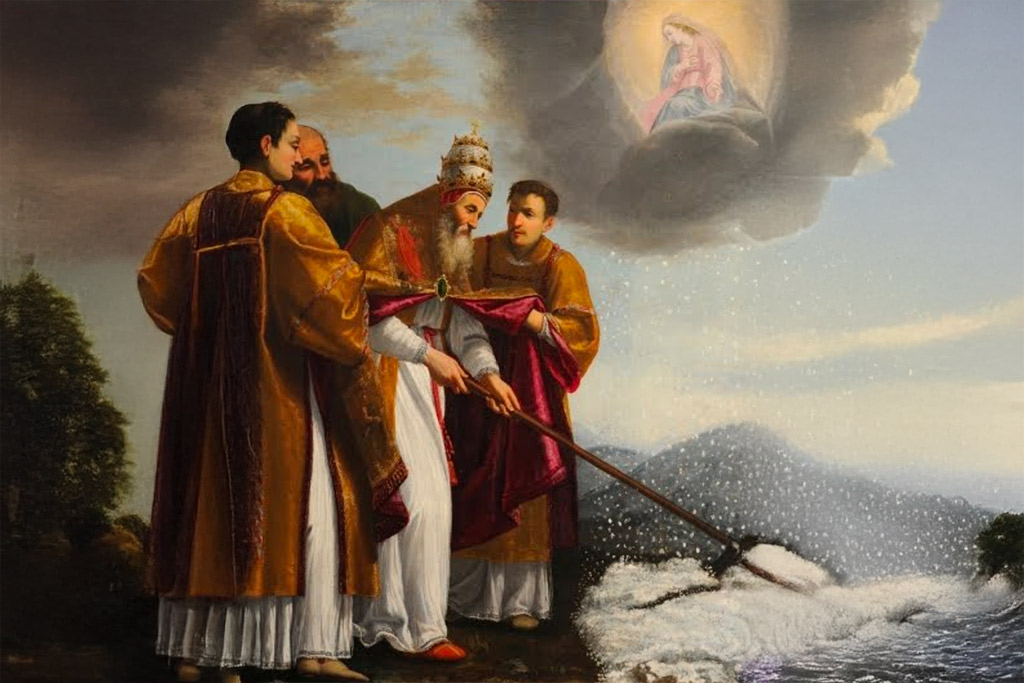

The Miracle of Snow in August
According to an ancient tradition, during the pontificate of Pope Liberius (352–366), a Roman nobleman named John and his wife, who were childless, decided to donate their wealth to the Virgin Mary for the construction of a church in her honor.
On the night between August 4 and 5 in the year 352, both husband and wife experienced a dream in which the Virgin appeared to them and told them that she would indicate the location for the church with a miraculous sign.
The next morning, the couple reported their dream to the Pope, who revealed that he had experienced the same vision. The Virgin had told him that the site of the future church would be where snow would fall.
That very day, guided by the miracle, they went together to the summit of the Esquiline Hill, to a place called Cispius, where snow had miraculously fallen. There, Pope Liberius traced the outline of the future church in the fresh snow.
Thus the first Basilica was born, known as the Liberian Basilica, also called Sancta Maria ad Nives (Saint Mary of the Snow) in memory of the miraculous event. Evidence of this early structure is found in the Liber Pontificalis, where it is written that Pope Liberius “built a basilica that bears his name near the Macellum Liviae.” Another passage refers to Pope Sixtus III (432–440), who “built the Basilica of Saint Mary, which in ancient times was called [the Basilica] of Liberius.”
It was in fact Pope Sixtus III, after the Council of Ephesus (431) which proclaimed Mary as the Mother of God, who rebuilt the Basilica and officially dedicated it to the Virgin—the first such dedication in the West.
During that Council, Bishop Cyril of Alexandria delivered a homily filled with profound devotion to Mary. He praised her with titles such as “Mother of God,” “precious treasure of the world,” “light that never dims,” “crown of virginity,” “guide of the true faith,” and “temple that cannot be destroyed.”
The commemoration of the dedication of the Basilica of Saint Mary Major has been celebrated since the 4th century in both the Roman and Ambrosian liturgical calendars. During the liturgy, white rose petals are scattered from the central nave to recall the miraculous snowfall.