


December 16: Saint Adelaide, Empress
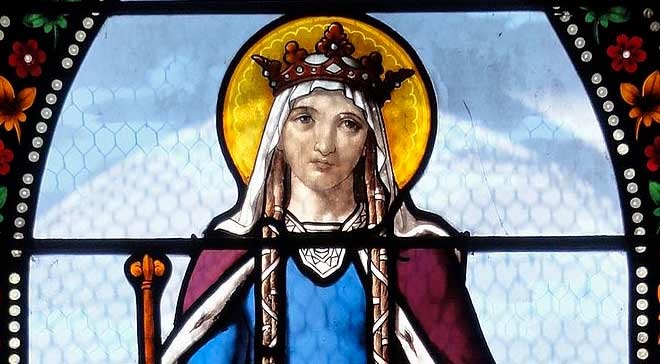

A strong and charitable woman
Queen and Empress, she remains to this day one of the brightest figures of the Christian Middle Ages: a strong, generous woman, capable of governing with a degree of competence rarely found even among the chroniclers of her time.
On December 16 the Church commemorates Adelaide of Burgundy, a woman who combined political intelligence - a rare level of culture for her age - and tireless charity, summed up in a principle she loved to repeat: “Those who possess must show mercy to those who have nothing.” Born in 931 to King Rudolph II of Burgundy and Bertha of Alemannia, she was involved from childhood in the great dynastic games of medieval Europe. Promised at a very young age to Lothair II, King of Italy, she married him at sixteen and soon became renowned for her practical faith and care for the poor.
Her destiny changed abruptly in 950, when Lothair died under mysterious circumstances, probably poisoned. Berengar of Ivrea, determined to seize power, demanded that Adelaide marry his son Adalbert. When the queen firmly refused, he imprisoned her in a castle on Lake Garda. The young woman, however, managed to escape and found refuge at the fortress of Canossa, where she appealed for help to Otto I of Saxony, eager to assert his influence over the peninsula.
Otto’s expedition ended with Berengar’s defeat and the assumption of the Italian crown. To consolidate his alliance with Burgundy, Otto chose to marry Adelaide, who thus joined her fate to his on Christmas Day of 951. Their marriage produced four children: Matilda, Henry, Bruno, and Otto, the future Otto II. In 962, in Rome, the two rulers were crowned emperors; from then on, Adelaide was no mere decorative figure, but a true collaborator of her husband, a promoter of the Cluniac reform and a supporter of places of worship and pilgrimages. Educated and trilingual—some chroniclers even say she spoke four languages—she was one of the brightest minds of the Ottonian age.
After Otto I’s death in 973, she briefly returned to her brother in Vienna, but was soon recalled to the German court: first she became the principal adviser to her son Otto II, then, after his premature death, she worked with her daughter-in-law Theophanu and with Archbishop Willigis of Mainz to secure the throne for the young Otto III. After Theophanu’s death, it was Adelaide herself who governed the Empire until her grandson came of age, alternating her political presence between Germany and Italy with a style of rule that combined firmness, diplomacy, and a Christian spirit.
When her regency ended, Adelaide dedicated herself entirely to works of mercy and to the foundation of monasteries, continuing to support the Cluniac reform with great conviction. In her final years she chose the monastery of Seltz in Alsace as her place of retreat. She died there in 999, leaving behind a reputation for wisdom, charity, and deep spirituality. Her tomb, once a destination for pilgrims, has not survived the events of later centuries. In 1097 Pope Urban II proclaimed her a saint, assigning her liturgical memorial to December 16.