


January 2: Saint Basil the Great
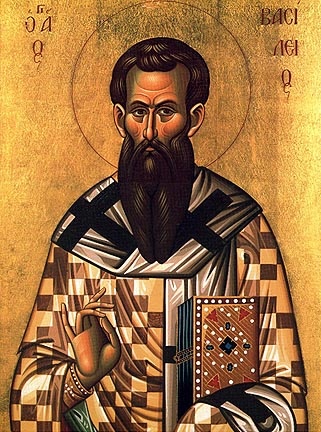

Father of many monks
In the fourth century, in a Cappadocia marked by deep doctrinal and political tensions, the figure of Basil emerged, destined to leave a lasting imprint on the life of the Church. Born in 329 in Caesarea into a cultured and profoundly Christian environment, since childhood he received an education in which faith and classical culture did not appear as opposing realities, but as complementary instruments at the service of truth. His family, marked by extraordinary spiritual intensity, was the first ground in which his vocation matured.
After a brilliant course of studies in the principal centers of the empire, Basil returned to his homeland, initially driven by a desire for intellectual distinction. However, a profound inner turning point led him to question worldly ambitions and to seek a more radical way of life. Having received baptism, he undertook a long journey among the ascetic communities of the Christian East, observing their practices and discerning what could be integrated into a balanced vision of monastic life. From this experience was born a communal model founded on sobriety, obedience, and fraternal charity, which Basil set down in a rule destined to shape Eastern monasticism in a lasting way.
His withdrawal into solitude did not long remove him from the needs of the Church. Ordained a presbyter in 360, he was soon involved in ecclesial governance during a period marked by the spread of Arianism and by imperial interference in doctrinal matters. When he became Bishop of Caesarea in 370, he assumed leadership of a vast ecclesiastical province with a style that combined firmness and pastoral sensitivity. Without yielding to doctrinal compromise, he knew how to resist political pressure with an inner freedom that earned him great authority, even in the eyes of ideological opponents.
His activity was not limited to the defense of the faith. Basil proved to be a tireless organizer of ecclesial and social life. He reformed the clergy, promoted an orderly and sober liturgy, and above all developed an extensive network of assistance for the poor, the sick and the marginalized. Near Caesarea he established an unprecedented charitable complex called the Basiliad, a true city of mercy, in which attention to material needs became a concrete expression of the Trinitarian faith professed.
On the theological level, Basil offered a decisive contribution to the formulation of the Trinitarian dogma. Against interpretations that reduced the Holy Spirit to a creature, he clarified the language of faith by precisely distinguishing the one divine essence from the three personal hypostases. His reflection did not arise in a purely speculative context, but as a pastoral response to a crisis that threatened the unity of the Church. His works and vast correspondence reveal a rigorous thought, always oriented toward the concrete life of communities.
He consumed his strength in the few years of his episcopate, worn down by illness and ecclesial tensions, yet never relaxing his sense of responsibility toward the people entrusted to him. He died on the first day of the year 379, leaving behind the image of a shepherd who had united asceticism with charity, doctrinal depth with the effectiveness of action.