


Negli Stati Uniti d’America Sr. Raffaella Petrini ha partecipato all’insediamento di Katia Passerini, 27ª Presidente della Gonzaga University
Nel segno dell’amicizia
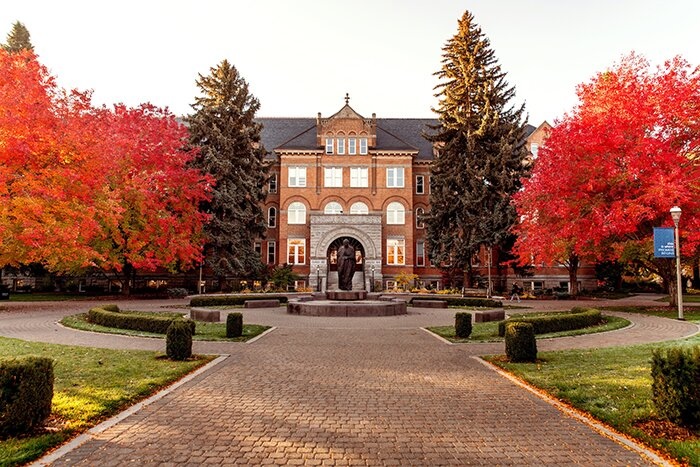
Katia Passerini è la 27ª Presidente della Gonzaga University di Spokane negli Stati Uniti d’America. Al suo insediamento e inizio del mandato - svoltosi, venerdì pomeriggio 26 settembre, al McCarthey Athletic Center di Spokane (Washington State) - ha partecipato Sr. Raffaella Petrini, Presidente del Governatorato dello Stato della Città del Vaticano, la quale ha tenuto un Keynote Address in inglese, che di seguito pubblichiamo integralmente, e in una nostra traduzione in italiano.
Precedentemente, nella chiesa di San Luigi era stata celebrata una Messa per l’inizio del mandato di Katia Passerini come Presidente. L’aveva presieduta il Vescovo di Spokane, Monsignor Thomas Anthony Daly, concelebrata da Padre Sean Carroll, Superiore provinciale della U.S. West Province della Compagnia di Gesù, e dal Gesuita Padre Gilbert Sunghera, Superiore della Comunità Della Strada della Gonzaga University.
Katia Passerini è entrata a far parte della Gonzaga University il 15 luglio scorso, divenendo la seconda laica a ricoprire il ruolo di Presidente. Fondata nel 1887, la Gonzaga è un'istituzione cattolica, gestita dalla Compagnia di Gesù, di arti liberali riconosciuta a livello nazionale. La Presidente Passerini ricopre anche l’incarico di professore presso la Facoltà di Economia Aziendale. Dal 2020 al 2025 è stata rettore e vicepresidente esecutivo della Seton Hall University.
Il testo del Keynote Address del Presidente del Governatorato:
I wish to thank your new President Katia Passerini for her kind invitation, as well as the Board of Trustees, the Regents, and the Board Members. Warm greetings to Fr. Sean Carrol, Provincial of the Jesuits’ Western Province, the Jesuit Community, the Faculty of the University, the Administrators and especially the Gonzaga Alumni, students and their parents.
I am very pleased and honored to be here with all of you today, and there are many reasons why I accepted Katia’s invitation. In fact, I would like to point out that your new President and I have a few important things in common.
First, although we were both born in Italy, our lives developed further in the United States of America, where we built relationships and became rooted in family, religious community, and professional environments. Therefore, not only have we both been deeply immersed in two cultures that share similarities and differences, but we also recognize that we have been profoundly enriched by this intense intercultural exchange. We have experienced the wealth that comes from embracing the precious gifts and uniqueness of a people different from us[1].
Second, we both studied at the LUISS University in Rome where we were gifted with the opportunity of receiving a fine formal education. We both were imbued with such values as respect for the human person, professional competence and growth, accountability, and sustainability.
Third, we both have strong connections with the Jesuit religious family. Because of her exemplary career, Katia was selected to further Gonzaga University’s mission. She will now also play a very active role in the educational mission of the Jesuit Community. I, on the other hand, was appointed as the President of the Pontifical Commission and the Governorate of Vatican City State by a Jesuit Pope. Moreover, the Vatican Observatory, which I oversee among other entities within the Vatican City State, is directed by the Jesuit Community.
Fourth, Katia and I are the first women presidents in the history of the institutions we love and serve with gratitude and dedication. We both firmly believe that collaboration, teamwork, loyalty and transparency are the foundational pillars of human-centered organizations which, inspired by Catholic Social Teaching, strive to pursue the common good.
Finally, Katia and I are friends. In fact, friendship is the main reason why I am here today. My hope is that you will continue to cultivate friendships at Gonzaga University under the guidance of your new President and her remarkable staff. All of you gathered here are the leaders of today or tomorrow, called to give back what you generously received through your family and the people that God’s Providence placed in your path[2]. Friendship tills the soil where the seed of dialogue among people and disciplines can grow.
- Empowering Potential
As you know, classical philosophy held that friendship played an important role in human existence, assuming that a person without friends cannot be truly happy, because no one can grow spiritually and morally alone[3]. For Aristotle, friendship implied a sincere desire for the other person’s good and a mutual awareness of these feelings. Common will and common judgement characterize this type of friendship[4]. Christian anthropology shares this conviction: human beings depend on God and others to satisfy their basic needs, but they also need others to develop their skills and inner talents; they need others to empower their potential. They need education, mentorship, support and care. Pope Francis reminded us that no one can face life in isolation: we need a community that supports and helps us to look to the future, because even dreams are built together[5]. This August, Pope Leo XIV reiterated to the youth gathered in Rome that “human relationships, our relationships with others, are essential for each of us”, because our lives begin with a bond with our parents, and “it is through relationships that we grow”[6].
Friendship, however, does not only include a relationship among people who freely choose to relate to one another, based on common interests. It is also a relationship among those called to spend time together as members of the same community[7]. Today, right now, you are called to be part of the wider community of Gonzaga University. Today, you are encouraged to commit time to your studies if you are a student, to your work and teaching, if you are an employee of the University, if you are a volunteer Board member or a valued guest committed to higher education in this country and beyond. You are here to be and to become leaders who are ready to pursue the good of others, leaders who are willing to sow the seeds of unity. As Pope Leo XIV said, unity “does not cancel out differences but values the personal history of each person and the social and religious culture of every people”[8].
As students, your time at Gonzaga University can indeed be a “training ground of fraternity and sharing”[9], a time when you can learn to walk forward together instead of moving as solitary travelers into the future[10]. You can connect not only digitally, but also in person, sharing the labor and the joy of each day. Together, you can aspire to something greater. You can cultivate the desire to improve yourselves and society as a whole, and to make the world more human and more fraternal[11].
- Opening Doors
True friendship, founded on the good of the other, is open to sacrifice and self-giving. It breaks through the narrow boundaries of individualism and competition to pursue higher goals and become an expression of love and solidarity. Pope Francis specified that true friendship “can only take root in hearts open to growth through relationships with others”[12]. Friends find that their hearts are capable to expand and open new doors as they step out of themselves to embrace others[13]. In the Christian tradition, like Aristotle, St. Augustine too identifies a strong connection between friendship and happiness. Since happiness finds its ultimate source in God, however, friendship has a Transcendent dimension. For this reason, it is inclusive and not exclusive; it is unbreakable, because not even death can separate true friends.
The friendships you cultivate at Gonzaga University while studying and learning or while working together in the field of higher education, have a universal mission because they profoundly impact your individual journey and your life in community[14]. In his encyclical Fratelli Tutti (2020), Pope Francis discussed the importance of social friendship emphasizing that “our love for others, for who they are, moves us to seek the best for their lives[15]. Social friendship is rooted in the “acknowledgement of the worth of every human person, always and everywhere”[16]. Only by cultivating this way of relating to one another can we foster fraternity, the structural framework of peace. Indeed, “friendship is a path to peace”, as Pope Leo XIV recently stated[17].
Pope Leo XIV also emphasized that all creation exists only in the state of being together, which is sometimes difficult and painful, but it is still a being together. “What we call ‘history’ only takes place as coexistence”[18]. Your personal history will unfold during your time here at Gonzaga University: whether you are a student, faculty member, or staff, make it a time for active participation, refining soft and hard skills, practicing kindness, and developing your natural talents for the greater good. Let it be a time for learning the “new language” of care that expresses both a fundamental need and the potential capacity of each one of us upon which the future of the next generations depend[19].
- Leading with Hope
Catholic Universities are meant to offer a space for encounter and to promote a culture of hospitality in the spirit of this Jubilee Year of Hope. In this space of encounter, students, faculty and staff are exposed to the mystery of otherness. Here, you can truly learn how to be receptive, how to make yourselves more vulnerable to others, how to take risks, and how to stay open to the unknown. These are all dimensions of friendship.
One of the main purposes of higher education – and especially of your Jesuit education at Gonzaga University under Katia’s guidance – is to build community. This community is not tailored only to satisfy individual needs but also to define common goals. Higher education, so intended, becomes an essential means of integration. It accomplishes its primary task when it can form people who are ready to journey together as friends. It is effective when it shapes leaders who can bring people together and care for them – servant leaders who wish to promote the well-being of those entrusted to them.
Education that nurtures true friendship becomes a peace-making force that can help heal fractures, protect the vulnerable, and bridge cultural and generational gaps.
I trust that, with the support of your faculty and staff, your time at Gonzaga as students will provide you with the opportunity to acquire knowledge, mature professionally, and develop your inner self. I truly believe that fostering dialogue among all here, all who are involved in various ways in the mission of this University, will help grow your capacity for collaboration and your awareness of our mutual responsibility as members of the one human family. May your time and dedication at Gonzaga inspire you to pursue greater life goals that require courage, honesty and integrity. May the spirit of true friendship that you cultivate here guide your freedom, direct your will, strengthen your hope, and help build a better future together [20].
Thank you.
[1] Cf. Francis, Fratelli Tutti, 100.
[2] Cf. S. Del Bove – F. Nicotri – D. Pelli, L’alleanza degli alumnni. Fare insieme, restituendo, trasformati, Academ Ed., Trento 2025, 28-32; C.Y. Woo, Rising, Orbis, New York 2022, pp. 21-23.
[3] Cf. M. Konrad, Dalla felicità all’amicizia, Lateran University Press, Rome 2007, 216.
[4] Ivi, 218-219.
[5] Cf. Francis, Fratelli Tutti, 8.
[6] Leo XIV, Prayer Vigil with the Young People, 2 August 2025.
[7] Cf. M. Konrad, op. cit., 217.
[8] Leo XIV, Homily, 18 May 2025.
[9] Id., Vigil Mass of Pentecost, 7 June 2025.
[10] Cf. Id., Homily, 29 June 2025; Homily, 8 June 2025.
[11] Cf. Id., Homily, Jubilee of Youth, 3 August 2025.
[12] Francis, Fratelli Tutti, 89.
[13] Ivi.
[14] Cf. M. Konrad, op. cit., 227.
[15] Francis, Fratelli Tutti, 94.
[16] Ivi, 106.
[17] Leo XIV, Prayer Vigil with the Young People, cit.
[18] Id., Homily, Pentecost Vigil, 7 June 2025.
[19] Cf. Francis, Angelus, 1 January 2023; D. Horac et al., Il potere e la vita, Ed. Paoline, Milano 2024, 13-15.
[20] Cf. Francis, Let Us Dream, op. cit., 6.
Al link seguente pubblichiamo una nostra traduzione in italiano del testo pronunciato