


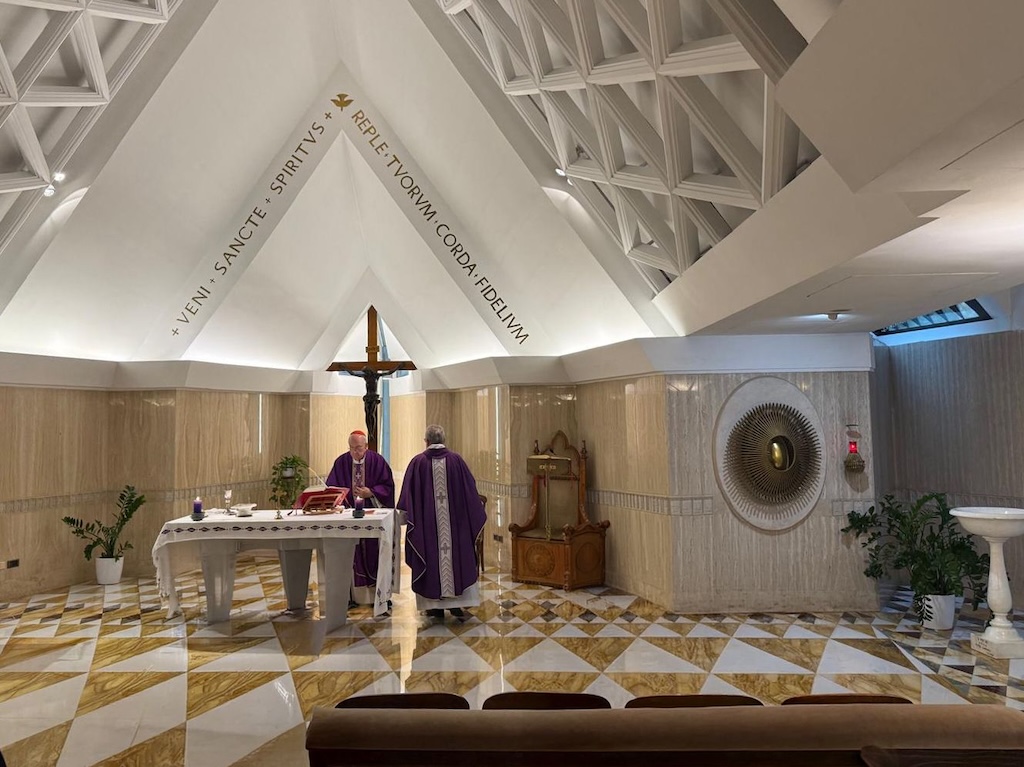
Cardinal Vérgez Alzaga celebrates Mass for the Staff of the Vatican Directorate of Health and Hygiene

Fostering trust in Christ Jesus
Cardinal Fernando Vérgez Alzaga, President Emeritus of the Governorate of the Vatican City State, celebrated Mass on the Fifth Sunday of Lent, for the personnel of the Directorate of Health and Hygiene on Saturday afternoon, March 21, in the Chapel of the Domus Sanctae Marthae in the Vatican.
Concelebrating with the Cardinal was Fra Dario Vermi of the Order of the Hospitaller Brothers of St. John of God, spiritual assistant of the Directorate of Health and Hygiene. Among those present were Giuseppe Puglisi-Alibrandi, Secretary General, and Doctors Luigi Carbone and Maurizio Soave, Director and Deputy Director respectively.
Below is the homily of the President Emeritus:
Dear Doctors Luigi Carbone and Paolo Maurizio Soave,
Director and Deputy Director of our department of Health and Hygiene, and all of you present here from the same Directorate,
The Gospel of the Fifth Sunday of Lent presents to us the miracle of Lazarus, brought back to life by Jesus. In recent Sundays, the liturgy has presented the episode of the Samaritan woman and of the blind man of Jericho. Today, we are offered the resurrection of Lazarus—or rather, a return to life of a man who had been dead for four days and was already in a state of decomposition.
There is an invisible thread linking these three episodes: the faith of the protagonists, or in the case of Lazarus, of his sister Martha. The Samaritan woman, whose name we do not know, believes in the Lord because he reveals her life and her past and enters into dialogue with her. Yet we know how unlikely it was for a Jew to speak with a woman, especially a Samaritan, who at that time were considered heretics. The man born blind of Jericho prostrates himself before the Son of Man after being healed and believes in him. In today’s Gospel account, Martha trusts in the Lord even though everything leads her to see no way out of the irreversible death of Lazarus.
In all three episodes, Jesus reveals himself as the Redeemer, the one who forgives sins and heals from illness. Lent is a training ground to prepare us to understand the resurrection of Christ—the definitive one, because the body of Jesus will assume the characteristics of eternity—whereas the resurrection of Lazarus is only a temporary event, not eternal or definitive. Indeed, Lazarus too, like all men and women, at the end of his earthly life would die again to await resurrection.
However, through the account of this miracle, the liturgy gradually leads us to understand Christ in his humanity and his divinity, in what will be the complete victory over sin and death.
Moreover, the dialogue between Jesus and Martha recalls the dialogue Christ had with the Samaritan woman. A woman who goes to the well at noon—an unusual hour to draw water—but perhaps she chooses that time precisely to avoid encounters, given her personal history. Yet that day she finds herself before a stranger from Judea. There existed a hostility, rooted in centuries of religious schisms and ethnic mixing, which led Jews to avoid all contact with Samaritans, all the more so with a woman. Jesus breaks every taboo and asks her for a drink, and the woman does not turn away. On the contrary, the dialogue becomes increasingly intimate and touches the woman’s soul.
In the same way, in his conversation with Martha, Jesus assures her that he will overcome the most insurmountable human limit: death itself. He reveals himself as the Lord of life. In sight of Martha’s faith, Jesus presents himself as the Resurrection. Therefore, whoever believes in him, even if he dies, will live - and whoever lives and believes in him will never die.
In this sense, Jesus offers Martha a solution to the problem of death and suffering—not only of her brother. He asks her if she believes. She is certain that Jesus is the God of life and not of death. What happens next is told by the Evangelist John: Jesus calls his friend Lazarus, for whom he sheds tears of sorrow and affection. Jesus too is truly human, and thus shows his participation in mourning and the dire separation from loved ones who have died. When Jesus orders that the stone in front of Lazarus’ tomb be removed, Martha reminds him that her brother is now a decomposing corpse. At this point, the Lord asks her once again to believe despite all appearances to the contrary. Then Jesus prays to the Father so that all may recognize him as the Son of God.
He shows that he is the one who can order one back to life by commanding Lazarus to come out of the tomb. The miracle is complete: life has been restored. Martha’s faith made it possible for the glory of God to be revealed, as happened with the blind man of Jericho and with the Samaritan woman.
Like the other miracles performed by Jesus, this one too aims to awaken faith and trust in him who is the Son of God, the Redeemer and Savior of humanity.
In these days right before Easter, let us allow ourselves to be drawn into faith in Christ and open our hearts to generously receive the message of salvation and hope. Let us be certain that our earthly destiny is not death, but resurrection and eternal life. The Redeemer always has the last word.
Happy Easter to you and to your families.