


July 8: Blessed Eugene III, Pope
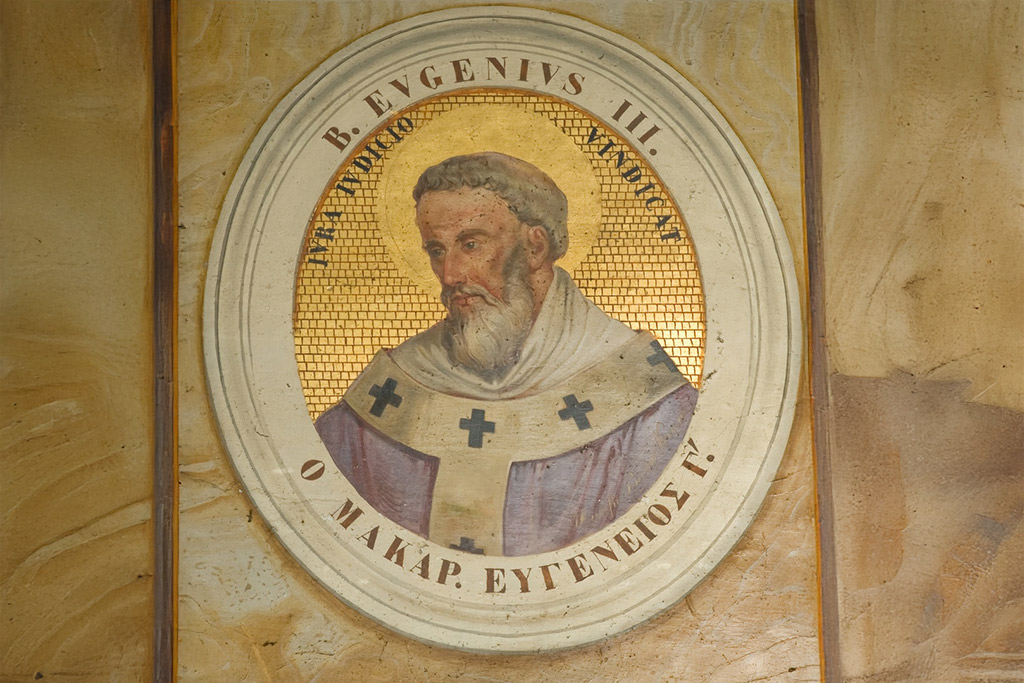

Disciple of Saint Bernard
“As soon as Peter recognized the Lord, he threw himself into the water and reached Him, while the others arrived by boat. [This event…] is a sign of Peter’s unique authority as Pontiff […]. [Peter] was given governance over the whole world, not just a single boat like the other Apostles.
The sea, in fact, represents the world, while the boats are the [local] Churches […]. Thus, while each of the other bishops has his own boat, one single, immense vessel has been entrusted to you [the Pope], made up of all the others, and that is the universal Church spread throughout the earth” (De Consideratione II, VIII, 16).
It was Saint Bernard of Clairvaux himself who wrote the treatise De Consideratione to his disciple Bernardo Paganelli, upon his election to the Chair of Peter under the name Pope Eugene III. On that occasion, as his spiritual guide, Bernard offered him this writing as a way to advise him on how to be a good pope. In this text—which remains a valuable read for any pontiff to this day—Bernard not only explains how to govern the Church well but also offers a profound meditation on the mystery of the Church and of Christ, which ultimately leads to the contemplation of the mystery of the Triune God.
The earliest confirmed reference to Bernard Paganelli dates to September 1125, when he appears as a subdeacon of the Cathedral of Pisa, having signed a solemn document of Archbishop Ruggero. He was listed second among three subdeacons, indicating that he was neither the youngest nor the most senior in that rank, and suggesting he had held the position for some time. This implies he was already over twenty years old, suggesting a birth year around 1100.
When Ruggero was succeeded by Archbishop Uberto in 1133, Bernard was appointed visdominus—an administrator of diocesan property—a role often entrusted to canons at the time. His activity in this role is documented from 1133 until May 9, 1138. After that date, there is no further record of him in Pisa. By August 10, 1139, a layman named Omicio had taken over the role of visdominus, appointed by Archbishop Baldovino. This confirms that Paganelli had left Pisa to enter the Cistercian monastery of Clairvaux.
Paganelli quickly distinguished himself within the Order, and in 1141 he was sent to Rome to become abbot of the recently restored monastery of Saints Anastasius and Vincent at the Tre Fontane, which Pope Innocent II had entrusted to the Cistercians.
Just a few years later, on February 15, 1145—the very day of the death of his predecessor, Lucius II, who had been injured during an assault on the Capitoline Hill, seat of the Roman Senate—Bernard Paganelli was elected Pope. He took the name Eugene III. His election, held surprisingly unanimously in the refectory of the monastery of San Cesareo on the Palatine, was followed by his enthronement at the Lateran. However, due to unrest, he had to flee Rome on the night of February 16–17, seeking refuge at the Abbey of Farfa, where he was consecrated pope on February 18, Sexagesima Sunday, also known as Exsurge.
The pontificate of Eugene III was marked by many challenges, especially due to the independence of the Roman Commune, which made dialogue difficult despite the pope’s diplomatic skills. For this reason, Eugene III spent little time in Rome, staying only briefly and infrequently, and preferring other towns in Lazio that remained loyal to the papacy, such as Viterbo, Tusculum, Ferentino, and Segni.
He departed for France in the first days of 1147 from Viterbo, accompanied by at least seventeen cardinals. On March 20, he arrived in Dijon and met with King Louis VII, whom he crowned on April 20 in the Abbey of Saint-Denis in Paris. He promoted the defense of Christendom and presided over four Church Councils. He died on July 8, 1153.