


July 11: Saint Benedict of Nursia, Patron of Europe
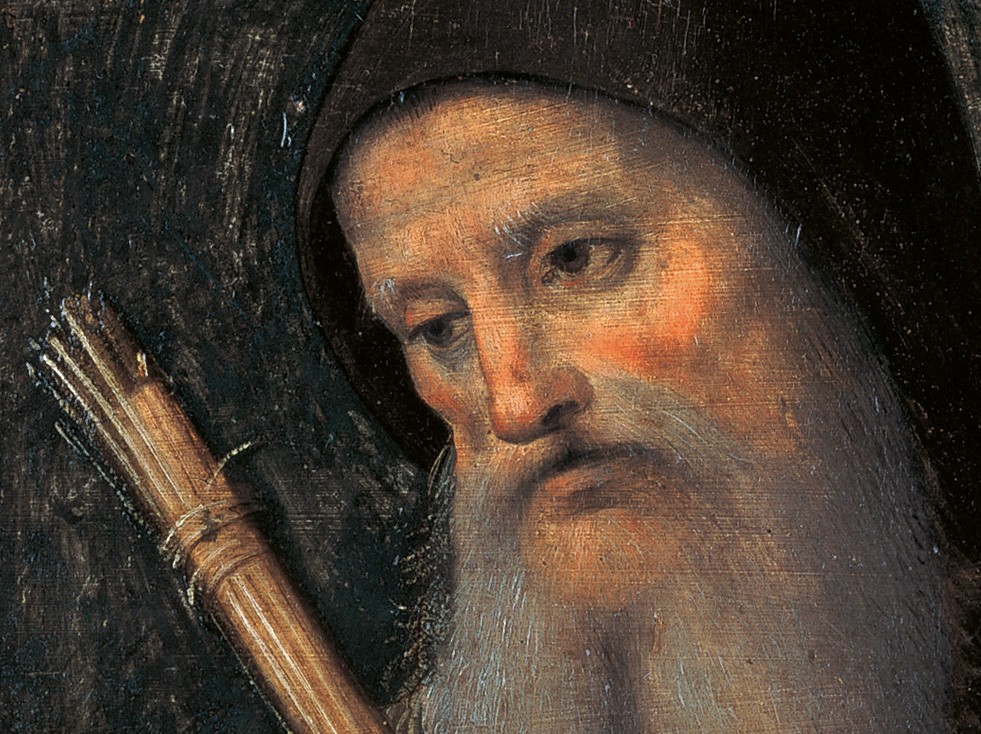

A Spiritual Father for Countless Men and Women
He is the father of a countless multitude of contemplative men and women who found in his Rule a source of life and inspiration. There is no doubt that the influence of Saint Benedict of Nursia spans the centuries and remains relevant even today.
He was born in Nursia, in the region of Umbria, in the year 480, into an aristocratic family belonging to the ancient Anician lineage. After his childhood, he was sent to Rome to complete his studies, but he was deeply disturbed by the corruption he found in the city. As a result, he decided to leave and move to Affile, a small village in the Aniene Valley, together with his governess, Cyrilla.
It was in Affile that his first miracle took place: he repaired a broken sieve that belonged to Cyrilla. This event brought him a certain amount of fame, which he found troubling, so he left the village. Following the Aniene River, he encountered a monk named Romanus who lived on Mount Taleo in a monastic community. Romanus helped him begin the eremitic life, showing him a cave where Benedict lived alone in prayer and penance.
After three years of solitude, he was discovered by locals. At that point, he decided to move to communal life. After the abbot of a nearby monastery died, Benedict—by then known for his holiness—was asked to take his place. Although he initially refused, the monks insisted, wanting him as their new abbot. However, the strict discipline Benedict introduced was not accepted by the monks, who eventually agreed to try to poison him. Benedict, however, discovered the plot through a miracle and decided to leave the monastery and return to his solitary life in the cave. But his reputation continued to grow and soon a large number of disciples gathered around him, choosing him as their spiritual guide.
He remained in the Aniene Valley for about thirty years and, due to the growing number of followers, founded thirteen monastic communities. In the thirteenth monastery, in Subiaco, he lived as the abbot.
Around the year 529, he left Subiaco and settled at Monte Cassino, where he founded another major monastery. There, around the year 540, he wrote his Rule, summarized in the famous motto Ora et Labora (“Pray and Work”). He died there on March 21, 547, and is buried alongside his sister, Saint Scholastica.
Pope Gregory the Great recounts the life and Rule of Saint Benedict in his book Dialogues. Thanks to this, Benedict became a central figure in the organization of Western monasticism, which until then had been loosely structured.
Benedictine monasticism played a crucial role in shaping European cultural identity. Even in the Middle Ages, the network of monasteries helped create cultural ties across the continent.
For this reason, on October 24, 1964, Pope Paul VI proclaimed Saint Benedict the Patron Saint of Europe.