


August 20: Saint Bernard of Clairvaux, Doctor of the Church
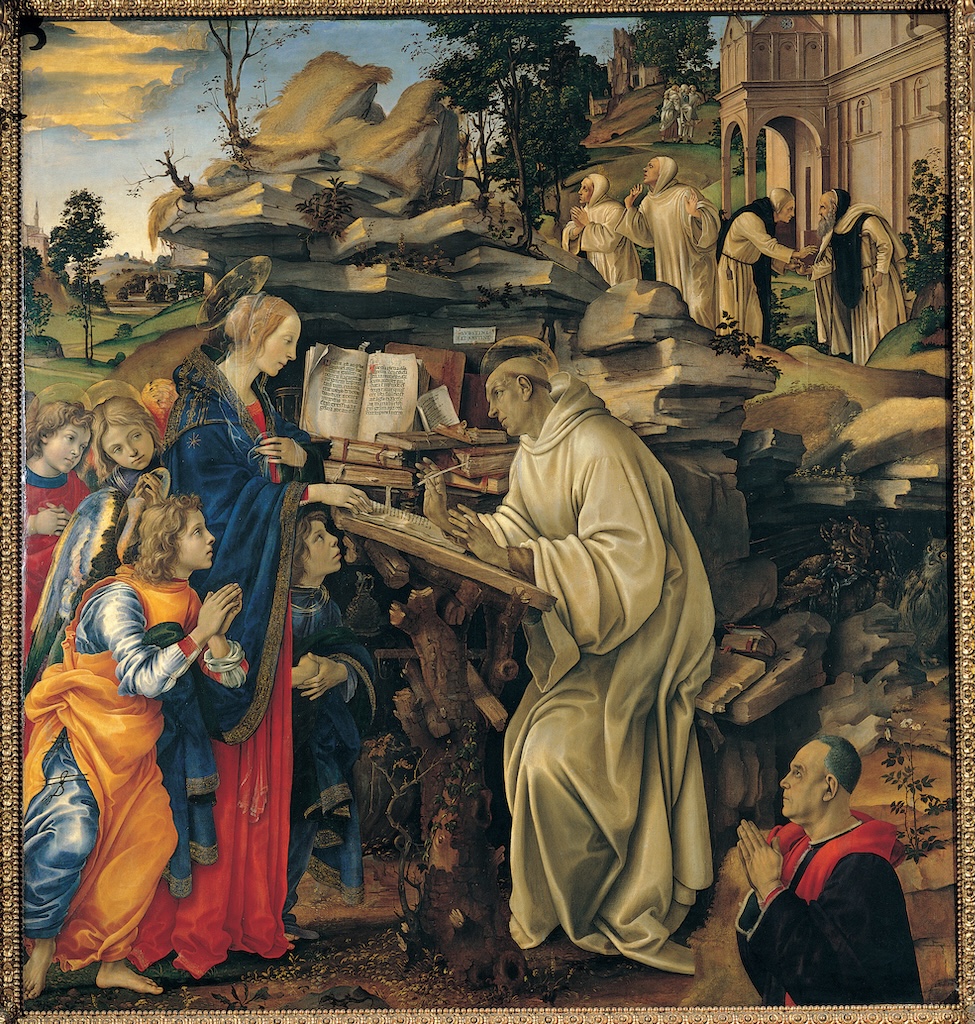

The Cantor for Mary
“If the waves of pride, ambition, slander, and envy toss you here and there, look to the star, call upon Mary! If anger, greed, or sensual urges shake the little boat of your soul, turn your thoughts to Mary!
If troubled by the enormity of your sins, ashamed by the ugliness of your conscience, terrified at the fearful thought of judgment, you are about to sink into the abyss of sadness and despair — think of Mary! In dangers, in trials, in perplexities — think of Mary, call upon Mary! Let Mary be ever on your lips and in your heart. And to win her intercession, follow her example. If you follow her, you will not go astray; if you pray to her, you will not lose hope; if you think of her, you will not err. Supported by her, you will not fall; protected by her, you will not fear; guided by her, you will not grow weary; with her favor, you will reach your goal!”
(ref. Homily II on the Annunciation, PL 183, 30)
Saint Bernard of Clairvaux sang of the Virgin Mary with words of extraordinary beauty and spiritual depth, especially in his commentary on the Annunciation, where he highlights Mary’s unique role in the mystery of the Incarnation.
One of his most famous Marian passages is a heartfelt invitation to invoke Mary as the “Star of the Sea,” a sure guide for the Christian’s spiritual journey.
Bernard was born into a noble family in 1090 at the castle of Fontaine-les-Dijon in Burgundy. He was the third of seven children. His father, Tescelin, was a knight in the service of the Duke of Burgundy and his mother, Blessed Aleth de Montbard, belonged to the local nobility. Around the year 1100, Bernard was entrusted to the school of the canons of Saint-Vorles in Châtillon-sur-Seine, where he received a solid classical and religious education, studying the Bible, the Church Fathers, and Latin authors such as Virgil, Cicero, and Seneca.
The death of his mother when he was about sixteen, affected him deeply. After a brief period of worldly life, in 1112, at the age of 22, he decided to enter the abbey of Cîteaux, accompanied by about thirty young men including three of his brothers. Cîteaux had been founded in 1098 with the aim of living the Rule of Saint Benedict more rigorously, emphasizing poverty, manual labor, and community life.
Despite his noble background, Bernard devoted himself to the humblest tasks. His fragile health made adaptation difficult, but he found strength in the study of Scripture and the Fathers of the Church. He made his monastic profession in 1114.
In 1115, Abbot Stephen Harding sent him to establish a new abbey in the Champagne region: Clairvaux (“Clear Valley”), where Bernard was ordained a priest and became abbot. The early years were harsh: conditions were extreme and resources scarce. The monks survived on the simplest food.
One day, according to tradition, the community miraculously received a donation exactly equal to what was needed for their needs after entrusting themselves to prayer. This event contributed to Bernard’s reputation as a miracle worker. Even his father and two other brothers became monks at Clairvaux. His sister Humbeline, initially resistant, converted and became a nun after a moving encounter with her brother.
In 1119, Bernard participated in the first general chapter of the Cistercian Order which established common rules in the “Charter of Charity” drafted by Harding. Bernard was one of the key figures in the Order’s expansion; starting from Clairvaux, he founded as many as 72 monasteries throughout Europe. At his death in 1153, there were 160 abbeys stemming from Clairvaux.
Bernard devoted himself to writing treatises and homilies, rich in biblical quotations. He especially commented on the Song of Songs and Saint Augustine.
He defended Cistercian austerity, in contrast to the more sumptuous style of the Cluniac monks, who used art and beauty in their liturgies. In particular, in his Apology to William of Saint-Thierry, he attacked these practices, which he considered distracting from prayer. His debate with the Benedictine Peter the Venerable, Abbot of Cluny, was intense but respectful, and the two eventually came to admire each other.
Bernard always showed a deep concern for the moral reform of the clergy. He wrote many letters to bishops, urging them to holiness. He himself lived in an extremely austere manner, to the point of compromising his health. He suffered from stomach problems throughout his life. To protect him, Bishop William of Champeaux built him a small house outside the monastery and imposed a less strict diet. However, Bernard’s health did not improve much.
His example inspired many, including Blessed William of Saint-Thierry, a Cluniac abbot who became a Cistercian in 1135 against Bernard’s own advice.
Saint Bernard is a central figure in medieval spirituality. Defender of evangelical poverty, promoter of Church reform, tireless founder and profound writer, he is considered one of the greatest saints of the 12th century.
In 1152, Saint Bernard fell gravely ill and everyone thought his end was near. However, the Bishop of Metz begged him to intervene to end a civil war devastating his diocese. Moved by compassion, Bernard, though very weak, rose from his bed, went to the site, fulfilled his mission, and then returned to Clairvaux completely exhausted.
His monks gathered around his bed, begging him not to leave them. Torn, Bernard replied with his last words:
“I do not know whom to obey: the love of my sons, who ask me to stay, or the love of God, who calls me to Himself…”
Bernard died on August 20, 1153, at the age of 63, surrounded by his fellow monks. He was canonized in 1174 by Pope Alexander III and declared a Doctor of the Church by Pope Pius VIII in 1830.