


September 16: Saints Cornelius and Cyprian, Martyrs
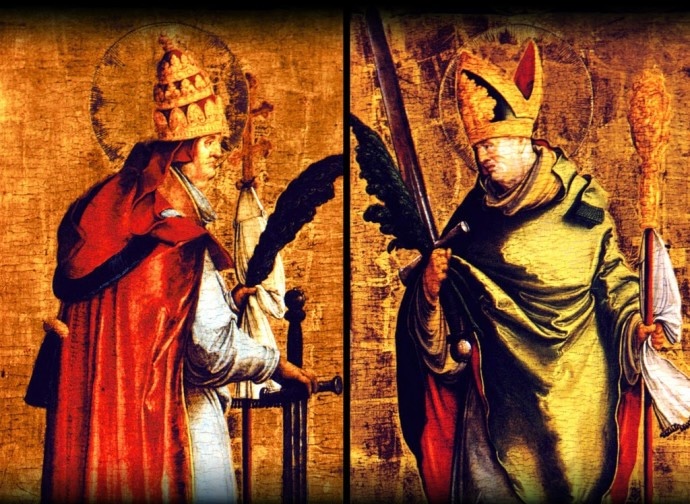

United in love for the Church
Cornelius, possibly a member of the noble Cornelii family, was elected Pope in 251 for his renowned qualities of kindness, prudence, and humility. Before his election, during the period of the Sede Vacante, Novatian, an educated and influential priest, had temporarily led the Church. When Cornelius was appointed, Novatian opposed him, accusing him of being too lenient toward those Christians who, during the persecutions, had renounced the faith (the so-called lapsi), thus causing a rigorist schism.
The Bishop of Carthage, Cyprian, supported Cornelius, sharing his approach of mercy and defending him against those who threatened the unity of the Church. Cornelius died in exile at Civitavecchia in 253, during the persecution under Emperor Gallus; in 258 his body was transferred to Rome and buried in the Catacombs of Saint Callistus.
Cyprian, born in Carthage around 210, was a rhetorician and lawyer before his conversion to Christianity in 246. He became Bishop in 249. He devoted himself to the organization of the Church in Africa and was involved in the issue of the lapsi during the persecution under Emperor Decius. He remained faithful to Cornelius’ pastoral approach and, together with him, condemned—through a council—those who sowed division within the Church.
He was an important teacher of Christian morality and his writings, especially his letters, offer valuable testimony to the faith and liturgy of the 3rd century. Along with Tertullian, he contributed to the birth of Christian Latin.
The letters exchanged between Cyprian and Cornelius reveal an extraordinary harmony between the two Churches, particularly in their vision of the Church as a community founded on the Eucharist.
During the persecution under Valerian, Cyprian withdrew for a time, but in 251 he returned to Carthage to publicly resume his role as pastor. He was arrested and executed on September 14, 258, in front of his people.
The Church remembers Cornelius and Cyprian together in the First Eucharistic Prayer, celebrating them as martyrs united in love for the Church and its unity. Their joint veneration underscores the deep unity between the ancient Churches, especially between Rome and Carthage.