


October 13: Saint Edward, King
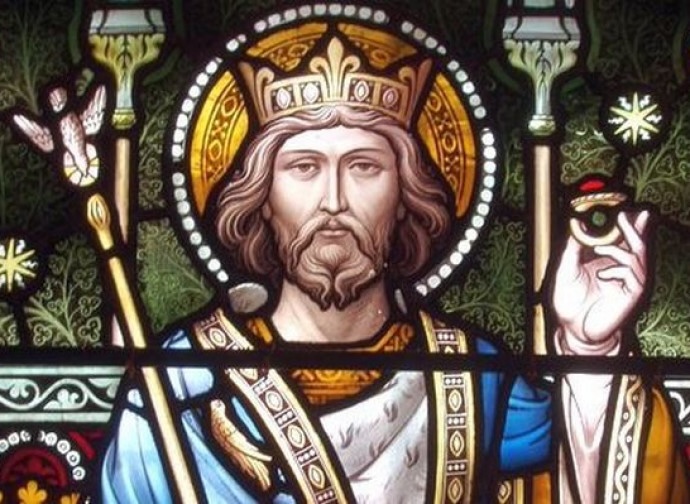

The Patron of the English Monarchy
Saint Edward the Confessor, venerated as the Patron Saint of the English monarchy, was born around the year 1002 in Islip, near Oxford. The son of the Anglo-Saxon King Æthelred II and the Norman Emma, sister of Duke Richard II of Normandy, he spent much of his youth in exile at the Norman court, where he had taken refuge following the Danish invasion of 1013. He remained in Normandy for about twenty-five years, during which he developed a deep spirituality and a profound attachment to the Christian faith.
He was recalled to England in 1041, at a time when the country was under Danish rule. After the death of his half-brother Harthacnut, the son of Emma and the Danish king Cnut the Great, Edward was chosen by the people and the nobility to ascend the throne. His coronation took place on Easter Day in 1043 at Winchester Cathedral, the ancient heart of Saxon power. As sovereign, he was distinguished by his peaceful, just and moderate rule, which won him the affection of his people although he faced opposition from certain powerful nobles.
In 1045, he married Edith, daughter of Earl Godwin, his political rival. According to tradition, theirs was a chaste marriage. Edward is also remembered for having vowed to make a pilgrimage to Rome—a vow he was unable to fulfill. Instead, he founded a grand Benedictine abbey dedicated to Saint Peter at Westminster, which became the heart of the English monarchy and has remained the site of royal coronations to this day.
During his reign, Edward promoted the spread of Christianity in England and embodied a deep religiosity combined with an evangelical spirit of mercy and prudence. For this reason, he was called “the Confessor”—not because he suffered martyrdom, but because he bore witness to Christ through his virtuous life.
Many popular legends attribute miraculous powers to him. In one, he is said to have carried a sick man on his shoulders, following a vision granted to a pilgrim by Saint Peter. In another, he gives a ring to a beggar, who later reveals himself to be Saint John the Evangelist in disguise.
Edward died on January 5, 1066, shortly after devoutly receiving the sacraments. His body, first buried at Westminster, was found incorrupt in 1102—an event that further strengthened his cult. He was canonized by Pope Alexander III in 1161, at the urging of King Henry II of England, who promoted his veneration as a symbol of unity between the Anglo-Saxon and Norman royal houses. Two years later, Archbishop Thomas Becket presided over the solemn translation of his relics to the new chapel of Westminster Abbey, where fourteen reliefs depict scenes from his life.
A second translation took place in 1269, and his shrine survived even the iconoclastic fury of the English Reformation. To this day, the tomb of Saint Edward the Confessor remains within the abbey he founded—a guardian of a thousand-year-old tradition.