


October 30: Saint Germanus of Capua, Bishop
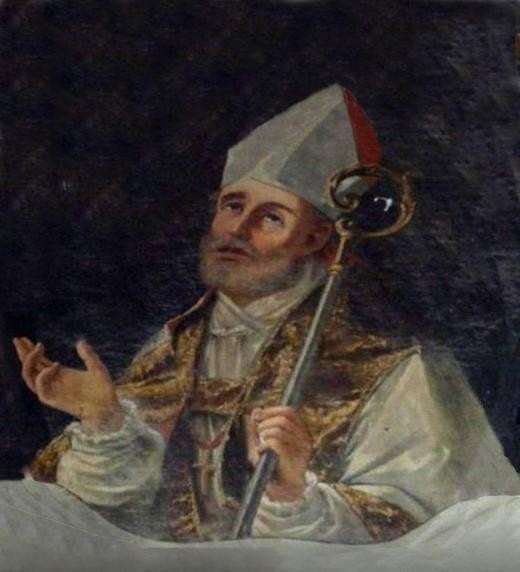

A Shepherd in the Service of Unity
Germanus was appointed Bishop of Capua around the year 519, but before that date, his life remains largely shrouded in obscurity. The only information about his origins comes from a hagiographic source of the ninth century, considered late and unreliable. According to this account, Germanus was born in the city of Capua between 470 and 480, to parents of high social rank, Amanzio and Giuliana. After his father’s death, and with his mother’s consent, he decided to sell the family’s possessions in order to devote himself entirely to an ascetic life and the study of the Scriptures. Upon the death of Bishop Alexander, the Capuan community elected him as successor, and only after much insistence did he accept the office.
The historical context in which he lived—the decline of Theodoric’s reign and the beginning of the Gothic War—makes it difficult to reconstruct precisely the actual impact of his episcopate on the political and religious life of Capua.
Germanus’s historically attested presence emerges in a crucial event: the diplomatic mission sent by Pope Hormisdas to Constantinople in 519, with the aim of ending the Acacian schism. The Liber Pontificalis is the only contemporary source that clearly attests to his role as Bishop of Capua; other sources refer to him only generically as episcopus.
The Acacian schism, initiated in 482 by Emperor Zeno and Patriarch Acacius through the promulgation of the Henotikon, sought to reconcile Catholic and Monophysite positions, but was rejected by Pope Felix III, who excommunicated Acacius. From that moment, relations between Rome and Constantinople deteriorated profoundly, until Pope Hormisdas, in 519, organized a new legation following the failure of previous attempts.
Germanus was chosen as head of the delegation, as shown by the sources that consistently mention him first. This role indicates that he was regarded as a man of remarkable spiritual and diplomatic gifts. The mission departed from Rome between January and March 519 and, after crossing the Adriatic and stopping at Vlora and Ohrid (where Germanus celebrated Mass), reached Constantinople at the beginning of Holy Week.
The delegates were received with great enthusiasm: Justinian, not yet emperor, met them with honors ten miles outside the capital, and the population welcomed them warmly. On Holy Monday they met Emperor Justin I and later the Senate and Patriarch John. The high point of the mission came on Holy Thursday, when the papal libellus—a key document reaffirming Rome’s authority in the universal Church—was formally discussed in the presence of the highest authorities. The result was a complete success, and Germanus remained in Constantinople for over a year to consolidate the agreement with the other Eastern Churches.
On July 9, 520, an encomiastic letter from the Emperor to Pope Hormisdas confirmed the effectiveness of the delegation, while in a subsequent letter dated July 15, the Pope expressed concern about the prolonged stay of his envoys—though justified by the delicacy of the final phase of negotiations.
Little is known about Germanus’s pastoral activity in Capua. The only recorded detail, found in the Chronicon Salernitanum, mentions that he changed the dedication of the Basilica of the Apostles to that of Saints Stephen and Agatha, perhaps after obtaining some relics from Constantinople.
Germanus’s lasting fame, however, is chiefly due to the testimony of Saint Gregory the Great in his Dialogues. In one passage (II, 35), Pope Gregory recounts a vision experienced by Saint Benedict of Nursia at Montecassino: he saw the soul of Germanus ascending to heaven in the form of a fiery globe. Later, he learned through messengers that Germanus had died at that very moment. In another episode (IV, 42), Germanus appears as an intercessor for the release of the soul of the Roman deacon Paschasius.
Germanus probably died in early 541, as suggested by the epitaph of his successor Victor, who served as Bishop of Capua from 541 to 554. His episcopal ministry therefore lasted for over twenty years, beginning in 519.
During the ninth century, the cult of the Capuan bishop enjoyed particular veneration, especially through the ties with the monastery of Montecassino. When Capua was refounded in 849 by Landon, the body of Germanus was translated to the new city. During a visit by Emperor Louis II around 873, part of his relics was transferred to Montecassino—a fact that may explain the origin of the place name San Germano in the area. Another portion was brought to Piacenza, probably by Engelberga, the Emperor’s wife, and placed in the crypt of the Church of San Sisto, which she founded in 874.