


November 6: Saint Leonard of Noblac, Hermit
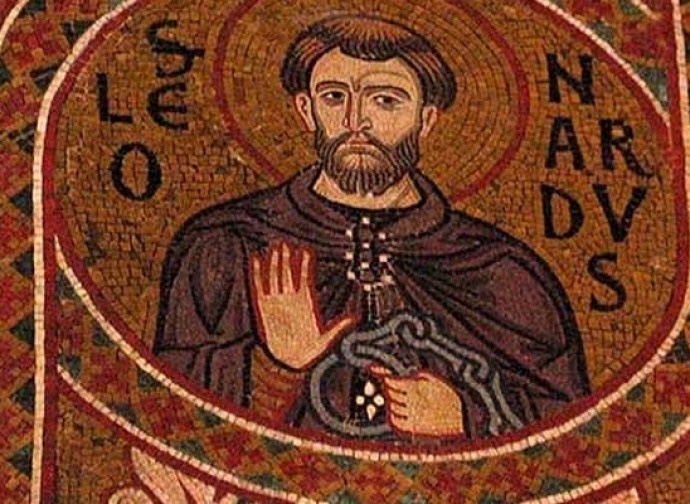

In search of God through prayer and solitude
Leonard was born at the end of the 5th century in a castle near Orléans, in what is now France. His family, connected to the Frankish court, had ancient roots and probably Roman origins. He received solemn baptism from Saint Remigius, Bishop of Reims, who became a deeply influential spiritual guide for him. Clovis, King of the Franks, served as his godfather and granted him the power to free prisoners whom he deemed innocent; Leonard used this privilege to help many oppressed people.
When he was offered a position of prestige within the Church, he refused, preferring instead a simple, contemplative life in a monastery near Orléans. As a young man, he had been educated to be an exemplary citizen, a brave soldier, and a man of the court, but he felt a strong calling toward prayer and the spiritual life. Deeply inspired by the life of Jesus—especially His childhood—Leonard sought always to follow His example of obedience.
Despite his dedication to helping the poor, Leonard felt the need to withdraw into solitude for a life of meditation and purification. For this reason, he gave all his possessions to the needy and embraced the monastic life, with the blessing of Saint Remigius. His brother decided to follow him on this path. The two were welcomed into an abbey, but after the abbot’s death, Leonard went farther afield, seeking an even more secluded retreat in the forests of Aquitaine.
There he lived in a hut made of branches beneath a great tree. He dug a well and built a small church dedicated to Mary and an altar in honor of Saint Remigius. King Clovis, grateful to him for helping the queen during childbirth, granted him the forest that he could travel around on a donkey within a single day. This area became the heart of his settlement, which later took the name Noblat in his honor.
Leonard died in 559, surrounded by his followers, who already regarded him as a saint. Around his monastery grew a community that took the name Saint-Léonard-de-Noblat.
His cult spread widely, especially from the 11th century onward. Notable figures such as Bohemond of Antioch and Richard the Lionheart venerated him as a saint, giving thanks for miracles attributed to his intercession. His tomb became an important pilgrimage site, and the church built in his honor was elevated to the status of a royal basilica. The veneration of Saint Leonard spread throughout Europe, reaching Italy through the Normans, particularly in the South.
He is often depicted as a monk or abbot, holding chains and shackles that symbolize his role as protector of innocent prisoners. He is also the patron saint of several cities and professions and is invoked for many needs—from difficult childbirths to animal diseases, and for protection against bandits and natural disasters.