


November 7: Saint Willibrord, Bishop
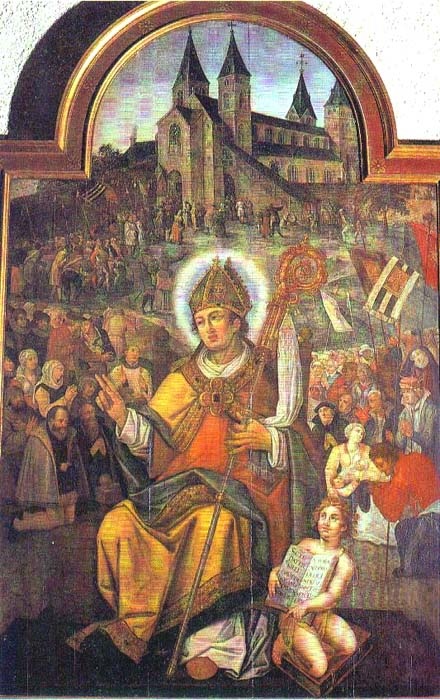

Missionary of the Netherlands
Willibrord was born around 658 in the English region of Northumbria. His education began at the monastery of Ripon, where he received a solid religious formation. At the age of twenty, he decided to deepen his theological studies in Ireland under the guidance of an abbot named Egbert. Around the age of thirty, he was ordained a priest and, together with a group of eleven companions, set out for the continent to spread Christianity in the still pagan lands of Frisia and northern Germany.
In 689, they landed in a marshy area near the Scheldt River, where they were warmly welcomed by Duke Pepin of Herstal, a powerful Frankish ruler. Before starting his mission, Willibrord travelled to Rome to obtain the approval of Pope Sergius I, who granted him official mandate. Upon his return, he established his base in Antwerp, from where he began founding Christian communities, including that of Utrecht, which would become an important religious center.
In 695, Willibrord returned to Rome to receive episcopal consecration, taking the name Clement. From then on, he undertook numerous journeys, extending his missionary work into the regions along the Rhine and beyond, reaching as far as Denmark. Despite his small stature and fragile health, he was a man of great inner strength—tireless in his work, disciplined, and faithful to Christian principles.With the support of several prominent figures, such as Saint Firmina and Bishop Basinus of Trier, he founded the monastery of Echternach, which became a spiritual landmark for the region. However, after the death of his protector Pepin in 714, the political situation changed and his territories were attacked, forcing him to take refuge in Echternach itself, where he spent the final years of his life.
Willibrord died on November 7, 738, leaving behind a spiritual legacy that contributed to the spread of Christianity in Northern Europe.