


December 9: Saint Juan Diego Cuauhtlatoatzin
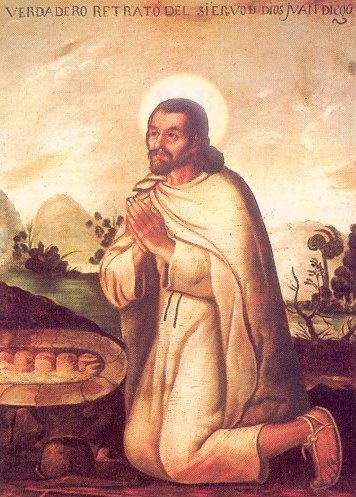

Humble servant of Mary
The apparition of the Virgin Mary at Guadalupe in Mexico is filled with spiritual and cultural meaning and at its center stands the figure of Saint Juan Diego: a simple man of Indigenous origin who, through his sincere faith, became an instrument of dialogue between different cultures.
Juan Diego was born in 1474 in Cuautitlán, then part of the kingdom of Texcoco (Mexico), a territory inhabited by Chichimec peoples. His original name was Cuauhtlatoatzin, an expression that evokes the image of an eagle letting out its call.
When he was already an adult and had a family of his own, he came into contact with the faith introduced by the Europeans and was deeply moved by it, especially thanks to the preaching of the Franciscans who arrived in the region in 1524. Later, he and his wife María Lucía received baptism and were married according to the Christian rite. Their married life, however, did not last long: she died prematurely.
On December 9, 1531, while crossing the slope of Tepeyac, Juan Diego had an extraordinary experience: a radiant woman appeared to him and introduced herself as the Virgin Mary. She instructed him to go to the Bishop of Mexico City, the Franciscan Juan de Zumárraga, so that a shrine might be built at the place of the apparition.
Juan Diego obeyed, but the Bishop did not believe him. The Virgin appeared to him again and encouraged him to persist. The next day, he returned to the prelate, who questioned him about Christian doctrine and asked him for a sign confirming the truth of what he claimed.
On December 12, the Virgin appeared once more and comforted him in his distress. She ordered him to climb to the top of the hill and gather flowers, even though it was winter and the ground was barren. With simple trust, Juan Diego did as he was told and found, to his astonishment, beautiful flowers in bloom. He picked them and wrapped them in his tilma, the traditional cloak of his people, to bring them to the Bishop.
When he opened the tilma before Zumárraga, the flowers fell to the ground and, at that very moment, the image of a young woman with an Indigenous face and dark-colored skin appeared on the fabric: the figure of the Lady who had appeared to him—the Virgin of Guadalupe. This event marked the beginning of one of the greatest Marian devotions in the world and gave new strength to the Christian mission in the Americas, symbolically uniting Spanish and Indigenous cultures.
The Bishop authorized the construction of the Shrine on Tepeyac, and Juan Diego became the first guardian of the sacred place. He chose to live in a small dwelling beside the chapel, which he tended with care, welcoming pilgrims until his death in 1548. He was beatified by Saint John Paul II in 1990 and canonized in 2002.