


April 3: Saint Richard of Chichester, Bishop
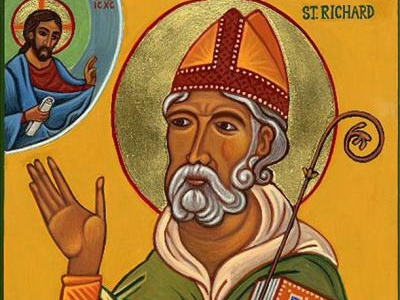

For the reform of the clergy
He devoted himself to the reform of the clergy, to the free administration of the sacraments, to the observance of holy days, and to charity toward the sick and elderly priests.
He is Richard of Chichester, born in Wych—modern-day Droitwich, in the county of Worcester, England—around 1197. His parents were modest landowners. Due to financial difficulties, he soon had to work on the family farm until he was able to move to Oxford to study, where his teachers included Robert Grosseteste and Edmund Rich. He later went first to Paris and then to Bologna to study Canon Law. He refused marriage twice.
In 1235 he returned to Oxford and was elected Chancellor of the University. Two years later, Edmund Rich, having become Archbishop of Canterbury, appointed him as his chancellor. Richard actively assisted the Archbishop in reforming the clergy and defending the Church’s independence from royal interference.
Edmund withdrew to France, to the Cistercian monastery of Pontigny, to avoid further conflict with King Henry III of England, and Richard accompanied him. In 1240, after Edmund’s death, Richard decided to become a priest, having studied theology for two years with the Dominicans in Orléans. In 1242 he was ordained a priest and returned to England, where he was appointed parish priest of a parish in Kent. He later resumed his role as chancellor to the new Archbishop of Canterbury.
In 1244 he was the candidate of the Archbishop and the bishops for succession to the See of Chichester, but King Henry III had his own candidate for that position, leading to conflict.
Pope Innocent IV confirmed Richard’s appointment and consecrated him bishop in Lyon in 1245. However, the king had confiscated all the goods of the diocese, so Richard had to be hosted by a parish priest and was forced to visit communities on foot, lacking financial means. After two years, Henry III, threatened with excommunication by the Pope, restored the goods to the diocese.
Richard was in Dover to erect a church in honor of Edmund Rich, who had been canonized by Pope Innocent IV, when he fell gravely ill and died on April 3, 1253.
After only nine years, he was canonized by Pope Urban IV on January 22, 1262. On June 16, 1276, in the presence of King Edward I, bishops, and the royal court, his body was translated from the tomb into a shrine behind the high altar of Chichester Cathedral.