

The Shrine of Arenzano (Genoa) Donates a Wooden Statue of the Infant Jesus to Vatican City State
%20Donates%20a%20Wooden%20Statue%20of%20the%20Infant%20Jesus%20to%20Vatican%20City%20State "Pin It")
Light of hope and symbol of God’s love for humanity
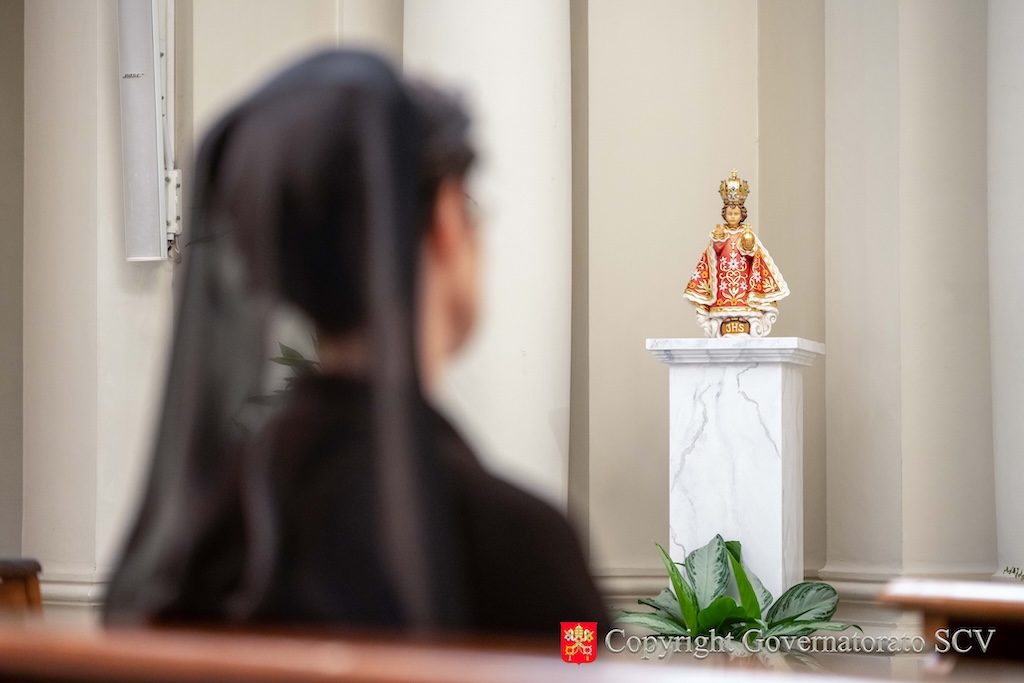
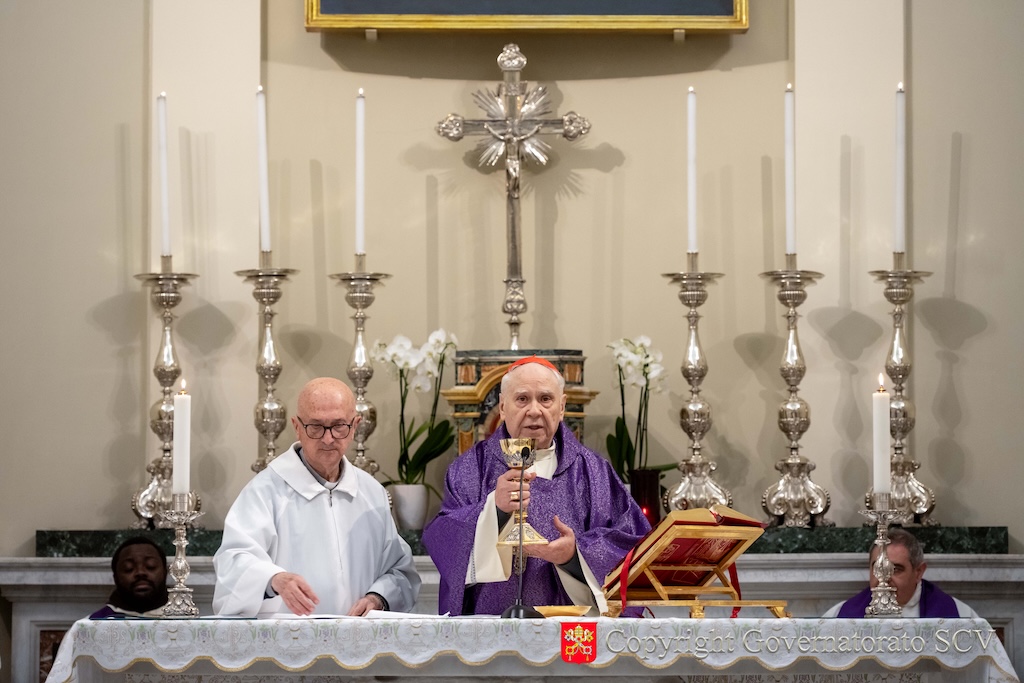
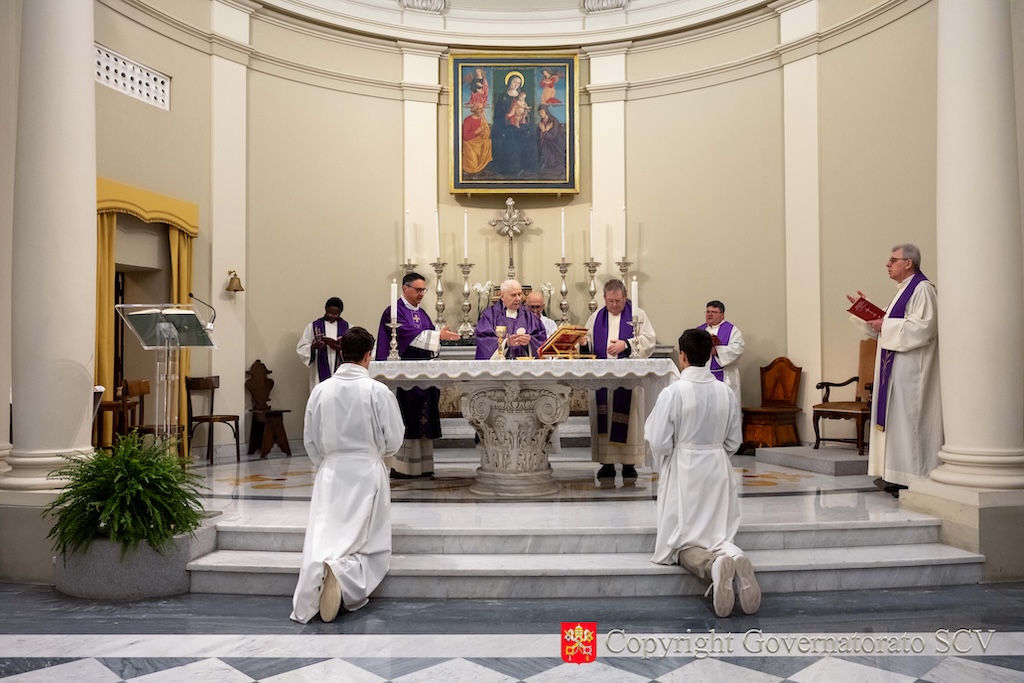
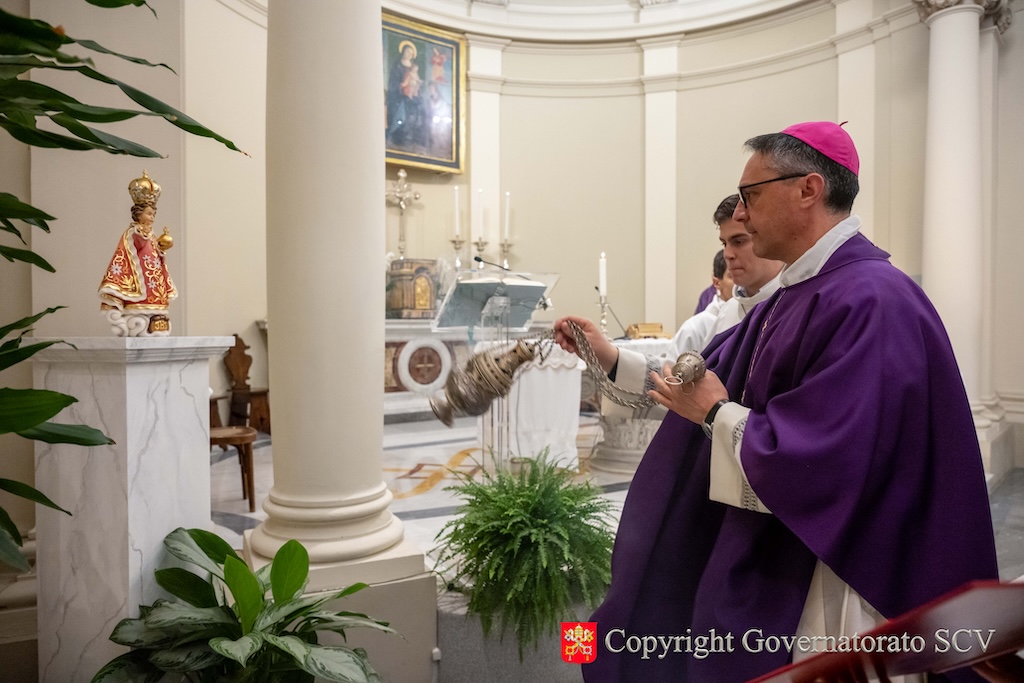
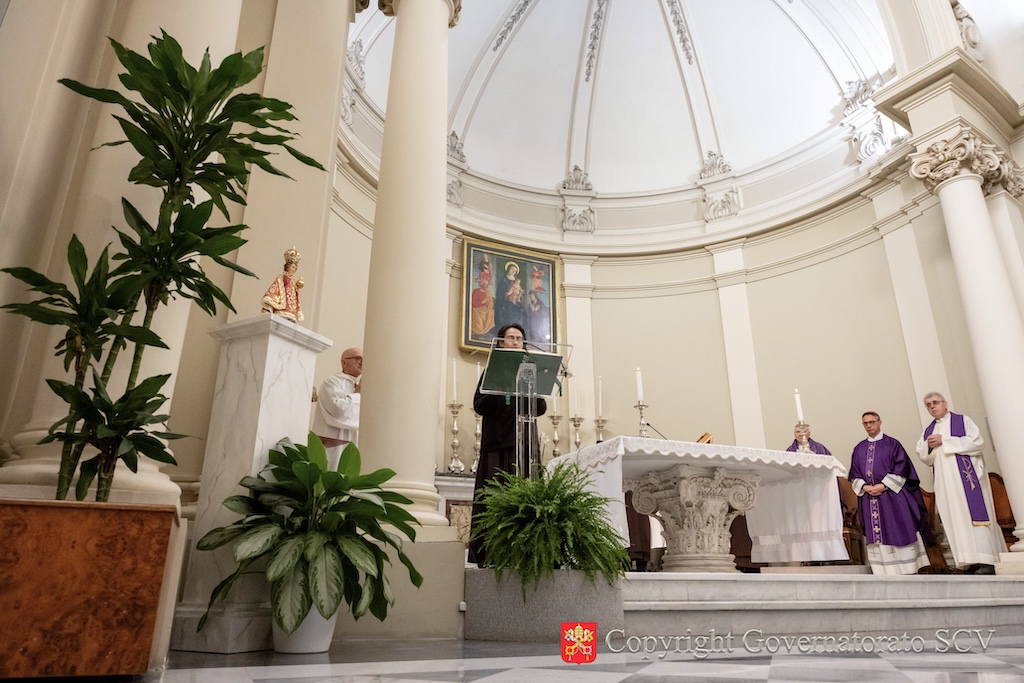
A wooden statue of the Infant Jesus is now present in the Church of Mary, Mother of the Family, in the Governorate building. It was donated by the community of the Discalced Carmelites of the Shrine of Arenzano (Genoa). The enthronement ceremony took place on Thursday afternoon, March 26, in the presence of Cardinal Domenico Calcagno, President Emeritus of the Administration of the Patrimony of the Apostolic See, who also presided over the Holy Mass.
Receiving the gift were Sr. Raffaella Petrini, President of the Governorate of the Vatican City State, and Archbishop Emilio Nappa, Secretary General, who also concelebrated Mass with the Cardinal.
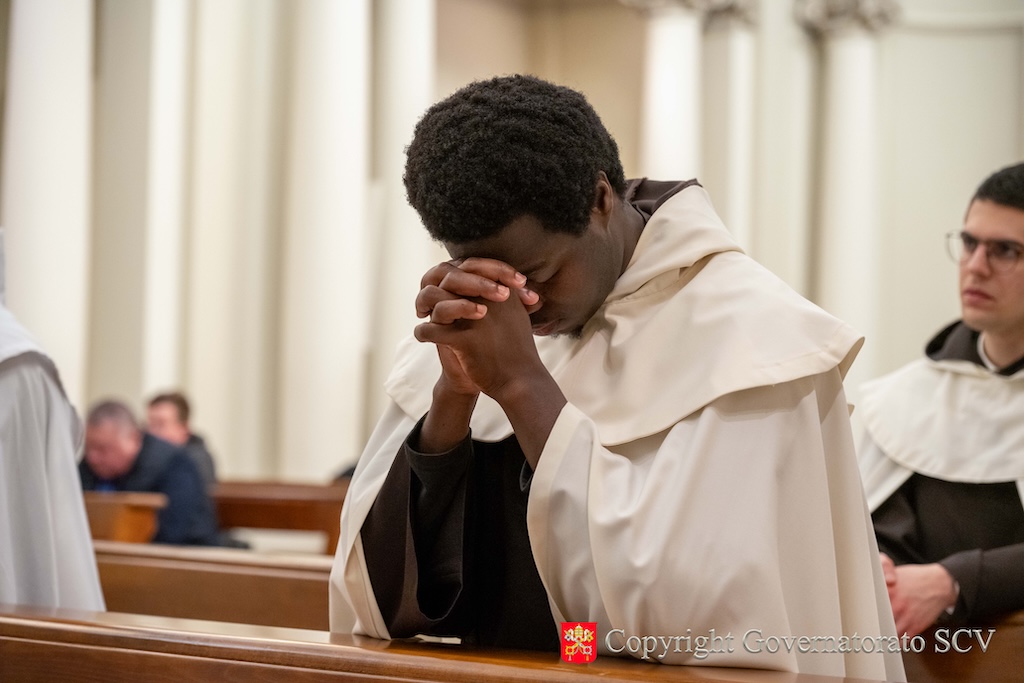
A delegation from the Shrine of the Infant Jesus was present, led by Father Domenico Rossi, Vice Prior, Father Pierluigi Canobbio, and Father Marco Cabula, Rector of the Minor Seminary, together with some seminarians and students from Genoa. Don Franco Fontana, Coordinator of the Chaplains of the Directorates and Central Offices, directed the liturgical rite.
The original of the famous wooden statue of the Infant Jesus, flanked by two small statues of the Virgin Mary and Saint Joseph, is displayed for the veneration of the faithful in the Church of Our Lady of Victory in Prague. The Infant Jesus is depicted in royal garments, with the right hand raised in blessing and the left hand holding a golden orb surmounted by a cross. The work was created in Spain by an unknown artist and was donated to the Discalced Carmelites in 1628 by Princess Polyxena of Lobkowicz, who had received it as a wedding gift from her mother, María Manrique de Lara.
From that moment on, crowds of faithful flocked to the church in Prague to honor the Infant Jesus. A great apostle of this devotion was the Venerable Fr. Cyril of the Mother of God (+1675), to whom the Infant Jesus promised in 1637: “The more you honor me, the more I will favor you.” The statue is adorned with three crowns and a wardrobe of 46 garments, which are changed about ten times a year according to the liturgical seasons.
Address by the President of the Governorate
Greetings to
His Eminence Cardinal Domenico Calcagno,
Archbishop Emilio Nappa, Secretary General of the Governorate,
Don Franco Fontana, Coordinator of the Chaplains of the Directorates and Central Offices,
Father Domenico Rossi, Vice Prior, and Father Pierluigi Canobbio, of the Shrine of Arenzano,
Father Marco Cabula, Rector of the Minor Seminary,
and through them I extend my greetings to Father Piergiorgio Ladona, Prior of the Discalced Carmelites of the Shrine of Arenzano.
I also welcome all of you present here.
I rejoice in your kind donation of the statue of the Infant Jesus of Prague, a faithful reproduction of the one venerated by the faithful in the Shrine of Arenzano in Genoa. I sincerely thank the Discalced Carmelites of the Shrine for their generosity.
There is a spiritual bond that unites Vatican City with Arenzano: devotion to the Infant Jesus and the See of the Successor of Peter. The Popes, beginning with Leo XIII and Saint Pius X, encouraged devotion to the Little King. Leo XIII established the Congregation of the Infant Jesus of Prague, and Pius X promoted the spread of its devotion.
In 1924, Pius XI sent Cardinal Raffaele Merry del Val – at the time the Archpriest of St. Peter’s Basilica in the Vatican - to Arenzano to solemnly crown the statue of the Infant Jesus. The same Pontiff, in 1928, granted the Shrine the title of Basilica.
Devotion to the Infant Jesus is linked to the mystery of the Incarnation of Christ. Some Church Fathers venerated God in the form of a child, such as Saint Athanasius and Saint Jerome. Among the saints closer to us are Saint Bernard of Clairvaux, Saint Anthony of Padua, and Saint Francis of Assisi, who created the first living Nativity scene in the town of Greccio. For him, the Nativity was a simple grotto, with a poor manger, and at its center the Child, born among his people. Two great saints, the founder of the Reformed Carmel, Saint Teresa of Ávila, and Saint Thérèse of Lisieux, also contemplated with deep devotion the mystery of Jesus’ birth and his childhood.
In this regard, I recall that Pope Francis, during the catechesis at the General Audience on Wednesday, December 30, 2015, emphasized: “To grow in faith, we need to contemplate the Infant Jesus more often.”
Pope Benedict XVI, during his apostolic journey to the Czech Republic on Saturday, September 26, 2009, visited the Church of Our Lady of Victory in Prague and paid homage to the Infant Jesus. On that occasion, he referred to the need to protect children and accompany them in their growth, avoiding offenses to their dignity: “In the Holy Child of Prague,” he said, “we contemplate the beauty of childhood and the preference that Jesus Christ has always shown for the little ones, as we read in the Gospel (cf. Mk 10:13–16),” also, because “children are the future and the hope of humanity.”
Finally, Pope Leo XIV, in his homily for the Mass during the Night of the Lord’s Nativity on Wednesday, December 24, 2025, emphasized that in the Child of Bethlehem, God’s omnipotence is revealed in fragility and smallness, inviting us to welcome the least and the weakest, overcoming all selfishness: “In the Child Jesus, God gives the world a new life: his own, offered for all. He does not give us a clever solution to every problem, but a love story that draws us in. In response to the expectations of peoples, he sends a child to be a word of hope. In the face of the suffering of the poor, he sends one who is defenseless to be the strength to rise again. Before violence and oppression, he kindles a gentle light that illumines with salvation all the children of this world.”
I therefore hope that the presence of the statue of the Infant Jesus within Vatican City—clothed in royal garments and bearing the insignia of a sovereign, in the act of blessing—may be a light of hope, a symbol of God’s love for humanity, and a source of prayer for so many children who are abandoned, deprived of their rights, exploited, and wounded by war. May the humanity and divinity of Christ, expressed in the image we venerate from today in this church of the Governorate, protect, accompany, and bless all the children of the world, and in a particular way the families that form the working community of the Vatican City State.
Thank you again for your presence and generosity.