

Interview with the Head of the Gardens and Environment Service of the Governorate

The Fisherman's Basket in Memory of Saint Peter
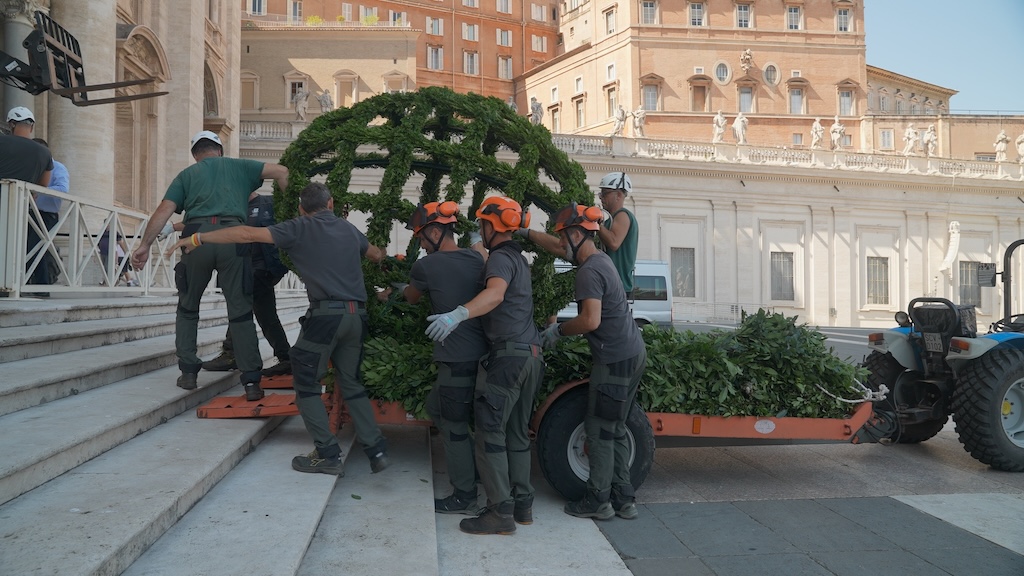
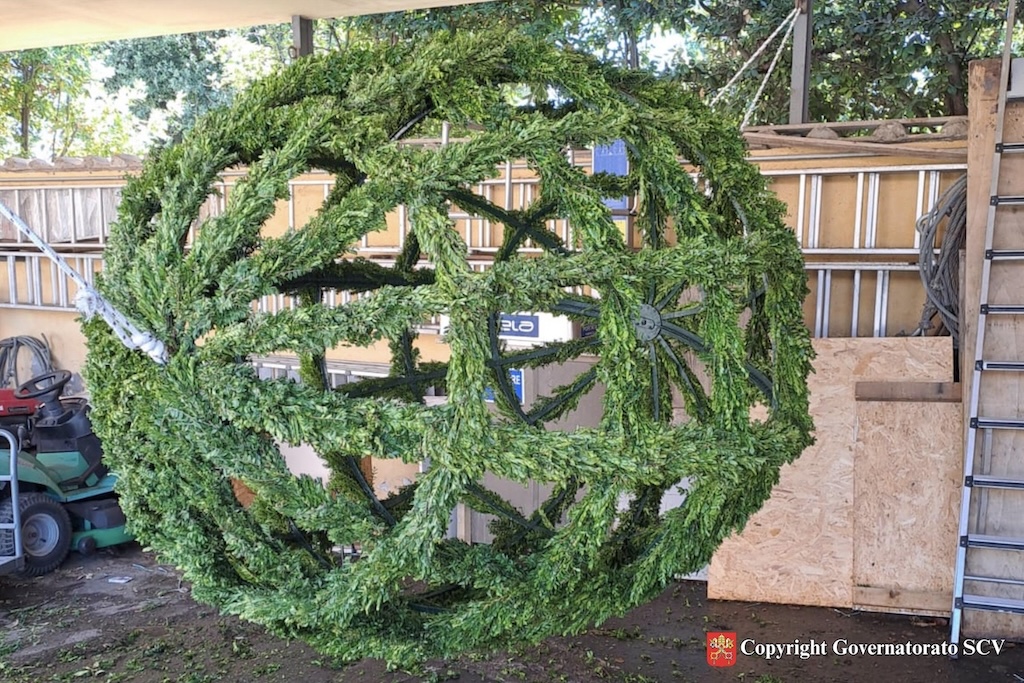
A team of professional gardeners combines its expertise each year to create a tribute to the Prince of the Apostles: the renowned Fisherman's Basket (Nassa del Pescatore). This metal structure reproduces an ancient woven fishing trap consisting of a funnel and a net that catches fish attracted by bait placed inside. It recalls the fish traps that fishermen on the Sea of Galilee would leave submerged overnight and retrieve the following morning.
The Fisherman's Basket is displayed from the evening before the Solemnity of Saints Peter and Paul atop the two white African marble columns at the main entrance to Saint Peter's Basilica. In this interview with www.vaticanstate.va, Stefano Giampaolo, Head of the Gardens and Environment Service, part of the Directorate of Infrastructure and Services of the Governorate of Vatican City State, explains the significance and preparation of this distinctive decoration.
How long have you been involved in the creation of the Fisherman's Basket?
As I was only recently appointed Head of the Gardens and Environment Service, this will be my first opportunity to take part in the creation of this distinctive decoration.
What exactly does your role involve in the preparation?
My role is primarily one of coordination: ensuring that everyone involved has the means to contribute their professional expertise to the fullest. Given the exceptional training and experience of our staff, I must say that this is one of the easiest aspects of my work.
How long does the complete installation take?
Preparation begins on the morning of 24 June and continues until the evening of 28 June. It is divided into several stages, including the selection of plant material, harvesting, preparation, assembly on the supporting framework, and the final installation on site. The work concludes on the evening of 28 June – the vigil of the Feast Day of St. Peter and Paul - when the installation is completed and carefully inspected to ensure that everything is ready for the following day.
What are the main technical challenges you encounter?
The principal challenges arise from working with living plant material, which must be prepared, assembled, and installed in very hot weather. This requires completing the work within a limited timeframe in order to minimize stress on the plant material. The final installation is also particularly delicate, as the Fisherman's Basket must be hoisted into place and secured above the entrance to Saint Peter's Basilica. This is where the experience of our longest-serving staff members proves invaluable.
How are the plant materials selected and prepared?
The expertise and professionalism of our staff are evident from these crucial initial stages. Achieving an excellent final result requires selecting exactly the right plant material. Branches that are too elongated or have irregular growth would make assembly more difficult and compromise the overall appearance of the structure. With a clear understanding of the overall design and every subsequent stage of the work, those responsible for selecting the plant material—drawing on experience passed down from colleagues who preceded them—are able to identify immediately the most suitable sections to harvest from each plant.
How many people work on the project, and how is the team coordinated?
For occasions such as this, it is standard practice to involve all available personnel. Routine maintenance activities throughout the Gardens are temporarily suspended so that resources can be concentrated on preparing the Fisherman's Basket and the other floral decorations. Naturally, this suspension is not absolute. Team leaders identify any urgent issues that may arise in the Gardens, greenhouses, or elsewhere, and together we determine who should address them and how. I therefore like to say that, although not everyone contributes in the same way, all 32 members of our staff—including office personnel—play a part in bringing this project to life.
Which plant species are most commonly used?
The Fisherman's Basket is made using bay laurel (Laurus nobilis) and Tarantine myrtle (Myrtus communis var. tarentina), two evergreen species that are characteristic of the Mediterranean landscape.
Are there any plants or colors that have a particular symbolic meaning?
Both myrtle and laurel, which are also mentioned in the Bible, have been used since ancient times in decorative art to symbolize resurrection, salvation, and victory. This symbolism perfectly complements the meaning of the Fisherman's Basket.
How do you keep the plant material fresh throughout the event?
The species used—myrtle and laurel—are relatively tolerant of high temperatures. Nevertheless, every stage of the work must be carefully organized to minimize stress on the plants. For this reason, they are kept in air-conditioned facilities for as long as possible and are installed only on the evening of 28 June.
If you had to describe the Fisherman's Basket in just one word, which would you choose, and why?
I believe the most appropriate word is "unity." Preparations such as this bring together different teams and professionals, who work side by side throughout every stage of the process. They exchange ideas, support one another, and ultimately create a work that reflects not only the tradition it represents but also their own dedication, craftsmanship, and passion for their work.