


The Dialogue between Faith and Reason: a Workshop on Spirituality and Astronomy at the Vatican Observatory
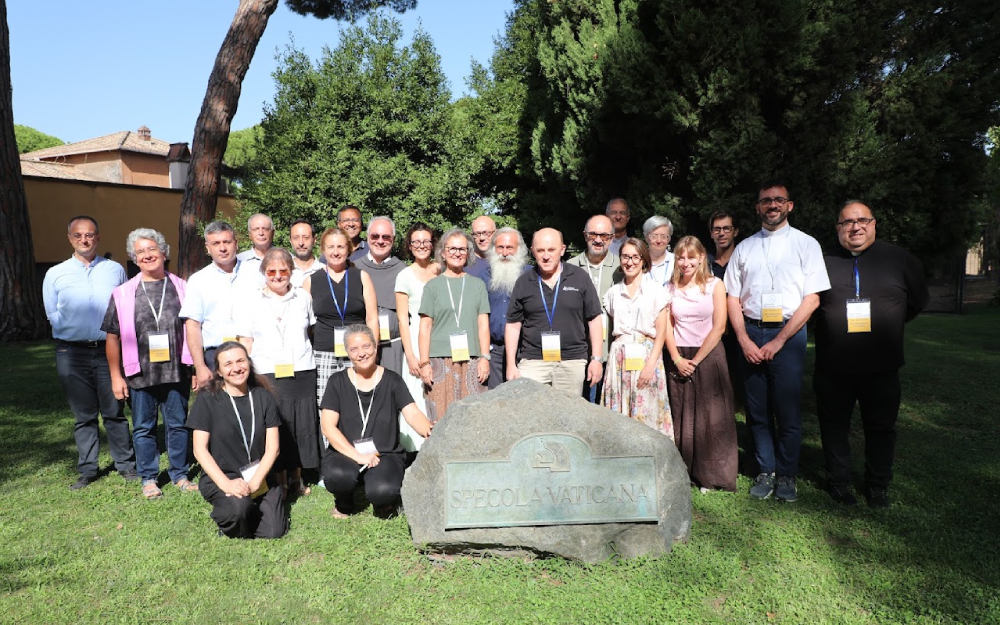

The “Spirituality and Astronomy” workshop, promoted by the Vatican Observatory at its Castel Gandolfo center outside Rome, concluded on Sunday, August 30. The initiative brought together the scientific view of the universe into dialogue with the spiritual dimension. Organized by Sr. Irene Tranquillini, O.F.M.I., with the contributions of Fr. Matteo Galaverni, Fr. Gabriele Gionti, S.J., and Fr. Robert Janusz, S.J, the aim was to create a path capable of weaving together scientific rigor, theological reflection, and contemplative experience, without allowing any one of these three dimensions to overshadow each other.
From Friday, August 28, to Sunday, August 30, twenty participants from a remarkably diverse range of backgrounds—including doctoral students and university students, professors, priests, religious sisters, lay professionals, pastoral workers, and teachers—gathered at the Vatican Observatory, all united by a desire to reflect together on the meaning of the cosmos.
The workshop was opened by Fr. Richard D’Souza, S.J., Director of the Vatican Observatory, who traced the centuries-old history of the Pontifical Observatory before turning to some of the most advanced frontiers of contemporary astronomy. The participants then moved to the Pontifical Parish of Castel Gandolfo for Holy Mass. On the liturgical memorial of St. Augustine, Fr. Paul Gabor, S.J., highlighted how this Doctor of the Church was at the origin of the metaphor of Nature as a Book. The first day concluded with a visit to the Observatory’s museum and historic telescopes at the Apostolic Palace and the Barberini Domes, followed by an observation of the night sky using the 1891 Carte du Ciel telescope (for more information and to arrange a visit: Vatican Observatory – Visit).
The second day opened with a presentation by Monsignor Tomasz Trafny of the General Secretariat of the Synod, who offered an anthropological reading of the encounter between science, spirituality, and religion. He identified wonder as the profound driving force that leads human beings both toward scientific inquiry and toward religious questioning. Sr. Irene Tranquillini then took up this theme, showing how astronomical observation and contemplation of the cosmos generate precisely that sense of awe capable of awakening both the critical spirit of science and the human being’s openness to religion.
Along the same lines, Fr. Robert Janusz led the participants in a reflection on theological integration, showing how love-charity unfolds harmoniously across the different dimensions of the human person—soul, reason, and body. On the more specifically scientific side, Fr. Matteo Galaverni guided the participants on a journey through the evolution of the cosmos: from the Big Bang theory and the cosmic microwave background radiation to current cosmological models, while also addressing the still-unresolved mysteries of dark matter and dark energy, which continue to challenge the international scientific community.
Fr. Gabriele Gionti, S.J., then introduced the spiritual journey of Monsignor Georges Lemaître, the Belgian priest, physicist and mathematician, regarded as the father of Big Bang theory. Retracing his spiritual formation and scientific career—from his corrections to Einstein’s models of relativistic cosmology to his formulation of the theory of the expansion of the universe—Fr. Gionti recalled how Lemaître arrived theoretically at the law describing the recession of galaxies even before Edwin Hubble confirmed it observationally, and how he demonstrated the instability of the static cosmological models proposed by Einstein.
He then focused on Lemaître’s well-known criticism of concordism and on his conviction that science and faith should be regarded as two distinct and parallel planes, each with its own method and autonomy, yet capable of enriching one another without being confused with one another or being mutually exclusive. The afternoon concluded with Holy Mass celebrated by Fr. Jacek Olczyk, S.J. In the evening, the participants gathered once again for telescope observations— the Moon, Saturn, Neptune, the Andromeda Galaxy, and more—and for a prayer vigil led by Fr. Guidalberto Bormolini, using texts and prayers by great scientists ranging from Kepler to Marconi.
Sunday morning opened with a contribution by Fr. Bormolini, who presented reflections by the Church Fathers on the cosmos and the origin of the world. He used the image of the harmony of the laws of the universe which, metaphorically, produces a harmonious sound. From this came the evocative suggestion of placing the term “Big Song” alongside “Big Bang”: the whole of reality does not arise from a simple event, but from an original harmony.
Finally, Fr. Massimo Vedova, O.F.M. Conv., led the participants through the cosmological visions of several great mystical figures, from Hildegard of Bingen and Angela of Foligno to Simone Weil. He emphasized how the separation imposed by contemporary hyperspecialization between the spiritual, scientific, and mystical dimensions risks generating nothing more than dissonance and poor harmonization within the consciousness of men and women today.
He also observed that many contemporary scientists now tend to deny the need to cultivate the mystical-spiritual dimension, and that this is partly due to a genuine fear of confronting such questions—a fear also fueled by modern scientism, which reduces every legitimate form of knowledge to the scientific-experimental method alone. Every person, he recalled, is continually challenged by a question that simultaneously concerns God, the cosmos, science, and the spiritual dimension of reality.
Many participants testified that they had felt warmly welcomed and that they had been introduced to horizons of knowledge and spiritual and scientific inquiry that they had never imagined could be explored - an unexpected enrichment capable of leaving a lasting mark. The workshop also provided an opportunity to lay the foundations for a future interdisciplinary program of study. The speakers shared their intention to examine texts in which scientists discuss science and religion using the same hermeneutical tools employed in the study of mystical texts, in the conviction that this approach could open up new and fruitful avenues for dialogue between science and faith.
The concluding Holy Mass, presided over by Fr. Bayu Christoforus Risanto, S.J., brought these intense days of study, observation of the heavens, and prayer to a close, reaffirming the deepest vocation of the Vatican Observatory: to be a place where the intellect that gazes into the stars and the heart that seeks God can—without conflict between one another—journey together in harmony.