


October 6: Saint Bruno of Cologne
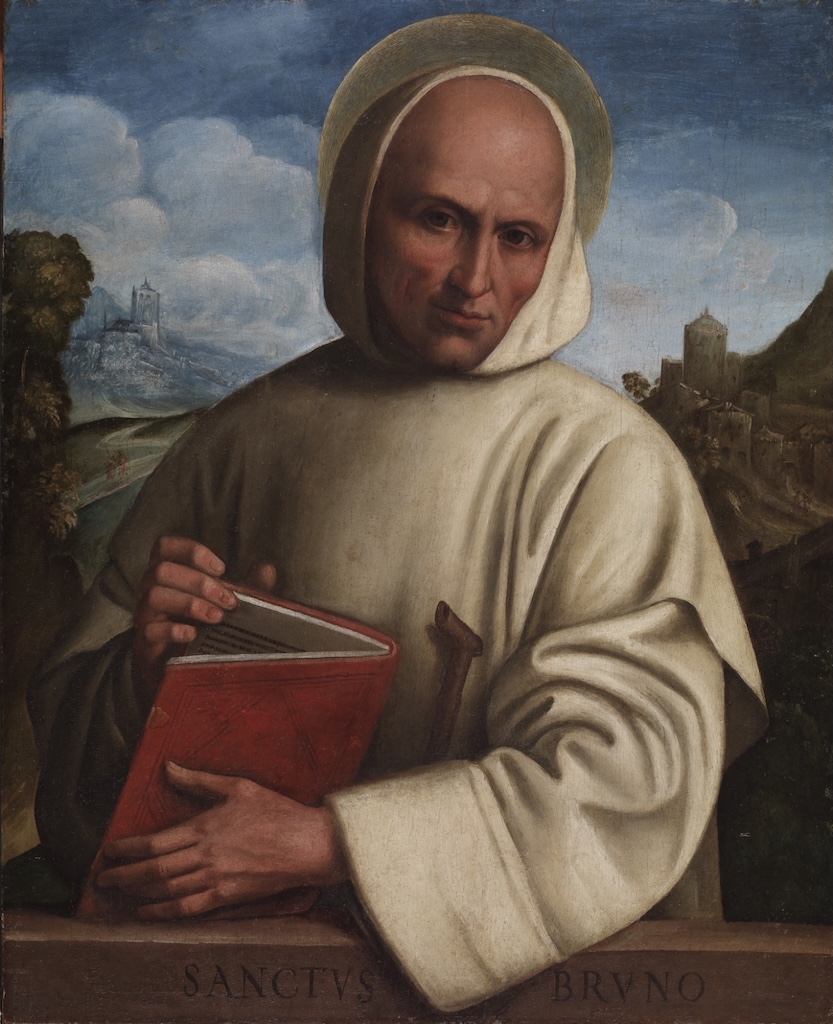

Founder of the Carthusians
Saint Bruno remains to this day a model of contemplative life, of fruitful silence and of authentic detachment from the world. His spiritual work left a lasting mark on the history of Western monasticism. Bruno was born around 1030 in Cologne, Germany, into a noble family.
From an early age, he displayed remarkable intellectual and spiritual gifts. He began his ecclesiastical path as a canon at the Church of Saint Cunibert, later moving to Reims, France, where he attended the renowned Cathedral School, a leading center of both sacred and secular learning. There he received an excellent education and studied under some of the most esteemed teachers of his time.
Bruno also excelled as a teacher and in 1056 he was appointed rector of the Cathedral School of Reims, one of the most prestigious in the Frankish kingdom. For over twenty years he educated generations of students, earning their esteem through his erudition, moral integrity, and kindness.
But his life changed radically when he became embroiled in a conflict with Archbishop Manasses of Gournay, notorious for his corruption and thirst for power. Bruno openly opposed the prelate and after years of tension, Pope Gregory VII intervened. Many saw Bruno as the natural successor to the archbishopric, but instead of accepting the post, he chose to renounce honors and worldly pursuits to follow an ideal of contemplative life.
In 1084, together with six companions—priests, religious, and laymen—he turned to Bishop Hugh of Grenoble to find a place suitable for a hermit’s life. Hugh, who had received a prophetic vision of seven stars guiding him toward a future monastery, welcomed them warmly and led them to a remote area in the French Alps. There, in the silence of nature, the first community of the Carthusian Order was born, in the place that has since been known as the Grande Chartreuse.
Bruno and his companions embraced a strict way of life inspired by the Desert Fathers: solitude, continual prayer, manual labor and profound silence. Their daily routine included the recitation of the liturgical hours—partly in individual cells, partly in church—with special solemnity on feast days. The founder guided his brothers more by example than by words.
After six years of monastic life, Bruno was summoned to Rome by Pope Urban II, a former student, who sought his counsel in reforming the Church. Obediently, Bruno accepted, but the worldly atmosphere of the papal court was foreign to him. He even declined appointment as Archbishop of Reggio Calabria, preferring instead to withdraw to a remote place in Calabria called La Torre.
With the help of the Norman Count Roger, he founded a new hermitage in Calabria, gathering around him other monks eager to live in prayer and seclusion. There he spent the final years of his life in peace. In one of his most famous letters, addressed to the monks who had remained at the Grande Chartreuse, Bruno encouraged them to persevere in solitude and purity of heart, praising their fidelity and urging them to stay far from the snares of the world.
Bruno died on October 6, 1101. For centuries, the Carthusian Order sought no official recognition for its founder, in keeping with its spirit of discretion. However, in 1514, Pope Leo X authorized a liturgical celebration in his honor, formally recognizing devotion to his memory. In 1623, his feast was extended to the entire Church.