


October 16: Saint Margaret Mary Alacoque
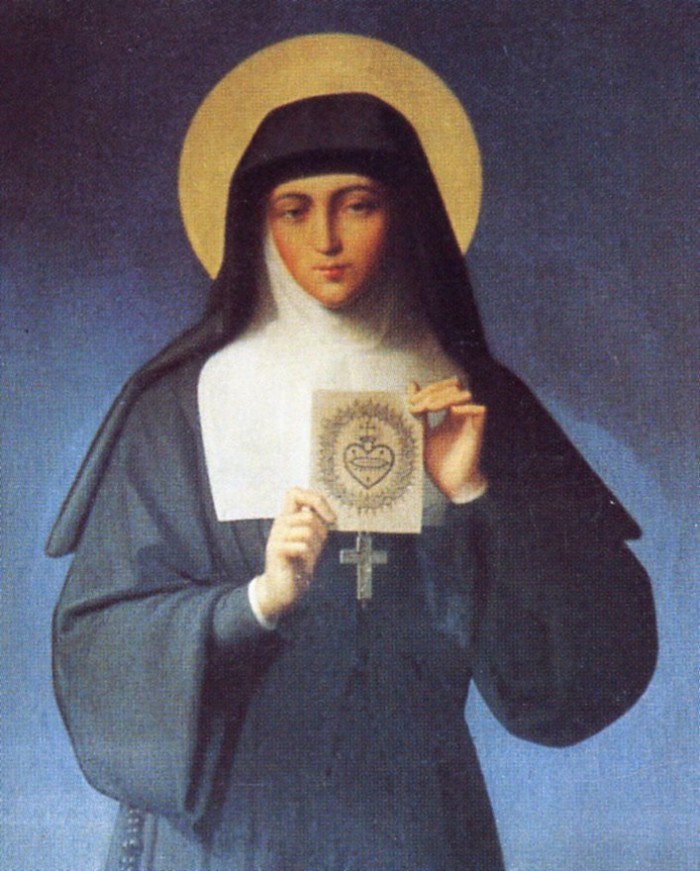

The Messenger of the Heart of Christ
In the heart of the 17th century, during the reign of Louis XIV (1638–1715), France was still bearing the wounds of the religious wars. Meanwhile, within the Church, a stern and austere spiritual current was spreading — Jansenism. This movement, far removed from the spirit of mercy, tended to instill fear rather than love of God in the faithful. At the same time, following the guidelines set by the Council of Trent, new religious communities were flourishing. Among them was the Order of the Visitation of Holy Mary, founded in Annecy in 1610 by St. Francis de Sales and St. Jane Frances de Chantal. The two founders saw their Order as a gift born from the very Heart of Jesus and Mary — the fruit of Christ’s sacrifice.
The symbol of the Order was a heart surmounted by a cross, encircled by thorns and pierced by two arrows, engraved with the sacred names of Jesus and Mary. In 1626, at the request of the Jesuits, a Visitation monastery was established in Paray-le-Monial, destined to become a key place for the spread of devotion to the Sacred Heart. It was there that St. Margaret Mary Alacoque lived.
Born near Charolais and baptized on July 25, 1647, she showed from early childhood a deep religious sensitivity. Raised in a profoundly Christian environment, she soon developed an intimate bond with Christ, especially in the Eucharist. At just five years old, during a Mass celebrated at her godmother’s residence, she spontaneously made a vow of chastity — an early sign of her vocation.
After her father’s death, Margaret and her mother moved in with relatives of harsh temperament. In that difficult setting, she found comfort in prayer, which became the refuge of her soul. It was during this time that she began to experience mystical visions — recurring apparitions of Christ crucified or scourged, sometimes in unexpected moments, such as during a social gathering she had been invited to. She thought such experiences were common to everyone and did not consider them extraordinary. Jesus himself taught her how to pray, to kneel, to acknowledge her sins, and to offer herself to him in silence.
At the age of 24, on June 20, 1671, she responded to the divine call by entering the Visitation monastery of Paray-le-Monial, after clearly hearing in her heart the words: “It is here that I want you.” During her religious profession on November 6, 1672, she experienced profound mystical graces. While preparing for her vows — and continuing her daily tasks, such as tending the convent’s donkey — she received new insights into the mystery of Christ’s Passion.
In the following years, her mystical experiences grew more intense. On July 1, 1673, during the recitation of the Divine Office, she was suddenly cured of a severe loss of voice through a vision of Jesus in the form of a child. Shortly afterward, she saw St. Francis of Assisi in glory, who became a guide to her in times of trial.
Between 1673 and 1675 took place the so-called Great Apparitions, during which Christ revealed to her His Heart — filled with love and sorrow for the indifference of humankind, especially toward the Eucharist. He asked that a liturgical feast be instituted in honor of his Sacred Heart, to be celebrated with fervor and special devotion. This solemnity, now known as the Feast of the Sacred Heart of Jesus, was officially recognized in 1765 and extended to the entire Church in 1856.
In 1675, Father Claude de la Colombière, a Jesuit of rare intelligence and sensitivity, arrived in Paray-le-Monial. He became Margaret’s confessor and spiritual supporter. At first, Father Claude carefully discerned the authenticity of her experiences and finally recognized her as a soul visited by grace. He advised her to trust fully in the Spirit while remaining faithful to her community duties and not replacing them with solitary prayer alone. He also ordered her, in obedience, to write down everything she experienced interiorly.
In 1676, Father de la Colombière was sent to the English court as preacher to the Duchess of York, while Margaret continued her spiritual journey. Gradually, her community opened itself to the message of the Sacred Heart and began to practice its devotions: the Holy Hour, veneration of the image of the Pierced Heart, and the celebration of the feast requested by Christ.
In 1684, Margaret Mary experienced what she called her “mystical marriage,” through which she consecrated herself in a deep and total union with Christ. She was later appointed mistress of novices, teaching them that the path to holiness passes through devotion to the Sacred Heart — “the shortest way to reach God.” In 1686, a chapel dedicated to the Sacred Heart was built in the monastery garden, where the feast was celebrated for the first time.
Also in 1686, she made a vow of perfection, committing herself to live every rule and every suffering as a total offering to the Heart of Jesus. In October 1690, a severe fever confined her to bed. The doctors, powerless to help, said that the cause of her illness was “an excess of love.”
On her deathbed, she said humbly to her sisters:
“I burn... If it were with divine love, it would be a consolation. But I have never known how to love God perfectly. Pray for me — and love Him with all your hearts, to make up for what I have failed to do. What joy it is to love God! Oh, what happiness!”
She died on October 17, 1690, after receiving the Sacraments, pronouncing the names of Jesus and Mary. The news of her death spread quickly through the town: “The saint has died!” people said. She was beatified by Pius IX in 1864 and canonized by Benedict XV in 1920.