


October 24: Saint Anthony Mary Claret
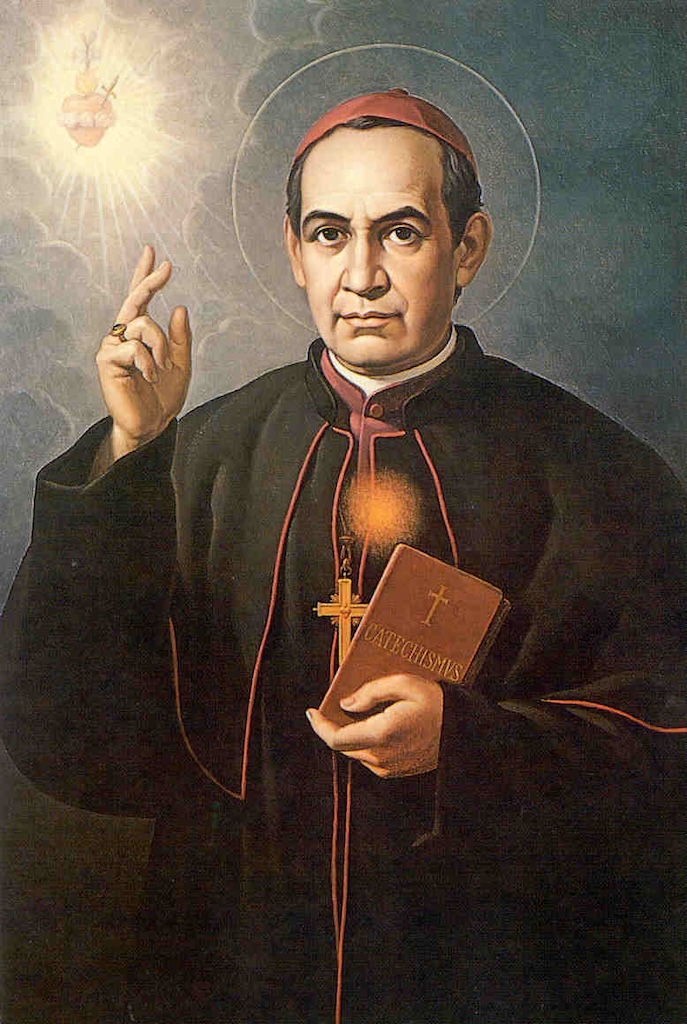

The Zeal of a Shepherd for His Flock
A tireless missionary, promoter of Christian culture and defender of justice, capable of uniting contemplation and action at every stage of his intense life — this was Saint Anthony Mary Claret. He was born on December 23, 1807 in Sallent, a small town near Barcelona, into a family working in the textile trade. His home was profoundly Christian and spirituality was as natural there as the air they breathed.
From an early age, Anthony showed a marked religious inclination: he was drawn to prayer, felt compassion for those who suffered, and reflected deeply on the meaning of life and eternal salvation. This sensitivity was strengthened by the hardships of his time — wars, insecurity and family sorrows shaped in him a firm and resolute spirit.
At twelve, he felt in his heart the desire to become a priest but the political and social turmoil of the era obstructed his first steps. His school was closed and Anthony was forced to work alongside his father at the family looms. Later, he moved to Barcelona to pursue technical studies in the textile field where he showed both talent and discipline. However, the pursuit of success began to draw him away from the simple faith of his childhood. Only a series of traumatic experiences — a friend’s betrayal, a moral temptation and a near-death experience by drowning — led him to reflect once again on the deeper meaning of life.
It was then that the Gospel struck him profoundly: the verse asking, “What does it profit a man to gain the whole world, if he loses his own soul?” made him reconsider every choice. He decided to leave everything behind and follow the path of religious life. He began his studies in Vic, intending to become a Carthusian monk, but poor health forced him to abandon that plan. He remained in the seminary, however, where he continued his studies and faced severe spiritual trials — overcome through prayer and devotion to the Virgin Mary.
He was ordained a priest in 1835 and began his ministry in his hometown. Yet the call to mission was too strong to keep him confined to a parish. He began traveling from village to village, preaching the Gospel with simplicity, walking on foot, refusing money, carrying only a Bible and a small bundle. His humble and direct style touched hearts and he soon became renowned as a preacher. He founded a publishing house to distribute inexpensive religious texts and produced catechetical works for children, youth, families, and priests. He also promoted ongoing religious formation and established confraternities to sustain the spiritual life of communities.
In 1849, he founded the Congregation of the Missionary Sons of the Immaculate Heart of Mary, giving concrete form to his apostolic spirit. Only a few months later, he was appointed Archbishop of Santiago de Cuba — a land marked by grave injustices, slavery and moral decay. During the six years of his episcopal ministry on the island, he visited every corner of the diocese multiple times, promoted popular missions, fought against the slave trade, established schools and social works, introduced religious communities, and, together with Mother Antonia Paris, founded a women’s institute. He suffered persecution and even survived an assassination attempt but never lost courage.
Upon returning to Spain in 1857, Queen Isabella II, struck by his spiritual charisma and moral authority, asked Anthony Mary Claret to become her personal confessor. This appointment required him to move to the capital, where he regularly attended court to provide spiritual guidance to the queen and to oversee the religious education of the young Prince Alfonso and the princesses. Despite the prestige of his position, Claret lived austerely and simply, faithful to his poor and detached lifestyle.
Nevertheless, life at court neither satisfied him humanly nor spiritually. He felt that his apostolic zeal could not be confined within palace walls. With his usual fervor, he also devoted himself to evangelization in Madrid — preaching, hearing confessions, visiting the sick in hospitals and ministering to prisoners. During official journeys with the royal family, he seized every opportunity to preach wherever he went, bringing the Gospel to every corner of Spain.
Committed to promoting Christian culture, he founded and supported the Academy of St. Michael — an ambitious project bringing together artists, scientists, and thinkers with the aim of uniting faith, art, and knowledge. Its purpose was to counter harmful ideologies, spread truth and promote good reading to form consciences.
In 1859, the Queen appointed him protector of the church and hospital of Montserrat, and president of the renowned monastery of El Escorial. In this role, he demonstrated extraordinary organizational ability: he restored the entire complex, enriched it with new sacred furnishings and revitalized it as a center of education — establishing a religious community, an interdiocesan seminary, a school for students, and even the first courses of a university.
One of his deepest desires was to see a living and renewed Church. For this, he worked to promote capable and fervent bishops, actively supported consecrated life, and cared for both the congregations he founded — the Missionary Sons of the Immaculate Heart of Mary and the Claretian Sisters — and many other religious communities struggling for recognition.
Although he stayed away from partisan politics, his public role and influence made him a target of criticism and attacks. His prudent choices did not spare him from suspicion and slander. He himself once admitted that, despite avoiding favoritism, he was still wounded by gossip and calumny. His profound union with Christ reached its summit in a mystical experience: on August 26, 1861, at the royal estate of La Granja in Segovia, he received the extraordinary gift of the preservation of the Eucharistic spirit in his heart.
After the revolution of 1868, Claret was forced to leave Spain with the deposed queen. During exile in Paris, he continued his ministry — offering spiritual assistance to the royal family, promoting the Conferences of the Holy Family and dedicating himself to Spanish immigrants and the poor.
In 1869, he went to Rome for the priestly jubilee of Pope Pius IX and to participate in the preparatory work for the First Vatican Council. During the Council, he ardently defended the doctrine of papal infallibility. But his health was failing and he felt the end approaching. Leaving Rome, he retired to Prades in southern France, where some exiled Claretian missionaries had settled.
Soon he learned that his enemies had obtained an arrest warrant to bring him back to Spain for trial. To escape capture, he had to leave Prades and take refuge in the Cistercian monastery of Fontfroide, near Narbonne. In that quiet and hidden place, surrounded by the affection of the monks and a few disciples, he peacefully passed away on October 24, 1870 at the age of sixty-two.
In 1897, his remains were brought back to Vic. He was beatified by Pope Pius XI in 1934 and canonized by Pius XII in 1950.