


October 27: Saint Evaristus, Pope
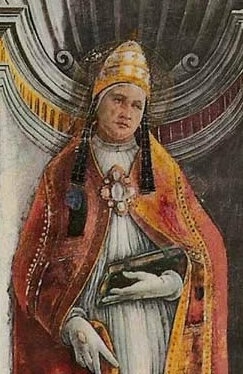

The Fifth Bishop of Rome
Evaristus is traditionally regarded as the fifth Bishop of Rome, the direct successor of Saint Clement I, according to the episcopal lists handed down by Irenaeus of Lyons and Eusebius of Caesarea. In some variants of these lists, where Anacletus/Cletus is placed after Clement, Evaristus appears as his immediate successor.
Eusebius of Caesarea, in his Historia Ecclesiastica (III, 34), dates the beginning of Evaristus’s pontificate to the year 99, lasting eight years; however, in the Chronicon (year 108), he mentions nine years.
The Liberian Catalogue (4th century) calls him “Aristus” and places his episcopate from 96 to 108, for a total of thirteen years, seven months, and two days.
The Liber Pontificalis (no. 6) repeats these dates but states that Evaristus governed the Church for nine years, ten months, and two days.
The sources therefore agree on a chronology between 96 and 108 AD, though they differ on the exact duration of his pontificate.
The Liber Pontificalis provides some biographical details, although they lack verifiable historical foundation:
Evaristus is said to have been of Greek origin, the son of a Jew named Judah from Bethlehem.
He is said to have died a martyr on October 27 and to have been buried near the tomb of Saint Peter in the Vatican cemetery.
He supposedly distributed the tituli (the first parish churches) of Rome among the presbyters, ordained seven deacons charged with “watching over” the Bishop during the recitation of the liturgy, and held three ordinations in which he consecrated 17 presbyters, 2 deacons, and 15 bishops.
The passage in the Liber Pontificalis referring to deacons who “watch over the Bishop” would not concern the act of preaching a homily but rather the liturgical recitation of the Preface and the Canon of the Mass. Their duty would thus have been to ensure the orthodoxy of the text being recited—especially during a period in the Church’s history when the liturgical formula had not yet been definitively fixed and there was a risk of theological errors.